


In The News
-Sathish Raman


A citizen-friendly guide to the new major-minerals framework, the State revenues that remain protected and the link between productive mines, jobs and local development
The MMDR Amendment Act 2026 simplifies India’s mining laws. Discover how this new framework protects state revenues, boosts job creation, and fuels local development. This guide explains the critical link between transparent auctions, mineral wealth, and a stronger, self-reliant India. Understand its profound impact.
Mining law can sound distant from everyday life. The materials it governs are not. Iron ore becomes steel, limestone becomes cement, copper carries electricity and graphite supports batteries. The MMDR Amendment Act 2026 deals with the rules behind that journey, especially how levies on major minerals are placed within a clearer framework for the years ahead.
What has the new law done?
The Mines and Minerals (Development and Regulation) Amendment Act, 2026 amends the MMDR Act 1957. Parliament passed it on 13 August 2026 and Presidential assent followed on 17 August 2026. It has come into force on 22nd August, 2026.
The Act defines mineral-bearing land and inserts Section 9D. Under the framework, State levies on mineral rights and mineral-bearing lands will follow conditions prescribed by the Central Government. In simple terms, major-mineral projects now have a common reference point for long-term fiscal planning.
Does this reduce the States’ existing mineral revenue?
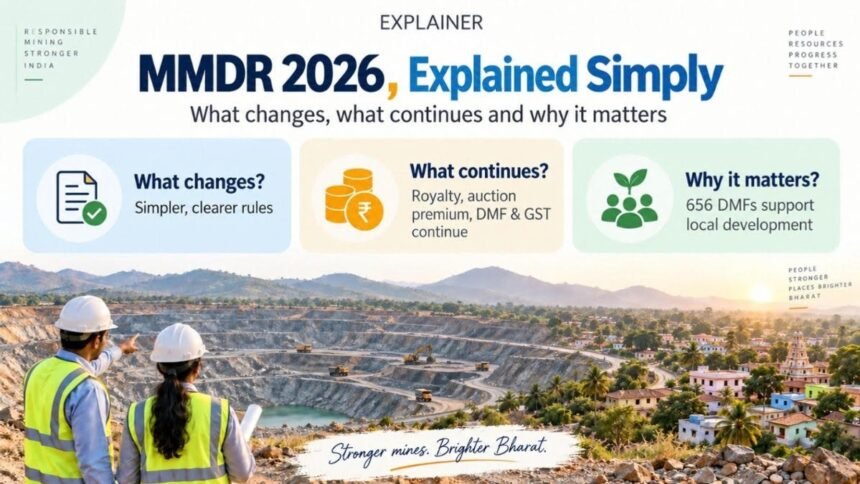
No. Royalty, auction premium, DMF contributions, NMET payments and the State share of GST continue. Nearly 50 minor minerals remain within the existing State framework. Around 90 per cent of mining-related taxes and statutory payments accrue to the States.
The wider trend has already moved strongly in favour of the States. Annual State mineral revenue rose from ₹25,206 crore in 2014-15 to ₹1,14,549 crore in 2025-26, a 354 per cent increase. Across twelve years, ₹7,67,548 crore accrued to the States, and their share of mineral revenue rose from 60.24 per cent to 88.53 per cent.
Why are auctions so important to this story?
Transparent auctions began in 2015. Since then, more than 720 mineral blocks have been auctioned and 105 have become operational. Coal has 141 auctioned mines, with 23 operating. Around 300 bidders have participated and 337 companies hold mining leases.
The important step is when an auctioned block actually begins work. Around 1,200 working mines generated approximately ₹2.32 lakh crore in royalty. Roughly 100 operational auctioned mines generated around ₹96,000 crore in premium. Major mining States collected more than ₹96,000 crore in auction premium between FY 2020-21 and FY 2025-26.
Can we see the difference in a State?
Odisha provides a clear example. It has auctioned 79 blocks and operationalised 34, the highest number among the States. Around ₹87,000 crore in auction premium accrued to the State between FY 2020-21 and FY 2025-26. Another 45 blocks form the next pipeline. Odisha has around 600 mining leases across nearly 1,00,000 hectares, with approximately 130 to 140 mines working at a given time.
Jharkhand shows another part of the story. Around ₹19,000 crore has been collected through District Mineral Foundations across all 24 districts, while 11 auctioned blocks add future production potential.
How does mineral revenue reach ordinary people?
India has 656 District Mineral Foundations, including 106 in aspirational districts. Their royalty-linked resources support roads, schools, healthcare, drinking water and other local priorities under the applicable district framework.
Mining also has a large employment footprint. Non-coal mining supports more than one crore direct and indirect jobs, while coal supports more than 25 lakh. Minerals then move into industries such as steel, cement, power, railways, housing, defence and solar, widening the employment and economic impact.
Why does predictability matter so much in mining?
Mining projects are planned for many years and currently work through around 14 categories of taxes, charges, fees and statutory payments. A clearer framework helps States estimate future receipts, operators plan costs and lenders assess long-term projects.
The 2024 Supreme Court decisions created a pathway for transactions from 1 April 2005, with payments spread over twelve years beginning on 1 April 2026 and interest relief for the earlier period. The amended law treats amounts already deposited with or recovered by a State as settled and provides a framework for future levies. NMDC has linked such predictability with long-term operations, investment planning, new mines and capacity expansion.
Where is the next opportunity?
India imported minerals worth ₹10,12,529 crore in FY 2025-26, including industrial minerals worth ₹1,18,330 crore. Copper ores accounted for ₹52,670 crore, phosphorite ₹16,410 crore, iron ore ₹11,115 crore, manganese ₹10,872 crore, limestone ₹7,085 crore, bauxite ₹4,822 crore and chromite ₹753 crore.
India already ranks fourth globally in iron ore, second in limestone, third in zinc and fifth in bauxite. Graphite and uranium connect mineral development with batteries, defence, semiconductors and nuclear power. The opportunity is to meet more of India’s own demand through Indian exploration, production and processing.
So what is the big picture?
The MMDR Amendment Act 2026 is best understood as part of a longer chain. Transparent auctions create access to resources. Operational mines create production and revenue. States receive a large share of that value. DMFs carry part of it closer to mining districts. Clearer rules can support the next round of investment.
For citizens, the end result is easier to understand than the legal text: stronger domestic supply, more predictable State revenues, jobs and more resources for local development. That is how mineral wealth can support Atmanirbhar Bharat and Viksit Bharat 2047.