



International
oi-Prakash KL

US President Donald Trump’s latest clash with the media had an unusual consequence on Monday: viewers could see him speaking at the White House, but could barely hear what he was saying.
Trump was unveiling a new helipad on the South Lawn when the audio on the White House livestream failed to clearly capture his remarks. The noise of a helicopter running nearby drowned out much of what he said during the ceremony.
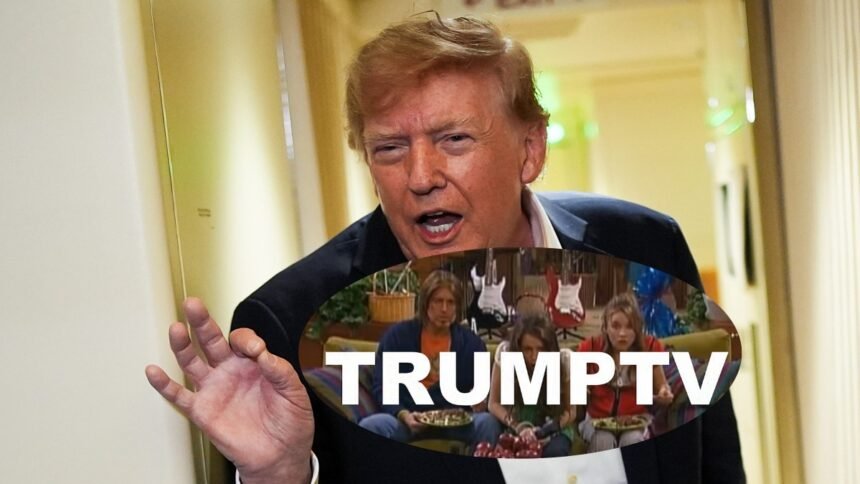
The White House banned CNN, MS NOW, and Politico, prompting a federal lawsuit over First Amendment rights and major networks to suspend shared presidential coverage, which caused audio problems during a helipad ceremony and led to the launch of “TRUMP TV”.

The problem came hours after the major US television networks suspended their shared coverage of presidential events following the White House decision to bar CNN, MS NOW and Politico from its grounds.
CNN had been scheduled to handle the television pool feed for Trump’s events. But after the network was removed from the White House, ABC, CBS, Fox News and NBC declined to take over its duties.
Bryan Boughton, Fox News’ Washington bureau chief and the television pool chair, told members that the pool would not cover events designated for pool coverage and that there would be no replacement arrangement.
The impact was immediately visible during the helipad ceremony. The White House still had its own video feed, but without the usual television pool operation, there was no standard shared production and audio setup to clearly capture Trump’s remarks.
The White House has since posted its own footage of the helipad inauguration on its website.
CNN, MS NOW and Politico take fight to court
The television dispute unfolded as CNN, MS NOW and Politico filed a federal lawsuit challenging the White House decision to block their journalists from the presidential complex.
The three organisations argue that the restrictions violate their First Amendment rights and were imposed because the administration objected to their reporting. They are seeking an emergency court order restoring their access.
The White House has rejected that argument.
Trump has defended the restrictions on Truth Social, saying the administration was not attacking the free press but was targeting what he calls “FAKE NEWS”. The White House has also argued that access to the building is a privilege rather than a guaranteed right.
“It is corrupt, purposeful, pervasive, fully coordinated, and totally out of control,” he wrote. “It is a threat to our National Security, and must be stopped, NOW!”
Vice President JD Vance similarly said the administration was not banning the organisations from reporting, but was withdrawing what he described as “special access” because of what he called propaganda.
The legal dispute is now set to determine how far the White House can go in controlling which news organisations receive access to presidential events.
Other news organisations join the protest
The standoff also prompted other news organisations to take action.

The New York Times said it would not publish or distribute photographs taken as part of the White House still photography pool on Monday. The newspaper said the decision was made in support of the organisations targeted by the White House.
The television networks, meanwhile, stressed that the public has an interest in receiving independent coverage of the president and said a news organisation should not be restricted because the administration objects to its reporting.
The dispute could have a wider impact because the television pool is not simply a normal news crew. The participating networks share the cost of covering the president and rotate responsibility for providing footage and audio that can then be used by broadcasters across the country.
With CNN removed from that arrangement and the other four networks declining to replace it, the usual system has effectively been disrupted.
White House launches ‘Trump TV’
The media battle took another turn on Monday when the White House launched a 24-hour digital stream called “TRUMP TV: The Essentials Station.”
The White House describes it as a platform bringing together major administration announcements, presidential remarks and other highlights, with content streamed around the clock and updated in real time.
The first programming included previously recorded footage rather than functioning as a conventional news channel. The launch came on the same day that CNN, MS NOW and Politico went to court over their White House access.
Critics have questioned whether an administration-controlled platform can serve the same role as independent news organisations. Jameel Jaffer of Columbia University’s Knight First Amendment Institute, for example, has argued that the move raises concerns about the public being presented with government-controlled messaging.
The White House, however, has presented the service as another way for Americans to follow the administration’s activities.
A bigger fight over presidential access
Trump has played down the significance of the television networks’ decision. During an exchange with New York Mayor Zohran Mamdani, he pointed to the number of journalists still covering him and said the media had not actually boycotted him.
But Monday’s helipad ceremony showed the practical effect of the dispute. The president was in front of the cameras, yet viewers struggled to hear him because the normal television pool was not there.
The immediate question is therefore not only about which journalists can enter the White House. It is also about who controls the machinery through which presidential events are recorded and distributed to the public.
The three affected organisations are asking the courts to restore their access, while the administration maintains that it is entitled to decide who receives access to the White House.