


India’s protein consumption is projected to more than triple by 2070, presenting a massive challenge for the national food system. A new ARE-FICCI report reveals the environmental and economic implications, while also outlining pathways to meet rising demand sustainably and create new investment opportunities. Discover India’s protein transition.
In The News
-Staff

India’s Protein Consumption to More Than Triple by 2070, Raising a National Food System Challenge With Global Consequences: ARE-FICCI Report. The modelling finds business-as-usual could generate more than 44 GtCO₂e in cumulative emissions by 2070 – equivalent to more than three-quarters of current annual global greenhouse-gas emissions.
Singapore, 28 September 2026— India’s annual average per-capita protein consumption is projected to more than triple by 2070, from 9.5kg in 2025 to 30kg. This has major implications for food security, agricultural production, natural resources, and investment, according to a new joint report from Asia Research & Engagement (ARE), and Federation of Indian Chambers of Commerce and Industry (FICCI).
India’s protein consumption is projected to more than triple by 2070, presenting a massive challenge for the national food system. A new ARE-FICCI report reveals the environmental and economic implications, while also outlining pathways to meet rising demand sustainably and create new investment opportunities. Discover India’s protein transition.

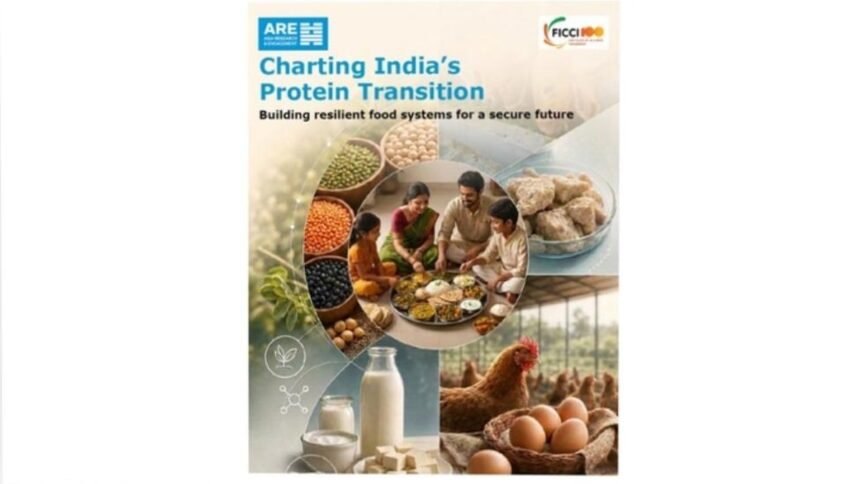
The report, Charting India’s Protein Transition, was launched at the FICCI Symposium, Protein for India: Nutrition, Business, Sustainability and Policy Perspective, at FICCI Federation House in New Delhi. It finds that annual protein-related emissions could reach 1.92 gigatonnes of carbon dioxide equivalent (Gt CO₂e) by 2070 under a business-as-usual pathway. That’s almost eight times the estimated climate-safe threshold of 0.25 GtCO₂e. More significantly, the report estimates cumulative excess emissions could exceed 44 GtCO₂. The findings come as India assumes an increasingly important role in global food demand. India and Southeast Asia are projected to account for 31% of 1 global agricultural and fisheries consumption by 2033. The report finds this trajectory can be changed, modelling pathways that significantly reduce emissions while meeting rising demand, protecting livelihoods, and creating new investment opportunities.
The report identifies four priorities for India’s protein transition:
- Production improvements will be critical, but not sufficient: Measures across methane, feed, manure, deforestation, energy, and food loss and waste could cut annual protein-related emissions to 0.73 Gt CO₂e by 2070 – but that’s still 2.9-times above the climate-safe threshold. Greater protein diversification could reduce this to 0.50 Gt CO₂e, while an integrated pathway could bring emissions down to 0.30 Gt CO₂e.
- Pulses present a major domestic innovation and growth opportunity: The report projects that pulse-derived protein consumption will rise from 3.5 million tonnes in 2025 to 9.3 million tonnes by 2070, making pulses India’s second-largest protein category, after dairy. This growth can create greater value for farmers and spur innovation around India’s established plant proteins. India also imports almost 90% of its processed plant protein isolates, creating further opportunity to expand domestic processing and higher-value manufacturing.
- Existing supply constraints could intensify as demand grows: The report highlights estimated shortfalls of 35.6% in green fodder, 10.5% in dry fodder and 44% in concentrate feed ingredients, with climate pressures likely adding further volatility to feed availability and production costs.
- Producers will be central to the transition: Smallholders account for around 72% of India’s milk production, while poultry and fisheries rely heavily on contract growers, fragmented producers, and smaller businesses. Targeted finance, procurement reform, technical assistance, and producer consultation are important to supporting their participation in the transition.
Turning the findings into action
Charting India’s Protein Transition finds that coordinated action across policy, finance, food production, and procurement can help India meet rising protein demand while reducing emissions, strengthening domestic value chains and supporting producer livelihoods.
Rituj Sahu, Director – Protein Transition/Sustainable Food Systems (India), Asia Research & Engagement, said, “India is at a critical point in the development of its future protein system, but no single sector can address this alone. Government and regulators have a role in strengthening policy support, banks and investors in directing capital towards the transition, and food and agricultural businesses in improving production, procurement and protein diversification. ARE’s partnership with FICCI draws on its industry reach and influence to take these findings into the policy, investment and business decisions shaping India’s future protein system.”
Ms Jyoti Vij, Director General, FICCI, emphasised, “The Charting India’s Protein Transition report highlights how India’s changing protein landscape presents a significant opportunity for industry to innovate, invest, and build resilient domestic food value chains. In line with the vision of Atmanirbhar Bharat, industry can play a key role in meeting evolving consumer needs, strengthening domestic capabilities and creating new opportunities for growth across the protein value chains.”
– Download the Report HERE
About Asia Research & Engagement (ARE)
ARE brings leading investors into dialogue with Asian-listed companies to address sustainable development challenges and help companies align with investor priorities. With decades of Asia experience, our cross-cultural team understands the region’s unique needs. Our high-quality independent research, robust investor network, and engagement expertise, provide corporate leaders and financial decision makers with insights leading to concrete action.