

By using this site, you agree to the Privacy Policy and Terms of Use.
Accept
Next India Magazine
  • Home
    • Home 2
    • Home 3Hot
    • Home 4
    • Home 5New
  • Home
  • Opinion

    That Provide Critical Analysis on Political Decision-Making

    krutikadalvibiz@gmail.com

    Analyzing Global Dynamics and Unraveling Key Policy Initiatives

    krutikadalvibiz@gmail.com

    Luxurious Stays Redefining Hospitality at Hotel Havens

    krutikadalvibiz@gmail.com

    Electric Cars Subsidies by German Taxpayers End Up on Foreign Roads

    krutikadalvibiz@gmail.com

    Challenge and Inspire Future of Political Thought

    krutikadalvibiz@gmail.com

    Assessing the Diplomatic Challenges and Global Security

    krutikadalvibiz@gmail.com
  • World
  • Politics
  • Market
  • Health
  • Insurance
  • Pages
    • Blog Index
    • Contact US
    • Search Page
    • 404 Page
    • Technology
    • World
  • Pages
    • Blog Index
    • Search Page
    • 404 Page
  • Technology
    TechnologyShow More
    Ramya Sudha Vinukonda: A Biology Teacher Turning Government School Classrooms into Spaces of Possibility
    6 Min Read
    Dr. Nishant Sawant: The Mind Behind Secure Digital Progress
    4 Min Read
    NASA’s Artemis II Mission Rekindles Humanity’s Dream of Deep Space Exploration
    5 Min Read
    Buying a Car Will Soon be Like Buying a Phone, Why Your Next Car Could be an EV
    Hands-On With the iPhone 13, Pro, Max, and Mini
    4 Min Read
  • Posts
    • Post Layouts
      • Standard 1
      • Standard 2
      • Standard 3
      • Standard 4
      • Standard 5
      • Standard 6
      • Standard 7
      • No Featured
    • Gallery Layouts
      • Layout 1
      • Layout 2
      • layout 3
    • Video Layouts
      • Layout 1
      • Layout 2
      • Layout 3
      • Layout 4
    • Audio Layouts
      • Layout 1
      • Layout 2
    • Post Sidebar
      • Right Sidebar
      • Left Sidebar
    • Review
      • Stars
      • Scores
      • User Rating
    • Content Features
      • Highlight Shares
      • Inline Mailchimp
      • Print Post
      • Inline Related
      • Source/Via Tag
      • Reading Indicator
      • Content Size Resizer
    • Table of Contents
      • Full Width
      • Left Side
    • Sponsored Post
  • Contact
  • Pages
    • Search Page
    • 404 Page
Reading: Nobel Prize In Physics 2026: Francis Halzen Wins For IceCube Neutrino Discovery
SUBSCRIBE
Next India MagazineNext India Magazine
Font ResizerAa
  • My Saves
  • Economics
  • Technology
  • My Interests
  • World
  • My Feed
  • History
  • Business
  • Technology
  • Lifestyle
  • Fashion
  • Health
  • Technology
  • World
Search
  • Pages
    • Blog Index
    • Contact Us
    • Search Page
    • 404 Page
  • Home
    • Home 1
    • Home 2
    • Home 3
    • Home 4
    • Home 5
  • Home
  • Blog
  • Categories
    • Technology
    • Lifestyle
  • Personalized
    • My Feed
    • My Saves
    • My Interests
    • History
  • Demos
  • Categories
    • Technology
    • Business
    • Fashion
    • Economics
  • Bookmarks
  • Categories
    • Technology
    • Health
    • World
  • More Foxiz
    • Blog Index
    • Sitemap
  • Bookmarks
  • Contact
  • More Foxiz
    • Sitemap
Have an existing account? Sign In
Follow US
  • Home
  • World
  • Contact
  • Blog
© Foxiz News Network. Ruby Design Company. All Rights Reserved.
World

Nobel Prize In Physics 2026: Francis Halzen Wins For IceCube Neutrino Discovery

India Times Now
Last updated: October 6, 2026 10:42 am
India Times Now
5 Min Read
Share
SHARE

International

oi-Prakash KL

Time
Updated: Tuesday, October 6, 2026, 16:09 [IST]

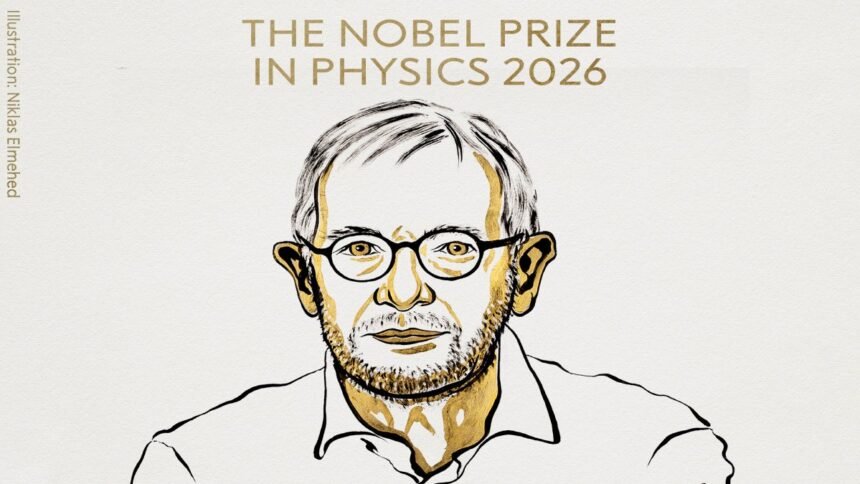
The 2026 Nobel Prize in Physics has been awarded to Francis Halzen for his contributions to the IceCube Neutrino Observatory and the discovery of high-energy neutrinos originating from distant cosmic sources.

The Royal Swedish Academy of Sciences recognised Halzen for his scientific vision and leadership in developing the observatory at the South Pole, where researchers use a vast volume of Antarctic ice to detect elusive subatomic particles known as neutrinos.

Francis Halzen received the 2026 Nobel Prize in Physics for leading the development of the South Pole’s IceCube Neutrino Observatory, which discovered high-energy neutrinos from distant cosmic sources. The observatory uses Antarctic ice to detect these elusive particles, establishing neutrino astronomy.

Nobel Prize In Physics 2026 Francis Halzen Wins For IceCube Neutrino Discovery

Halzen first proposed the idea of using South Pole ice to detect neutrinos in 1988. His concept eventually led to the creation of IceCube, a massive observatory spanning one cubic kilometre of ice and equipped with light sensors designed to capture signals produced when neutrinos interact with matter.

Neutrinos are among the most difficult particles to detect because they rarely interact with other matter. They constantly pass through the Earth and human bodies without being noticed. However, when a neutrino collides with an atomic nucleus, it can produce a flash of light that specialised sensors can detect.

The discovery of high-energy neutrinos has opened new avenues for understanding some of the universe’s most energetic and mysterious environments. Scientists believe these particles are produced in cosmic regions capable of accelerating matter to energies far beyond those achievable in laboratories on Earth.

Unlike many other particles, neutrinos can travel across vast cosmic distances without being significantly deflected or losing energy. This allows researchers to trace them back to their sources and investigate astrophysical processes that might otherwise remain hidden.

How IceCube Helped Advance Neutrino Research

The observatory takes advantage of the clear, stable ice beneath the South Pole, which provides a suitable environment for detecting the faint flashes of light produced by neutrino interactions. The remote location also helps minimise interference that could affect observations.

Since high-energy cosmic neutrinos are extremely rare, researchers needed an enormous detection area to identify enough interactions. The IceCube Observatory, completed in 2011, was designed to meet that challenge.

Scientists detected the first high-energy neutrinos using the facility and later reported evidence of neutrinos originating beyond the solar system. These findings helped establish neutrino astronomy as a new way to study the universe.

Mark Pearce, chair of the Nobel Committee for Physics, said Halzen had led an international team of researchers and engineers in developing the observatory. He credited Halzen’s persistence and scientific vision with paving the way for a new form of astronomy.

The continuous stream of observations collected by IceCube is expected to provide further insights into the extreme environments that produce high-energy neutrinos. Researchers also hope the data could help identify previously unknown cosmic phenomena.

Nobel Prize Recognises Breakthroughs in Physics

The Nobel Prize in Physics is among the most prestigious awards in science, recognising discoveries and inventions that have significantly advanced humanity’s understanding of the natural world.

Previous recipients include Albert Einstein, Marie and Pierre Curie, Max Planck and Niels Bohr, whose work helped shape modern physics.

Last year’s prize went to US-based scientists John Clarke, Michel Devoret and John Martinis for experiments demonstrating quantum mechanical effects in electrical circuits. Their research contributed to the development of technologies with potential applications in quantum computing and other advanced digital systems.

The Physics award was the second Nobel Prize announced in 2026, following the announcement of the Medicine prize on Monday. The Chemistry prize is scheduled to be announced on Wednesday.


TAGGED:DiscoveryFrancisHalzenIceCubeNeutrinoNobelPhysicsPrizeWins
Share This Article
Facebook Email Copy Link Print
Previous Article Mizoram cracks down on codeine syrup abuse, warns of licence cancellations
Next Article From Jharkhand’s Coal Belt to Chevening Scholar: How a first-generation learner made it to the University of Sussex
Leave a Comment Leave a Comment

Leave a Reply Cancel reply

Your email address will not be published. Required fields are marked *

You Might Also Like

World

Sonia Gandhi Snaps at Digvijaya Singh Over Nitish Kumar Reference at CWC Meet

India oi-Prakash KL Published: Wednesday, September 30, 2026, 12:44 A…

4 Min Read
World

Congress Manifesto for TN Assembly Elections 2026, Rahul Gandhi Missing from Campaign

Chennai oi-Madhuri Adnal Published: Thursday, April 9, 2026, 22:54 The…

5 Min Read
World

Crude Oil Price Today – April 10: Brent Crude Slips; Track WTI, Russian Urals, OPEC Basket, Dubai Crude Latest Prices

India oi-Prakash KL Published: Friday, April 10, 2026, 9:08 Global…

4 Min Read
World

‘This Is Just the Beginning’: Congress Says Dharmendra Pradhan’s Exit Won’t End Fight

India pti-PTI Updated: Saturday, July 25, 2026, 22:52 The Congress…

4 Min Read
Next India MagazineNext India Magazine
Follow US
© 2026 Next India Magazine powered by India Times Now. All Rights Reserved.
Welcome Back!

Sign in to your account

Username or Email Address
Password

Lost your password?