


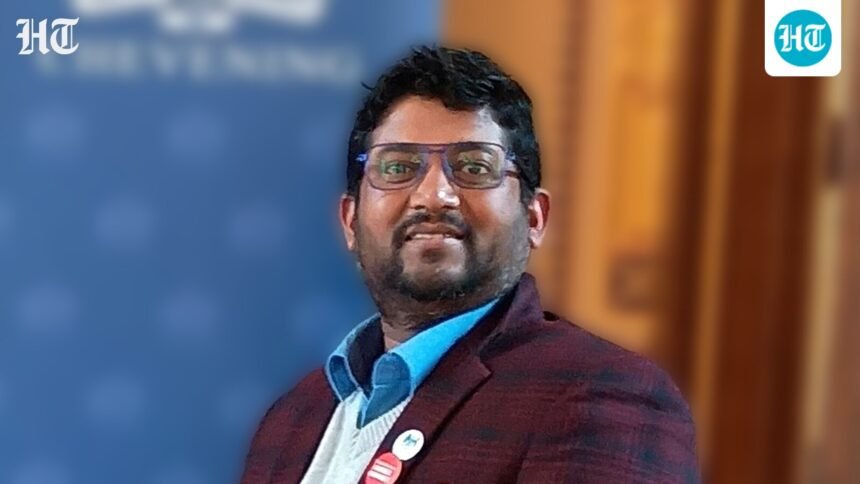
Growing up in Jharkhand’s coal-mining region, Baijnath Kumar Paswan faced challenges of energy transition. Surrounded by coal mines, dust and air pollution, he went on to study Energy and Climate Policy at the University of Sussex after securing the prestigious Chevening Scholarship.

Baijnath took three attempts to achieve the scholarship, which later opened doors to student leadership, international networks and a fully funded research opportunity with Pele Energy Group in South Africa.
While speaking with HT Digital, Baijnath opened up about the challenges he faced while living in a coal mining region, difficulties while pursuing higher education, about the scholarship and his internship days and future ambitions. Read the interview here.
1. Could you take us through your journey from Jharkhand’s coal-mining region to studying Energy and Climate Policy at the University of Sussex? What were some of the biggest turning points in your academic journey?
My journey into Energy and Climate Policy really began in the coal-mining region of Bermo, Jharkhand, where I was born and brought up. I grew up surrounded by the coal-mining ecosystem—underground mines, coal dust and air pollution. I saw how the environment around mining communities could be engulfed by dust and pollution. Many people in the region experienced the consequences from a young age.
A major turning point in my academic journey came when I was selected for the Chevening Scholarship. For me, it was not simply an opportunity to study abroad; it was a chance to connect the different stages of my academic and professional life and give them a stronger academic foundation. It was also a deeply proud and emotional moment for my wife and family, as I became the first person in my family to travel abroad for a fully funded academic programme.
Studying in the UK allowed me to view India’s energy transition from an international perspective. I came to understand more clearly that moving away from carbon-intensive development is not simply a technological challenge; it requires sustained investment, strong institutions, appropriate skills, effective governance and inclusive policies that ensure communities can participate in and benefit from the transition
2. As a first-generation learner, what challenges did you face while pursuing higher education, and how did you overcome them?
As a first-generation learner, one of the biggest challenges I faced was not initially having a clear understanding of what higher education could make possible. I grew up in a family where the first priority was to get a job and start earning, regardless of the level of the job, whether as a peon, clerk, operator or in another junior position. This was not because my parents did not value education; rather, social perception and understanding of career possibilities were shaped primarily by what they had seen around them.
Based on my experience, I believe one of the biggest barriers for first-generation learners is not always the affordability of education; it can be the ability to imagine a different future and understand the pathways to reach it. When parents and students have limited exposure to professional and higher-education opportunities, ambitions can become constrained by what they already know.
For me, I was fortunate to have teachers who recognised potential in me before I could recognise it myself. Their mentoring taught me to dream beyond what I knew and to keep learning long after entering the workforce. My journey has shown me that talent is everywhere among first-generation learners, but without information, counselling and mentorship, many never discover how far their potential can take them.
How Mathematics Can Help in Cancer Research: IIT Guwahati PhD holder shares his academic journey
3. What was your experience applying for the Chevening Scholarship? What do you think helped your application stand out, and what advice would you give students who are applying this year?
My Chevening story began quite unexpectedly. One of my friends introduced me to the Chevening Scholarship and, after hearing about my professional experience, suddenly asked me, “Why don’t you apply for Chevening? Your experience and career journey align very well with what Chevening looks for.”
My first Chevening application was unsuccessful. I applied the following year again, reached the interview stage and was placed on the reserve list. Rather than giving up, I reflected, strengthened my application and clarified my academic and career goals. On my third attempt, I was finally selected for the Chevening Scholarship.
For students applying this year, my first advice is simple: do not try to sound like someone else—tell your own story. Chevening is a leadership scholarship; it requires demonstrating who you are, what you have done, what you have learned, and what you hope to achieve.
Second, connect your past, present and future. Explain the experience or challenge that motivates you, show how your academic and professional journey has prepared you, and clearly explain why studying in the UK is important.
Third, use specific examples rather than general claims. If you describe yourself as a leader, explain what you led, the challenge you faced, who was involved and what changed as a result.
Finally, do not be discouraged by rejection. A rejection does not necessarily mean your journey is wrong; sometimes it means you need to understand and communicate your journey more clearly.
Finally, be patient and persistent. Do not be discouraged by rejection. My journey took three attempts. There is no single formula for success, but connecting your past experience, present purpose, and future contribution can make the application journey transformative in itself.
4. How did the Chevening Scholarship change your academic and professional journey? Beyond financial support, what opportunities, networks or experiences did it open up for you?
The Chevening Scholarship transformed my academic and professional journey far beyond providing financial support. Studying Energy and Climate Policy at the University of Sussex broadened my Chevening network and exposed me to diverse perspectives and professionals from across the world.
One of the most meaningful experiences during my time at the University of Sussex was being elected as a Senate Member through the Students’ Union election. As a Senate Member representing the Student Union, I had the opportunity to engage with senior professors, Deans and university leadership and contribute to important institutional discussions, including debates on the appropriate use of “Artificial Intelligence (AI) in academic research”.
I was also selected as a Senior Representative (Senior REP) for the Sussex Business School, where I worked with student representatives across more than 10 courses within the Business School. At the completion of my term, the Dean of Sussex Business School presented me with an Appreciation Letter in recognition of my contribution and commitment to student representation. This experience brings me different perspectives together and creates constructive dialogue between students and institutional leadership.
Chevening also encouraged me to engage beyond academics. I undertook voluntary activities in the UK, including food distribution and sustainable agriculture initiatives, and received a Chevening Volunteering Award from FCDO, London. These experiences reinforced my belief that leadership is not only about professional achievement, but also about contributing to communities.
5. You were one of two students selected for a fully funded research internship with Pele Energy Group in South Africa. How did this opportunity come about, and what did you learn from the experience?
The opportunity with Pele Energy Group was particularly meaningful because it was offering a fully funded dissertation research opportunity in South Africa. My research focused on energy access; less attention was given to how energy and digital infrastructure shape entrepreneurship, employment and livelihoods in peri-urban communities. I developed a research proposal around this relationship, which was selected, making me one of two students to receive the fully funded opportunity.
My fieldwork in Touwsrivier, near Cape Town, showed me that infrastructure systems cannot be viewed in isolation. Limited public transport and the closure of railway services had increased dependence on taxis, affecting mobility and access to economic opportunities. This helped me understand how energy, transport, digital connectivity and other infrastructure interact to either enable or constrain livelihoods and entrepreneurship.
The experience exposed me to how history, culture, gender and social structures shape economic opportunities, particularly for Black and Coloured women. The Pele Energy team was also a welcoming and supportive host, caring for us as researchers, facilitating our fieldwork and helping us understand the local context beyond academic literature. I was inspired by Pele Energy’s approach to community participation and economic ownership, supported by the Pele Knowledge Group. This strengthened my belief that a just energy transition must ask not only how we replace fossil fuels, but who participates, who benefits and whether the transition creates meaningful opportunities for local communities—a valuable lesson for BRICS countries.
6. Looking ahead, what are your ambitions in the energy and climate-policy space, and how do you hope to use your education and experiences to create an impact in India and beyond?
Looking ahead, I want to work at the intersection of energy transition, climate finance and inclusive economic development, particularly in India and the Global South. Having grown up in Jharkhand’s coal-mining region, the transition away from coal is not an abstract policy issue for me. I have seen how deeply coal is connected to employment, livelihoods and regional economies. As India moves towards a lower-carbon energy system, I believe the challenge is not only replacing coal with cleaner energy, but also creating sustainable economic opportunities for communities and regions that have historically depended on coal.
I want to contribute to India’s transformation in renewable energy, energy efficiency, clean technology and climate-resilience. I am particularly interested in Article 6 of the Paris Agreement and how carbon-market mechanisms can mobilise finance for mine-land restoration, afforestation, ecosystem restoration, renewable energy and energy-efficiency projects.
In the long term, I aim to work with governments, development institutions, investors and communities at national and international levels. My ambition is to bridge the gap between climate ambition and implementation—turning policy commitments into bankable investments while ensuring that the transition creates inc