India
oi-Prakash KL

India has hit back at the Organisation of Islamic Cooperation (OIC) for its remarks on Jammu and Kashmir and New Delhi’s strikes on terror infrastructure in Pakistan, accusing the grouping of failing to distinguish between those responsible for terrorism and its victims.
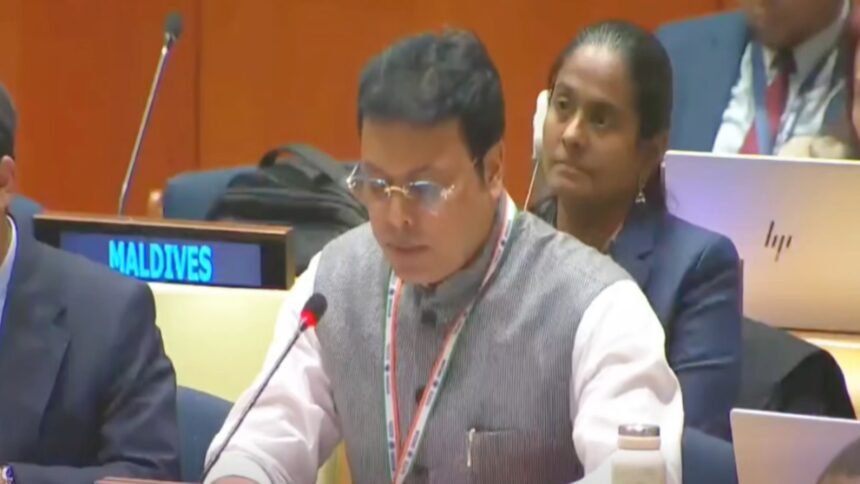
Speaking at the UN General Assembly’s Sixth Committee meeting on measures to eliminate international terrorism, Lok Sabha MP Biplab Kumar Deb said India would continue to exercise its right to protect its citizens from cross-border terrorism originating in Pakistan.
At the UN, India rejected the OIC’s criticism on Jammu and Kashmir and terror strikes, accusing the group of failing to distinguish victims from perpetrators; MP Biplab Kumar Deb affirmed India’s right to self-defense against cross-border terror from Pakistan.

“India reserves the right to defend its people against cross-border terrorism emanating from Pakistan. There will be consequences for indulging in terrorism,” Deb said.
His remarks came in response to a statement made by Saudi Arabia on behalf of the OIC. The grouping had criticised what it described as “unjustified strikes” at several locations in Pakistan and referred to UN Security Council resolutions concerning Jammu and Kashmir, without directly naming India.
Deb rejected the OIC’s description of India’s actions, saying the grouping’s intervention was based on an incorrect portrayal of the issue. “It is regrettable that those delivering the statement are unable to separate fact from fiction and distinguish between victim and perpetrator,” he said.
He also criticised the OIC over reference to Jammu and Kashmir. The BJP leader said, “The OIC chair would do better to focus on Pakistan’s illegal occupation, especially in Rawalakot, where wanton killings, brutal violence and the denial of basic rights to the people living there are so visible. Such willful blindness only speaks of bigotry and intolerance.”
Deb’s comments come amid continuing tensions in Pakistan-occupied-Kashmir, where protests over various issues have been followed by clashes and a security crackdown. Allegations surrounding the recent elections to the region’s legislative assembly have also added to the tensions.
Turning to the threat of terrorism, Deb referred to the April 2025 Pahalgam attack in Jammu and Kashmir, which killed 26 civilians, mostly tourists. He described the attack as an assault on India’s sovereignty and alleged that the perpetrators continued to receive support, safe havens and logistical assistance from across India’s western border.
“The Pahalgam terror attack was a calculated assault on our sovereignty,” Deb said.
India responded to the attack in May 2025 with Operation Sindoor, targeting terror infrastructure in Pakistan and Pakistan-occupied Jammu and Kashmir.
Deb said terrorism remained among the most serious threats facing the international community, particularly when civilians were deliberately targeted.
“Terrorism is antithetical to the values of the UN. There can be no justification whatsoever for deliberately targeting civilians. There is no distinction between good and bad terrorism,” he said.
Quoting Prime Minister Narendra Modi, Deb said India regarded even a single terrorist attack and every loss of life as unacceptable. He said New Delhi viewed terrorism not merely as a security challenge but as an attack on humanity.
The Indian delegation also used the UN meeting to push for faster progress on the proposed Comprehensive Convention on International Terrorism (CCIT). India first circulated its draft convention in 1996, but negotiations on a final agreement have remained unresolved.
“An early conclusion of the CCIT would strengthen the international legal framework to comprehensively counter terrorism,” Deb said.
He further pointed to the New Delhi Declaration adopted at last month’s BRICS Leaders’ Summit, which condemned the Pahalgam attack and described terrorism in all forms as criminal and unjustifiable.
Deb is part of a 15-member delegation of Indian MPs currently visiting the United Nations for a familiarisation programme. During the visit, the lawmakers are scheduled to attend a series of meetings and engagements at the world body.