


International
oi-Prakash KL

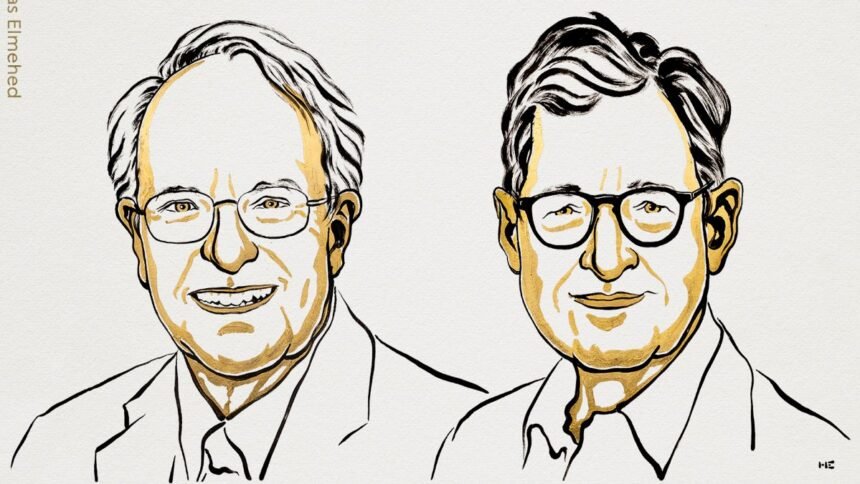
Economists Robert E. Hall and Michael Woodford have been awarded the 2026 Sveriges Riksbank Prize in Economic Sciences in Memory of Alfred Nobel for their work on the “microeconomic foundations of macroeconomic stabilisation”.
The Royal Swedish Academy of Sciences said their research has transformed the way economists understand and respond to fluctuations in the economy by connecting the decisions of individuals and businesses with broader macroeconomic trends.
The Royal Swedish Academy of Sciences awarded the 2026 Sveriges Riksbank Prize in Economic Sciences to Robert E. Hall and Michael Woodford for their work on the microeconomic foundations of macroeconomic stabilization.

The work played a major role in the development of New Keynesian economic models, which are now widely used by central banks and finance ministries to assess economic shocks and formulate stabilisation policies.
Earlier Keynesian models largely relied on statistical and historical relationships between major economic indicators. The newer approach instead examines how households and businesses make decisions, providing a microeconomic basis for understanding developments such as inflation, recessions and business cycles.
Hall made a major contribution to modern economic research through his work on consumption. In 1978, he proposed that changes in consumption could not be predicted in advance because they were driven by new information that, by its nature, could not be known beforehand.
His findings marked an important breakthrough in the study of consumer behaviour and became influential in the development of modern consumption research.
Woodford’s work, meanwhile, helped establish a framework for understanding how monetary and economic policies influence the wider economy. Together, the laureates’ research helped create models that can be used to explain and quantify the impact of stabilisation policies on business cycles.
The Academy noted that these models have continued to evolve since the original research was published and can be adapted to changing economic conditions and the circumstances faced by households and companies.
The influence of this research has also extended beyond academic economics. The models have helped policymakers respond to major economic disruptions, including the COVID-19 pandemic and the energy crises of recent years.
While recessions and periods of high inflation have not disappeared, the Academy said they have generally become less prolonged. The economic disruptions of recent years have also not produced the kind of prolonged damage to growth and inflation seen during the crises of the 1930s and 1970s.
The 2026 economics prize therefore recognises research that has helped bridge the gap between individual economic decisions and the broader policies used to keep economies stable.