



India
oi-Ashish Rana

An independent review of voter lists and Electronic Voting Machines (EVMs), action against officials and a halt to the ongoing voter-list revision are among the 10 demands raised by Congress leader Rahul Gandhi and other INDIA bloc leaders before the Supreme Court on 12 October.

On October 12, Rahul Gandhi and INDIA bloc leaders filed a Supreme Court petition challenging the voter list revision (SIR), seeking suspension of the process, an independent audit of lists and EVMs, record disclosure, and action against officials due to alleged irregularities.
The joint petition challenges decisions linked to the Special Intensive Revision (SIR) of electoral rolls and asks the court to intervene over alleged irregularities in the process. The petitioners have also sought access to official records held by the Election Commission of India (ECI).
Why Has Rahul Gandhi Filed The Petition?
The plea was filed in the Supreme Court under the title Rahul Gandhi v. Election Commission of India. Lawyer S Prasanna submitted it after Gandhi could not reach the court before the 4.30 pm deadline.
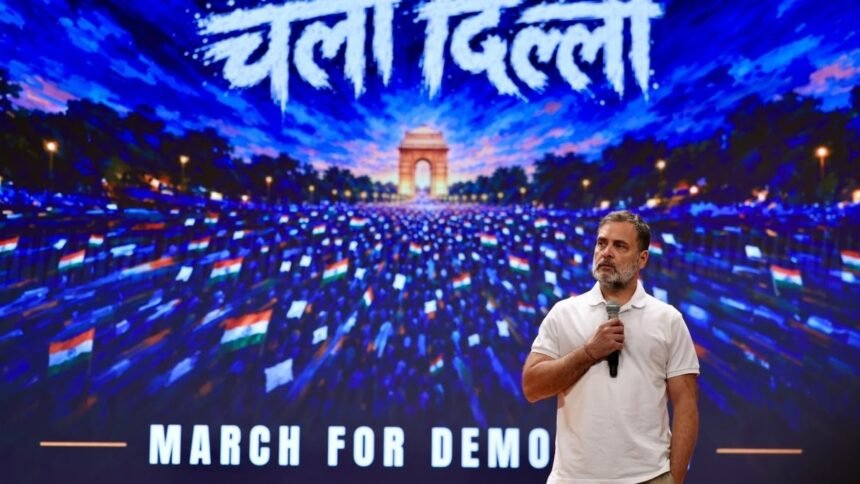
Gandhi joined an INDIA bloc march to the Supreme Court alongside Congress president Mallikarjun Kharge, Priyanka Gandhi, Samajwadi Party chief Akhilesh Yadav, Trinamool Congress chief Mamata Banerjee and RJD leader Tejashwi Yadav, among others.
The protest followed Chief Justice of India Surya Kant’s refusal to meet Gandhi the previous day, as the matter was sub judice. The Opposition has also called for Chief Election Commissioner Gyanesh Kumar to resign.
What Are The 10 Demands In The SIR Petition?
The petition seeks the following reliefs from the Supreme Court:
- Disclosure of SIR records: Direct the ECI to submit files, agreements, meeting minutes, objections, ECINET and ERONET access logs, and file notings linked to the decision to begin SIR on 24 June, 2025.
- Legal review of SIR decisions: Examine whether the decisions follow Article 324 of the Constitution, Section 18 of the Chief Election Commissioner and Other Election Commissioners Act, 2023, and the principles laid down in Seshan v. Union of India (1995).
- Action against responsible officials: Take action against officials found responsible for violating electoral laws or constitutional provisions, including under Section 32 of the Representation of the People Act, 1950, where applicable.
- Written decisions on complaints: Ensure that the ECI examines the petition and related grievances and properly records its decisions in accordance with the law.
- Compliance with Form 6 rules: Ensure the online Form 6 for voter registration follows the Registration of Electors Rules, 1960, unless changes are made through the prescribed legal process.
- Independent audit of voter lists and EVMs: Set up a committee headed by a retired Supreme Court judge, with technical experts and eminent citizens, to examine voter deletions, database changes and EVM technology, policies and procedures.
- Details of deleted voters: Publish booth-wise lists of deleted names, reasons for removal and details classified by gender and age. The petition also seeks a system to restore eligible voters’ names.
- Protection against wrongful deletion: Prevent the removal of voters without legally required notice and a reasonable opportunity to be heard. It also seeks to allow eligible applicants in Punjab and other election-bound states to apply for inclusion until the legally prescribed cut-off date.
- Suspension of SIR: Stop the ongoing revision exercise across all states until the court examines and decides the issues raised in the petition.
- Additional relief: Pass any further orders considered necessary to protect eligible citizens’ voting rights and the fairness of elections.
Petition Seeks Safeguards For Voters
The demands focus on transparency in electoral-roll revision, accountability in the election process and safeguards for eligible voters. The proposed independent committee would also examine technical aspects of EVMs and consider global practices for conducting free and fair elections.
However, these are requests made by the petitioners. They do not mean the Supreme Court has accepted the demands or ordered a stay on SIR.