


India
oi-Prakash KL

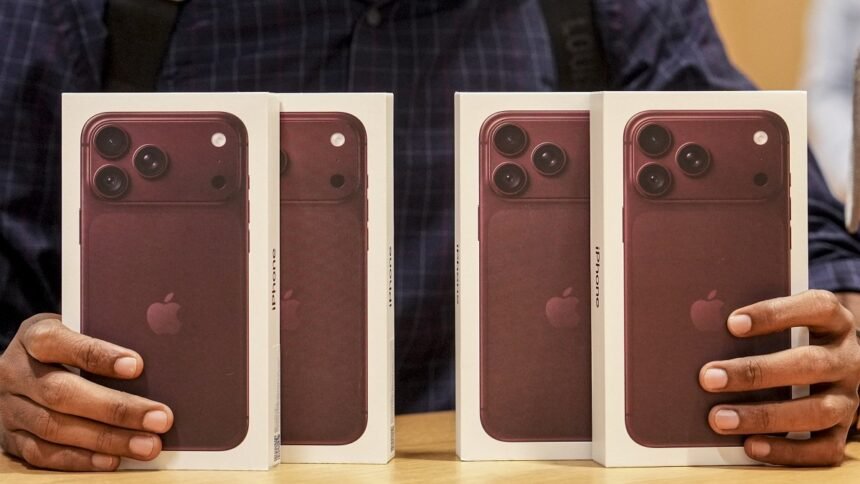
India’s consumption story is becoming increasingly difficult to read through a single economic indicator. While households are dealing with rising food prices, employees are watching global companies restructure their workforces and automobile dealers have reported a decline in Navratri registrations, demand for premium smartphones continues to grow.
The contrast raises a question that goes beyond Apple’s success: are Indians becoming more prosperous, or are they finding new ways to sustain an aspirational lifestyle despite mounting financial pressures?
India exhibits contrasting consumer trends: Apple’s India revenue surpassed ₹1 lakh crore in FY26 amidst rising inflation and tech job cuts, while Navratri vehicle registrations declined, indicating uneven economic prosperity. This raises questions on whether premium spending reflects genuine purchasing power or aspirational lifestyles sustained by credit.

The latest figures offer a striking contrast. Apple’s India business crossed ₹1 lakh crore in revenue in the financial year ended March 2026, even as passenger vehicle registrations fell sharply during Navratri this year. The two developments do not necessarily contradict each other, but together they reveal how differently consumers are responding to the economic pressures around them.
The more important question is whether this appetite for expensive products reflects growing purchasing power across the country or the spending capacity of a relatively smaller section of consumers.
Inflation is back to being a household concern
The pressure on household budgets is not merely anecdotal. According to the Ministry of Statistics and Programme Implementation, India’s retail inflation rose to 5.54% in September 2026, compared with 4.83% in August. Food inflation climbed to 7.74% from 5.97% during the same period. The figures were released on October 12 and are provisional, according to the government data.
Food inflation matters because it affects spending that households cannot easily avoid. Families can postpone replacing a car or buying a new television, but they cannot indefinitely cut back on groceries, rent, transport or school expenses. When these costs rise faster than disposable income, households have less room for discretionary purchases.
The impact, however, is not uniform. A household with a comfortable salary and few financial commitments may absorb higher prices without significantly changing its spending habits. For a family already managing EMIs, education expenses and medical bills, even a moderate increase in everyday costs can make a difference.
This is why strong sales of premium products should not automatically be interpreted as evidence that consumers across India are financially comfortable.
Job cuts are adding to the uncertainty
Employment prospects provide another important part of the picture, particularly for young Indians working in technology and other white-collar industries.
According to a recent report in Reuters, Amazon had carried out another round of job cuts, primarily in its Stores division. The company described the latest reductions as small, while a person familiar with the matter told the news agency that fewer than 1,000 white-collar employees were affected. Workers in the United States, India and the United Kingdom were among those receiving termination notices. The cuts followed a much larger restructuring exercise that had begun the previous year.
Oracle has also been cutting jobs. An Economic Times report published in September, citing industry experts tracking the company, said a fresh round of reductions was expected to affect around 3,000 employees in India. The company had already cut approximately 21,000 jobs globally earlier in the year, including around 12,000 in India.
These developments do not mean that every sector is shedding jobs or that India’s unemployment rate is necessarily rising. They do, however, illustrate the uncertainty facing sections of the organised workforce. Corporate restructuring, cost-cutting and the growing use of artificial intelligence have made employment stability a concern for some workers, even when companies continue to report strong business performance.
For a young professional, the calculation can be uncomfortable. A regular salary provides the ability to buy expensive products, but uncertainty over how long that salary will continue can make long-term financial planning more difficult.
Yet the same uncertainty does not necessarily stop people from spending. That is where the iPhone phenomenon becomes interesting.
Apple’s growth is impressive, but it is not the whole Indian market
According to The Economic Times, Apple India Pvt Ltd reported revenue from operations of ₹1,03,853 crore in FY2026, up 31% from ₹79,060 crore in FY2025. Its net profit rose 66% to ₹5,311 crore, compared with ₹3,196 crore a year earlier. The figures are based on company filings with the Registrar of Companies accessed through business intelligence platform AltInfo.
The wider smartphone market grew much more slowly. Counterpoint Research data cited in the report showed that India’s smartphone market expanded 2% in volume terms and 9% in value terms during FY2026. Smartphones priced above ₹30,000 recorded 12% volume growth, while Apple’s own volume growth accelerated to 24%, against 11% in the previous financial year.
Counterpoint research analyst Shubham Singh attributed Apple’s performance to the shift towards premium smartphones, the company’s brand appeal, its expanding retail presence, deeper distribution in tier-2 and smaller markets, and easier financing options.
These figures suggest that a section of Indian consumers is willing to pay more for smartphones even as the overall market matures. But Apple’s revenue is not a measure of the average Indian’s income, savings or financial security. A company can achieve exceptional growth by attracting a relatively small but valuable segment of the market.
That distinction is important. India’s premium smartphone boom tells us what a growing section of consumers wants to buy; it does not tell us how comfortably the rest of the population is managing its expenses.
Why does an expensive phone remain a priority?
Part of the answer lies in the changing role of smartphones. For many young Indians, a phone is no longer simply a device for calls and messages. It is used for work, banking, photography, entertainment, shopping and social interaction. A premium model can therefore be justified as a product that serves several purposes throughout the day.
But usefulness alone does not explain the demand for the most expensive models. Brand perception and social aspiration also play a role.
An iPhone has become a recognisable status product. For some buyers, owning one signals professional success or membership of a particular social group. Social media reinforces that aspiration by making premium consumption visible and seemingly commonplace, even though the people posting their purchases are not representative of the entire population.
There is also a practical difference between paying the full price upfront and spreading the cost over monthly instalments. Exchange offers, credit cards and EMI schemes can make a phone that costs tens of thousands of rupees appear manageable within a monthly budget.
This does not necessarily mean that every buyer is overspending. Some have the savings to afford the device, while others may reasonably consider it worth the price. The concern arises when a purchase is driven more by peer pressure or the desire to keep up appearances than by genuine affordability.
A monthly payment may look small in isolation, but it competes with other obligations. Multiple instalments can gradually reduce the money available for emergencies, savings and essential expenses.
The automobile slowdown offers a useful counterpoint
The latest festive vehicle registration figures provide another perspective on consumer behaviour.
According to provisional data from the Federation of Automobile Dealers Associations (FADA), 11.23 lakh vehicles were registered during the 10-day Navratri period from October 11 to October 20, 2026, compared with 12.01 lakh during the corresponding period last year. Overall registrations declined 6.52% year-on-year, while passenger vehicle registrations fell 21.91% to 1,82,728 units. Two-wheeler registrations dropped 2.79% to 8,34,075 units.
The decline needs context. Navratri period coincided with the rollout of GST 2.0, which brought a wave of purchases into a single festive window. FADA President Sai Giridhar said the year-on-year dip was largely optical and noted that this year’s registrations were still substantially higher than in Navratri 2024.
Nevertheless, the latest figures show that the festive rush did not match last year’s exceptional performance, particularly for passenger vehicles.
A car is a much larger financial commitment than a smartphone. Buyers must account for a down payment, loan repayments, insurance, fuel and maintenance. A household uncertain about its future income may decide to postpone a car purchase even if it can manage the cost of a phone.
That makes the comparison useful, but not conclusive. The Navratri data alone cannot establish that inflation or job cuts caused the decline in registrations. Nor can Apple’s growth prove that the broader consumer economy is healthy.
What the figures do show is that spending is not moving uniformly across categories.
Is easy credit changing the meaning of affordability?
One of the more uncomfortable questions behind the premium-consumption boom is how much of it is funded by disposable income and how much depends on credit.
Financing allows consumers to buy products earlier than they otherwise might. That can be useful when a purchase is necessary or when a buyer has stable income and a clear repayment plan. But it can also encourage people to commit future earnings to products they do not strictly need.
The distinction between being able to purchase something and being able to comfortably afford it deserves greater attention. A buyer may be eligible for an EMI and still have too little money left at the end of the month to build savings.
This is especially relevant for younger workers who are beginning their careers, living in expensive cities and facing uncertainty over salary growth. The pressure to own premium devices, travel frequently and maintain a particular lifestyle can make financial restraint feel like falling behind.
It would be unfair to assume that every young person buying an iPhone is doing so on credit or making an irresponsible decision. Apple’s sales figures do not reveal how individual purchases are funded. But the growing role of financing in consumer markets makes it worth asking whether easier access to expensive products is always translating into genuine financial well-being.
What the numbers really tell us
India’s consumption story is neither one of universal distress nor one of widespread prosperity. It is a more uneven picture in which some consumers continue to spend on premium products while others must prioritise rising household expenses and worry about the stability of their incomes.
Apple’s growth demonstrates the strength of India’s premium smartphone market. The Navratri figures show that demand in another major consumer category has moderated against an unusually strong comparison period. Inflation and corporate layoffs provide important context, but they do not, by themselves, establish a direct relationship between economic anxiety and either trend.
The larger issue is whether the country’s aspirational spending is being supported by durable income growth or, in some cases, by easy credit and social pressure. Revenue figures and festive sales data cannot answer that question on their own. Household savings, debt levels, real wage growth and the quality of employment are equally important measures of economic health.
A country should not be judged solely by how many premium phones it sells or how much revenue a global brand earns from its consumers. Those numbers tell us something about demand, but much less about financial security.
The real test is whether households can afford the products they want without compromising their ability to pay for the things they need. Until that distinction is clearer, India’s premium-consumption boom should be viewed as a sign of changing aspirations, not definitive proof that the average consumer has become financially better off.