International
oi-Gaurav Sharma

A brief farewell at Delhi airport has drawn wide attention online after Abu Dhabi Crown Prince Sheikh Khaled bin Mohamed bin Zayed Al Nahyan turned back to personally thank his driver before leaving India. The moment, captured on video during his departure from New Delhi, has been widely shared for its simple display of courtesy during a high-profile diplomatic visit.
Sheikh Khaled was in the capital for the 18th BRICS Summit, hosted by India at Bharat Mandapam on September 12 and 13. He represented UAE President Sheikh Mohamed bin Zayed Al Nahyan at the summit and also held bilateral engagements with Prime Minister Narendra Modi during the visit.
Abu Dhabi Crown Prince Sheikh Khaled bin Mohamed bin Zayed Al Nahyan’s gesture of turning back to personally thank his driver at Delhi airport upon leaving India after the 18th BRICS Summit gained widespread online attention for its respectful courtesy.

Abu Dhabi Crown Prince’s airport gesture wins praise
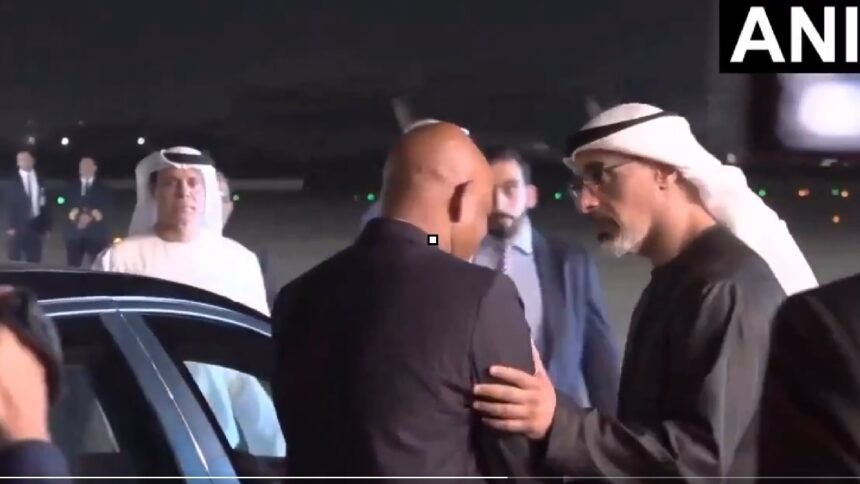
In the video circulated by news agency ANI and shared widely on social media, Sheikh Khaled is seen stepping out of his vehicle and greeting officials before walking towards his aircraft. Moments later, he appears to pause, turn around and return to the car to acknowledge the chauffeur.
He then shakes hands with the driver and speaks to him briefly before resuming his departure. ANI reported that the chauffeur was Indian. The short exchange has resonated with many users, who described it as a respectful gesture towards a person usually outside the spotlight of official visits.
The clip spread quickly because it showed an unscripted moment amid tightly managed diplomatic protocol. Airport departures of visiting leaders usually follow a fixed order, with security personnel, officials and protocol teams guiding each movement. In that setting, the Crown Prince’s decision to return to the vehicle stood out to viewers.
விமானத்தில் ஏற இருந்த அபுதாபி இளவரசர் திரும்பி வந்து இந்திய கார் ஓட்டுநரின் கை குலுக்கி திரும்பிச் சென்றார் pic.twitter.com/ec1EyKYlg6
— E Chidambaram (@JaiRam92739628) September 14, 2026
Social media reactions largely focused on the humility of the gesture. Many users said the moment reflected personal courtesy rather than ceremonial formality. Others linked it to India-UAE warmth, noting that small public gestures often gain larger meaning when they occur during major international engagements.
Visit came during India-hosted BRICS Summit
India hosted the 18th BRICS Summit under the theme “Building Resilience, Innovation, Cooperation and Sustainability.” The gathering brought together 13 world leaders and 17 delegations in New Delhi, making it one of the biggest diplomatic events hosted by India this year.
The UAE’s participation was significant because the country is part of the expanded BRICS framework. Its growing role in the grouping comes at a time when India and the UAE are also deepening cooperation across trade, energy, technology, finance and strategic affairs.
During Sheikh Khaled’s engagements in Delhi, discussions with Prime Minister Modi covered several areas central to the India-UAE partnership. These included energy supplies, trade, artificial intelligence, financial cooperation, education and tourism. The talks also touched on regional security issues and the safety of Indian seafarers amid tensions in West Asia.
The UAE is one of India’s most important partners in the Gulf. It hosts a large Indian diaspora and remains a key destination for Indian workers, professionals and businesses. Bilateral ties have expanded sharply in recent years, especially after the Comprehensive Economic Partnership Agreement between the two countries came into force.
Why the moment struck a chord online
The viral response to the airport video also reflects how audiences now engage with diplomacy. Formal statements and summit declarations remain important, but unscripted human moments often travel faster on social platforms. A handshake, a pause or a brief conversation can become a widely discussed symbol of leadership style.
In this case, the appeal came from the contrast between the scale of the event and the simplicity of the act. Sheikh Khaled had been attending a summit involving global leaders, security teams and formal bilateral talks. Yet the clip showed him taking a few seconds to acknowledge someone who had served him during the visit.
Such gestures often attract attention in India, where visiting dignitaries’ interactions with local staff, cultural performers and members of the public are closely watched. They can shape public perception beyond official communiques, especially when the interaction appears spontaneous and respectful.
The incident also fits into a broader pattern of India-UAE public diplomacy, where warmth between leaders has frequently been highlighted. Prime Minister Modi has visited the UAE several times, while senior UAE leaders have been prominent participants in major Indian diplomatic and investment events.
PM Modi’s diplomatic schedule in Delhi
The Ministry of External Affairs said Prime Minister Modi held 15 formal bilateral meetings over three days during the summit period. He also had informal interactions with world leaders and heads of international organisations on the sidelines of the event.
For India, the summit was an opportunity to underline its diplomatic reach across emerging economies, energy producers and major trade partners. For the UAE, the visit offered another platform to engage India on long-term economic and strategic priorities while taking part in BRICS discussions.
The viral airport video does not change the substance of those talks, but it has added a softer public note to the visit. At a time when summit diplomacy is often measured through agreements, statements and strategic signals, the brief exchange with the chauffeur became the image many people remembered.
Sheikh Khaled’s departure from Delhi will likely be recalled not only for the formal meetings around the BRICS Summit, but also for a small act of acknowledgement caught on camera. The moment gained attention because it was brief, direct and easy for viewers to understand: a visiting leader stopped to thank the person who drove him.