


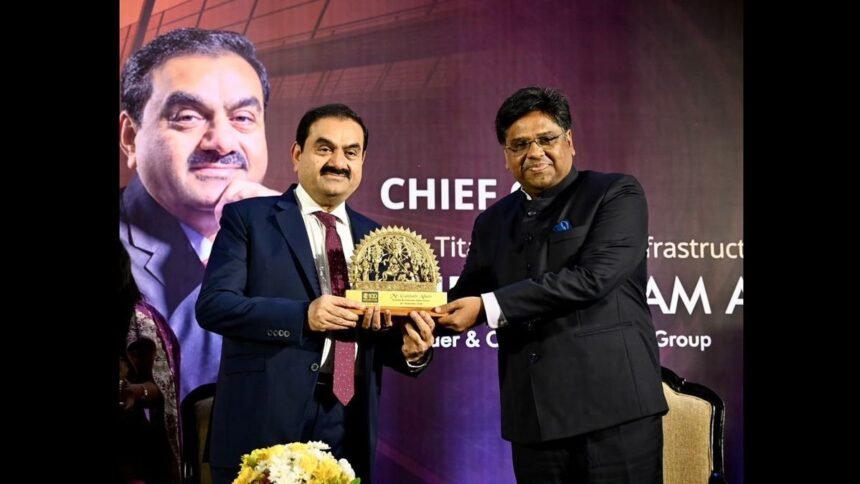
Gautam Adani announces a comprehensive INR 1 lakh crore investment in West Bengal, covering ports, logistics, energy, roads, and healthcare, alongside cultural and heritage projects. The initiative positions Bengal as a strategic growth hub and emphasises building ahead of demand through integrated networks.
India
-Oneindia Staff

Gautam Adani, Chairman of the Adani Group, announced a mega investment plan for West Bengal while delivering the keynote address at the Indian Chamber of Commerce (ICC) here on Wednesday, pledging to deploy over ₹1 lakh crore across the state over the next decade. Addressing industry leaders, government representatives and ICC members, Adani said the investments would span ports, logistics, power generation, transmission and distribution, roads, bridges, ropeways, green cement and hyperscale data centres.

Recalling his three-decade journey since starting the Mundra Port in Gujarat, Adani said Bengal was set to become his “second karmabhoomi,” even as he stressed that the state should not be seen as replicating Gujarat’s model but should rise as “the strongest version of Bengal itself.”
Gautam Adani announces a comprehensive INR 1 lakh crore investment in West Bengal, covering ports, logistics, energy, roads, and healthcare, alongside cultural and heritage projects. The initiative positions Bengal as a strategic growth hub and emphasises building ahead of demand through integrated networks.
*Healthcare push: Adani Arogya Mandir*
Among the announcements made at the event was the Adani Arogya Mandir, a 2,000-bed medical institute planned for New Town, Kolkata. The group said half of the hospital’s beds would be reserved for patients unable to afford private healthcare.
The industrialist also spoke of the group’s commitment to Bengal’s cultural heritage, including the revitalisation of Kumartuli Ghat, a curated Durga Puja programme to showcase Bengali artistes globally, and support for the conservation of the historic Writers’ Building.
*”Build ahead of demand”*
Much of Adani’s address focused on his philosophy of anticipating economic shifts rather than reacting to them. Citing examples ranging from the group’s early bets on AI data centre capacity, the acquisition of Haifa Port in Israel ahead of the India-Middle East-Europe Economic Corridor (IMEC) announcement, and the integrated logistics network spanning 15 Indian ports, he argued that businesses must “build ahead of demand” during moments of global disruption.
He pointed to the group’s flagship projects — Mundra Port in Gujarat and the Khavda Renewable Energy Park in Kutch — as examples of how connected infrastructure “networks” create more value than isolated assets. Summarising the approach, he said scale creates size, but networks create strength.
*Why Bengal, why now*
Adani argued that India’s next phase of growth must shift eastward, after decades of momentum concentrated in the western and southern corridors. He described Bengal’s geographic position — bordered by the mineral-rich states of Odisha, Jharkhand and Chhattisgarh, linked to India’s Northeast, and opening onto Southeast Asia and the Indo-Pacific through the Bay of Bengal — as uniquely suited to become what he called a “strategic national node.”
*Tribute to Bengal’s legacy*
Adani opened his address with warm remarks about Kolkata’s intellectual and cultural traditions, referencing the city’s Nobel laureates and historical figures including Swami Vivekananda, Netaji Subhas Chandra Bose and Jagadish Chandra Bose. He also shared a light-hearted anecdote involving Adani Group’s Head of Transformation, Sudipta Bhattacharya, and Bengal’s love for hilsa fish, drawing laughter from the audience. He closed his speech with a Hindi rendering of Rabindranath Tagore’s prayer for the nation, invoking a vision of an India “awake to its possibilities.”