



40M+face photos used to train the base AI
34,363photos of cancer patients used to teach survival prediction
5.1 yrsaverage error when guessing age on a public test set
3.23×higher death risk in the top-risk group versus the lowest
Doctors have long said they can “see” serious illness on a patient’s face — sunken cheeks, hollow eyes, a drawn look. Researchers at Mass General Brigham, the Harvard-affiliated hospital system in Boston, have tried to turn that bedside instinct into a number.
Their system, called FAHR-Face (Foundation Artificial Intelligence for Health Recognition), looks at an ordinary photograph and produces two separate health readings. The work was published on 19 October 2026 in The Lancet Digital Health.

One base AI, two health tools
The researchers first trained a general-purpose AI — a “foundation model” — on more than 40 million unlabelled face images from a public dataset called WebFace42M. At this stage the AI is not told anything about health. It simply learns what human faces look like across all ages.
Think of it as a medical student who studies millions of faces before choosing a specialty. Once the basics are learned, the same model can be quickly retrained for specific jobs. The team built two.
How FAHR-Face was built
Step 1 · Learn faces
Base model trained on 40 million+ unlabelled face photos covering the whole human lifespan
↓
FAHR-FaceAge
Retrained on ten public image datasets to estimate biological age
FAHR-FaceSurvival
Retrained on 34,363 photos of cancer patients, with their known outcomes, to estimate death risk
↓
Step 3 · Check on new patients
Tested on independent cancer patient groups, including 4,892 patients treated in Maastricht, the Netherlands
Graphic: OneIndia · Data: Haugg F et al., The Lancet Digital Health, 2026
Tool 1: How old does your body look?
Your biological age reflects how worn your body is, not the number on your birth certificate. Two 60-year-olds can be in very different physical shape.
FAHR-FaceAge guesses this from a photo. On a public benchmark dataset of presumably healthy people, it was off by an average of just 5.1 years — the lowest error among the models compared — and it stayed accurate from childhood to old age.
What matters most is the gap. When the AI thinks someone looks older than they actually are, researchers call that the FAHR-FaceAge deviation. In cancer patients, a bigger gap was linked to poorer survival, even after accounting for real age, sex and cancer type. The new tool also beat the team’s earlier FaceAge model at predicting survival.
The researchers also noticed lifestyle showing up on the face. Heavy drinking, drug use and smoking were associated with looking biologically older. Smoking showed the clearest pattern: current smokers looked older than former smokers, who in turn looked older than people who had never smoked.
Tool 2: Reading risk directly from the face
The second tool skips age entirely. FAHR-FaceSurvival was shown photos of cancer patients — mostly routine pictures taken before radiation treatment — along with what later happened to each person. From this it learned to estimate death risk from the face alone.
Risk of death: highest-risk quarter vs lowest-risk quarter of patients
Adjusted hazard ratio 3.23 (p < 0.0001). Graphic: OneIndia · Data: Haugg F et al., The Lancet Digital Health, 2026
The gap was sharpest in the short term. Among patients the AI flagged as highest risk, roughly half died within 90 days. Among the lowest-risk group, about two in a hundred did.
Out of every 100 patients, how many died within 90 days?
AI’s highest-risk group
≈ 52 in 100
AI’s lowest-risk group
≈ 2 in 100
died within 90 days alive at 90 days
Rounded from reported figures (64 of 122 vs 20 of 975 patients). Graphic: OneIndia · Data: Haugg F et al., The Lancet Digital Health, 2026
Crucially, the results held up outside Boston. All main findings were re-checked in a separate group of 4,892 cancer patients from Maastricht, and the tools worked across age, sex, race and cancer subgroups.
Same AI, different clues
Although both tools grew from the same base model, they are not copies of each other. Their scores were only weakly related (correlation R = 0.16), meaning each captures a different side of a patient’s health. When both were analysed together, each remained independently linked to survival — and combining them improved prediction.
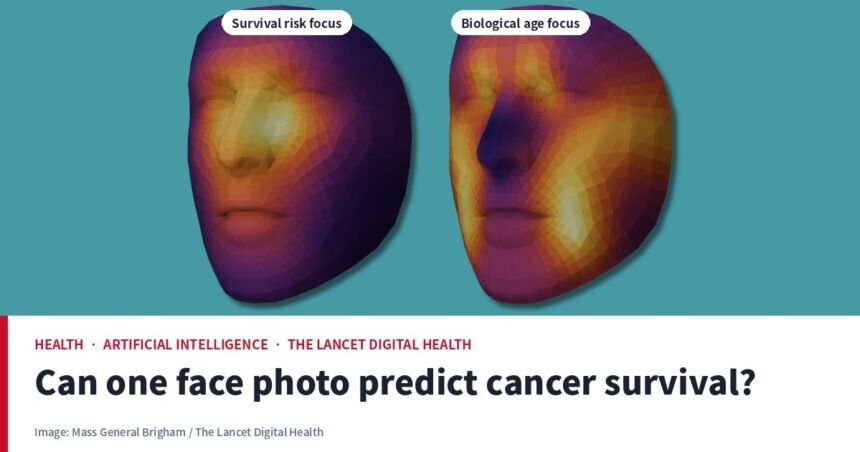
The heat maps show why. The two tools focus on different parts of the face:
Survival tool looks at
- The area just below the eyes
- The bridge of the nose
Age tool looks at
- Smile lines (nasolabial folds)
- Forehead just above the eye sockets
- The temples
An echo from 2,400 years ago
The survival tool’s focus closely matches what Hippocrates, the ancient Greek physician, described around 400 BC as the face of a dying patient: a sharp nose, hollow eyes and sunken temples. Study author Dr Raymond Mak, a radiation oncologist, has said he suspects the AI may be detecting loss of soft tissue and muscle, but stresses this is speculation. The AI was given nothing but photographs and patient outcomes — no medical texts, no doctors’ notes.
- c. 400 BCHippocrates describes the tell-tale face of a dying patient
- 2025The same Boston team reports FaceAge, an earlier AI that estimates biological age from a photo
- 2026A follow-up study tracks how fast a patient’s face ages across repeated photos
- 19 Oct 2026FAHR-Face published: one base model, two tools, direct survival prediction
Hard to fool — mostly
A common worry with face-based AI is that a good camera angle or makeup could change the result. The researchers report that FAHR-FaceAge stayed consistent across differences in pose, lighting, facial expression and makeup, and across most plastic surgery procedures tested. The only noticeable shift came after nose surgery (rhinoplasty).
Why doctors are interested
Before recommending tough treatment such as radiation, surgery or strong chemotherapy, a doctor has to judge whether the patient’s body can take it. Today that judgment leans on birth age and a quick visual impression. The team says the goal is to make that assessment more measurable and consistent — to support doctors, not replace them.
What the study does not prove
Is it better than a doctor’s eye?
Experienced oncologists already read patients’ faces informally. Independent experts want proof that adding the AI to everything a doctor already knows actually improves predictions — and, beyond that, improves care.
Frailty (how physically weak or vulnerable a person is) not fully measured
The analyses adjusted for age, sex, race, cancer type and treatment, but not detailed frailty tests (checks such as grip strength, walking speed, weight loss and how well a person manages daily tasks, which show how much physical reserve the body has to cope with illness and treatment). So it is possible the AI is mainly spotting frailty that such tests would also pick up. A separate trial is comparing face-age scores with strength assessments in older lung cancer patients.
Risk of hidden bias
An AI learns from past records, including their unfairness. A face reveals a person’s race or ethnic background, so the AI effectively “knows” it even though no one told it. Now suppose that, in the hospital records it learned from, patients of one community had worse survival — not because of their biology, but because they were diagnosed later, could not afford the best treatment or received poorer care.
The AI cannot tell these reasons apart. It may simply learn that faces from that community mean “higher risk”. If doctors then used such a score to decide who gets aggressive treatment, those patients could be offered less care, repeating the original unfairness. Experts say any face-based tool must be checked carefully for this before it is used.
Not tested on Indian patients
The patients came from cancer groups mainly in high-income countries. The authors call for testing in broader, more representative populations, and for prospective trials before any clinical use.
Bottom line: This is not an app that tells you how long you will live. It is a research tool, tested only in cancer patients, showing that an ordinary photo carries measurable health signals. Whether it becomes a routine “digital vital sign” depends on trials that have not yet been done.
Quick check: fact or myth?
Tap your answer for each statement.
1. The AI looks up a patient’s medical history online to make its prediction.
2. Cancer patients whose faces looked older than their real age tended to have poorer survival.
3. Good lighting or makeup can easily fool the age tool.
Jargon buster
Foundation modelA large AI first trained on huge amounts of general data, then adapted for specific tasks.
Biological ageHow old your body behaves, as opposed to your age by birth date.
Hazard ratioA measure of relative risk. A value of 3 means roughly three times the risk of death over the study period.
Attention mapA heat map showing which parts of an image the AI relied on most.