



International
oi-Prakash KL

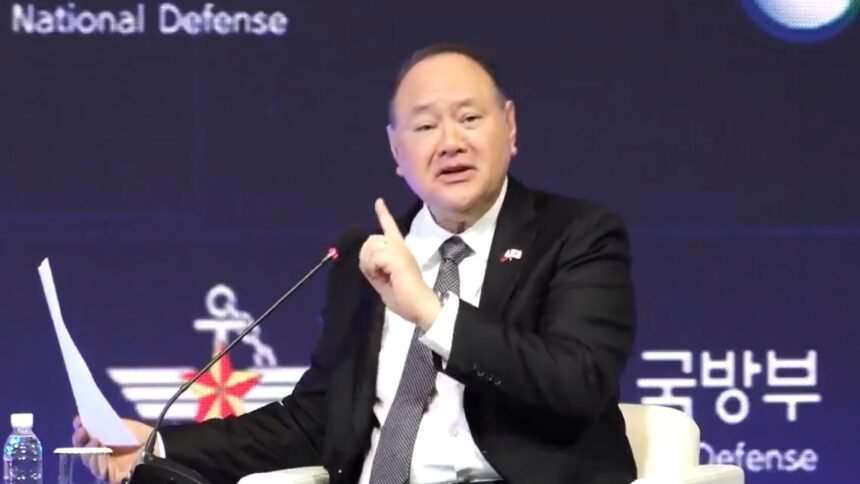
Philippines Defence Secretary Gilberto C Teodoro publicly confronted China after a note outlining Beijing’s position on the South China Sea was handed to him during a defence forum in South Korea.
Teodoro was speaking at the Seoul Defence Dialogue when a man in a white sports coat approached the table and placed a sheet of paper beside him. The unusual interruption was caught on video and has since gone viral, according to South Korean news agency Yonhap.
Philippines Defence Secretary Gilberto C Teodoro publicly rebuked China after receiving a note dismissing the 2016 South China Sea arbitration ruling during a defense forum in South Korea, calling the delivery disrespectful and aggressive behavior.

The note was sent by a Chinese military attaché at the Chinese Embassy in Seoul. The attaché had reportedly given the note to a staff member, asking that it be passed on to Teodoro. The staff member, however, believed it was a message from the Philippine delegation and handed it to the defence secretary while he was speaking.
Teodoro stopped his remarks, picked up the paper and told the audience that he believed it was a message from China. He then asked whether he should read it aloud. “China’s position on the South China Sea arbitration is clear, consistent and firm. They have no position. The arbitration violates fundamental principles of international law,” the note read.
Apparently, the message referred to the arbitration case initiated by the Philippines against China under the United Nations Convention on the Law of the Sea (UNCLOS). In its 2016 ruling, the tribunal rejected several of China’s expansive claims to historic rights in the South China Sea. It also found that Beijing had no legal basis to claim historic rights to resources within areas falling under the Philippines’ exclusive economic zone.
A live demonstration of Chinese bullying tactics against its smaller neighbours – but this time Phillipines decided to thrash it publicly and in a manner we have not seen many doing it. Class pic.twitter.com/MrtspC3iVD
— Mihir Jha (@MihirkJha) September 9, 2026
China has refused to accept the ruling and has maintained that the tribunal did not have jurisdiction over the case.
After reading the note, Teodoro questioned why Beijing had chosen to deliver such a message in the middle of an international forum.
“How can you deal with a country in an international forum – beyond the question asked to me – disrespecting the organizers of this forum, how do you expect to deal with it civilly?” Teodoro said, looking at the crowd.
“I ask you the question, is this the right paper to post to me when I’m being asked a question on the floor? And how will you treat this kind of behavior? It not only disrespects, shows, if this is a Chinese position sent to me, it not only disrespects international law, throwing UNCLOS to the floor and trampling upon it, but it also disrespects the basic decency accorded that should be accorded to our most gracious host, the Republic of Korea and the rest of the audience here,” he added.
“So, perhaps basic decency and behavior is what China needs to do. This is actual coercion, bullying and aggression. I will keep this paper as a memento of how desperate China is and how ineffective its position is in the face of a free audience. Thank you very much for the person who gave me this piece of paper. You have just done your country a great service,” Teodoro added.
Concluding his speech, he said, “I think it is well known to the public, to everyone here about the Philippine situation where we face challenges daily from the People’s Republic of China which tries to occupy and illegally assert its presence over our territory and especially our exclusive economic zone. In contravention with the UNCLOS. We live in a very interconnected world, and there is no right for any state of that matter to appropriate an international common for its exclusive use or right, contrary to what the international norms clearly state. So the Philippines has been forced to enter into creative defense arrangements and alliances,”
The South China Sea remains one of Asia’s most closely watched flashpoints. China claims large parts of the waterway, while the Philippines and several other countries have competing territorial and maritime claims.
Manila continues to cite the 2016 arbitration ruling in challenging Beijing’s claims. China, however, continues to reject the decision, keeping the dispute at the centre of relations between the two countries.