


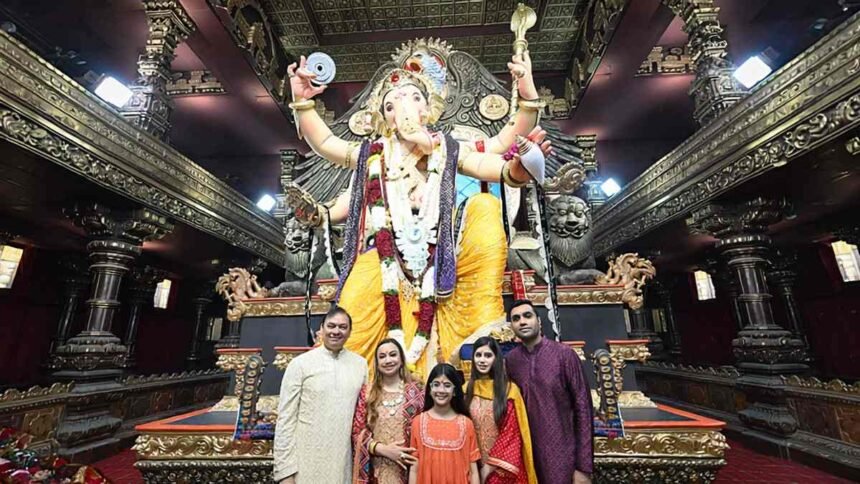
The Adani family, including Pranav Adani and Karan Adani, attended the Chinchpokli Cha Chintamani Ganesh Chaturthi celebrations in Mumbai. The event featured a South Indian temple-inspired idol of Lord Venkateshwara Balaji, honouring a century-old tradition rooted in Mumbai’s mill culture and public festival heritage.
India
-Oneindia Staff

Pranav Adani, Director, Adani Enterprises, and Karan Adani, Managing Director, Adani Ports and Special Economic Zone Ltd. (APSEZ), along with their family members, visited the iconic Chinchpokli Cha Chintamani pandal to offer prayers on the occasion of Ganesh Chaturthi.

The Adani family, including Pranav Adani and Karan Adani, attended the Chinchpokli Cha Chintamani Ganesh Chaturthi celebrations in Mumbai. The event featured a South Indian temple-inspired idol of Lord Venkateshwara Balaji, honouring a century-old tradition rooted in Mumbai’s mill culture and public festival heritage.
Speaking on the occasion, Pranav Adani, who also serves as Managing Director (Agro, Oil & Gas) at Adani Enterprises, said the Adani Group was honoured to partner with the Chinchpokli Sarvajanik Utsav Mandal. He noted that in its 107th year, the Chinchpokli Cha Chintamani’s legacy has remained synonymous with devotion, unity, and Mumbai’s cultural spirit.
Chinchpokli Cha Chintamani, Mumbai’s second-oldest public Ganapati, traces its roots to the city’s former textile hub spanning Parel, Girgaon and Lalbaug. The celebration carries forward the tradition started by freedom fighter Lokmanya Bal Gangadhar Tilak, who turned Ganesh Chaturthi into a public festival in the 1890s.
Continuing its tradition of unique annual themes, this year’s celebrations draw inspiration from South Indian temple architecture. The idol is designed around Lord Venkateshwara Balaji of Tirumala Tirupati, incorporating sacred motifs such as the Garuda, Keertimukh, Shankha, Chakra and a camphor Tilak.
The pandal recreates the grandeur of the Sri Venkateswara Temple (Swarnagiri) in Hyderabad and Bhuvanagiri, featuring towering gopurams, sacred deepastambhas, and intricately sculpted yali/vyala guardian figures.
*A Legacy Rooted in Mumbai’s Mill Culture*
Mill workers were central to the festival’s origins. Despite the disruptions caused by the 1982 mill strike and the city’s subsequent urban transformation, Chinchpokli Cha Chintamani has continued to serve as a cultural anchor for its neighbourhood. The mandal today counts nearly 5,000 contributors and has expanded its work beyond Ganeshotsav into healthcare and education initiatives.
The celebrations have been held on the eastern side of Chinchpokli railway station since 1939, organised continuously by the Chinchpokli Sarvajanik Utsav Mandal.
*Community Work Beyond the Festival*
Beyond Ganeshotsav, the mandal regularly conducts blood donation camps, healthcare initiatives and programmes for children. During the Covid-19 pandemic, it scaled back public celebrations in favour of health-focused efforts, including testing camps, medical assistance and blood donation drives.