



International
oi-Prakash KL

Elon Musk has once again pushed Tesla into territory that sounds more like science fiction than the automobile industry.
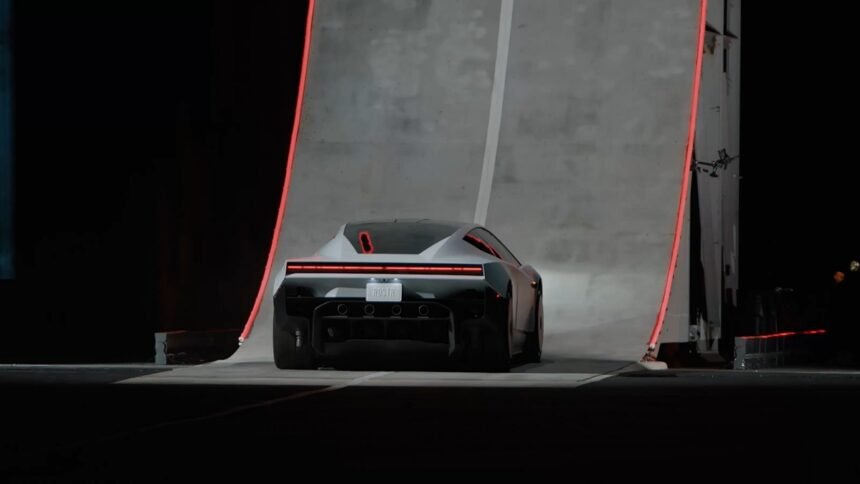
Tesla unveiled its next-generation Roadster at a SpaceX test facility in Texas on Thursday, with Musk claiming that the two-seater sports car can do something few road cars have even attempted – take off into the air.
Tesla unveiled its next-generation Roadster at a SpaceX facility in Texas on Thursday, demonstrating aerial stunts using jet technology and ultra high-pressure air tanks, with production planned for 2028.

The demonstration was certainly dramatic as the Roadster raced from a standstill to 60 mph in less than a second, climbed a steep ramp and appeared to stick to the surface before turning upside down. It then spun away from the ramp, flipped through the air and used jets to make a controlled landing.
There was no driver inside the car during the stunt.
Real life, baby https://t.co/3QEqn18wig
— Tesla (@Tesla) October 16, 2026
Musk said the decision was made for safety reasons, joking that Tesla did not want to “kill anyone” during the demonstration. He also admitted that there was an element of risk involved.
“Success is not guaranteed,” Musk told the audience. “It’ll probably work, but if it doesn’t work, we’re at a safe distance.”
Do a kickflip! https://t.co/DJ1Bq1yu8m
— Tesla (@Tesla) October 16, 2026
The Roadster later performed another eye-catching stunt, using its jets to jump over a row of Tesla vehicles parked alongside each other. The same technology was then used to help the car reach 60 mph in what Musk described as record-breaking time.
How Does Tesla’s Flying Car Work?
According to Musk, the Roadster is fitted with 10 nozzles and what he called “ultra high-pressure air tanks”. The system is designed to provide additional thrust when the vehicle is airborne and help deliver rapid acceleration while it is on the ground.
Roadster event livestream https://t.co/G0jU4mWfid
— Tesla (@Tesla) October 15, 2026
Musk described the project as the result of a collaboration between Tesla and SpaceX, calling them the world’s best car and rocket companies respectively.
The technology certainly makes for an impressive demonstration. But whether the Roadster can actually fly in the way people imagine a flying car should is another question.
Thursday’s event showed the vehicle making short aerial movements and performing stunts. It did not demonstrate sustained or long-distance flight.
Roadster transforms in Track ModeThese aero features arent just for looks: they provide the best passive downforce package of any road car (approaching F1 levels!) with wing actuation driven by the @Tesla_Optimus actuator system https://t.co/AqrC4qUga9
— Tesla (@Tesla) October 16, 2026
Tesla Roadster Production In 2028
Musk said Tesla plans to put the new Roadster into production in 2028. However, the timeline will be watched closely given Tesla’s history of announcing ambitious targets that have sometimes taken years longer than originally promised.
Musk also appeared keen to convince the audience that what they were watching was real and not simply a computer-generated spectacle. “We need an audience to prove that it’s not AI or SI,” he said, urging those present to tell others that they had witnessed the demonstration themselves.
For Tesla, the bigger challenge now may be turning a spectacular stage demonstration into a practical vehicle that can be driven on public roads and safely leave the ground when required.
Flying Cars Still Face Major Hurdles
Tesla is not entering an entirely unexplored field. Several companies have been developing electric vertical take-off and landing aircraft, commonly known as eVTOLs.
Some of those aircraft have already reached the testing stage, but building a vehicle that combines the everyday practicality of a car with the safety and engineering requirements of an aircraft remains a far bigger challenge.
The Roadster’s demonstration may have brought the idea closer to reality. Whether it can truly become a flying car, rather than an extremely fast car capable of spectacular jumps, will only become clear when the technology is tested much further.