



Artificial Intelligence
oi-Oneindia Staff

Every day, millions of people search online for answers to important questions. Whether it’s comparing personal loans, understanding insurance options, or learning more about a health concern, search engines have become a go-to source of information.
As the volume of online content continues to grow, readers are seeing information from a wide range of sources. Some articles are written by experienced professionals, some by organizations and experts, and many are created with the assistance of artificial intelligence tools. For readers, the key is not who or what helped create the content, but whether the information is accurate, transparent, and useful.
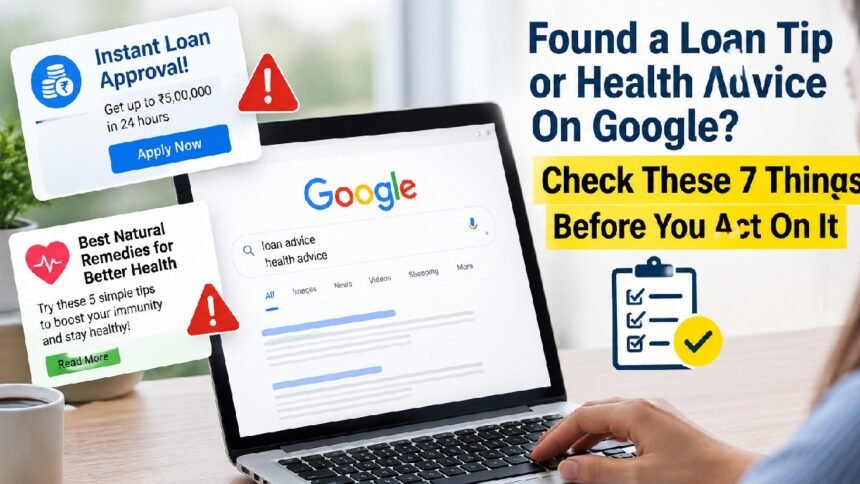
Google emphasizes people-first content, while expert Sandeep Amar advises readers to vet online information for authorship, expert review, dates, and sources, especially for crucial finance and health topics, using it as a starting point.

Google recently updated its guidance for website owners, emphasizing the importance of helpful, reliable, people-first content. The guidance highlights expertise, originality, accuracy, and appropriate human review, particularly when AI tools are used during content creation.
For readers, these principles can also serve as a useful checklist before acting on information that could affect their finances or health.
“If an article about your money or your health does not tell you who wrote it and who checked it, treat it as a starting point for further research rather than the final answer,” says Sandeep Amar, SEO and AEO Top expert.
1. Find out who wrote it
One of the simplest checks is to look at the author’s profile.
“Click on the author’s name,” Amar says. “A real writer usually has a profile, a publishing history, or a professional presence that helps readers understand their background and expertise.”
A transparent author page can provide useful context about the source of the information.
2. Look for expert review
For subjects such as finance, insurance, taxation, or health, expert review can add an extra layer of confidence.
“For a loan, tax or insurance article, it helps to see whether a qualified financial professional has reviewed the content,” Amar says. “For health-related topics, readers may look for evidence that a medical professional has reviewed the information.”
3. Check the date-and the details
Information can change quickly, especially in areas such as interest rates, regulations, taxes, and healthcare guidance.
“An updated date is helpful, but readers should also look at the figures and recommendations themselves,” Amar says. “A strong article makes it clear that important information has been checked and remains current.”
4. See where the facts come from
Reliable content often cites authoritative sources.
“Good articles show readers where the information comes from,” Amar says. “Government agencies, regulators, hospitals, research institutions, and published studies can all help readers verify important claims.”
Checking a source directly can provide additional confidence in the information being presented.
5. Look for original value
Not all content offers the same level of insight.
“Ask yourself one question: what does this article add?” Amar says. “Original research, practical examples, expert analysis, useful tools, or firsthand experience often provide value that goes beyond a simple summary.”
Google’s guidance similarly highlights the importance of originality and unique contributions.
6. Be careful with absolute promises
Many financial and health decisions depend on individual circumstances.
“AI and modern publishing tools can produce content very quickly,” Amar says. “That makes it even more important for readers to focus on evidence rather than confidence. When it comes to money or health, there is rarely a one-size-fits-all answer.”
Readers may benefit from articles that explain limitations, risks, and different scenarios rather than offering universal guarantees.
7. Ask why the page exists
Understanding the purpose of a page can help readers evaluate it more effectively.
“A bank can publish a useful article about home loans, and a healthcare company can publish helpful health information,” Amar says. “The important thing is transparency. Readers should be able to understand whether the content is purely informational, connected to a product, or both.”
What this means for readers
As online information continues to expand, readers have access to more knowledge than ever before. At the same time, taking a few moments to evaluate the source, expertise, and evidence behind an article can make that information even more valuable.
“Google is encouraging publishers to demonstrate expertise, accuracy, and transparency,” Amar says. “Readers can benefit from looking for those same qualities when deciding how much weight to give any piece of content.”
For important decisions involving finances or health, online information is often best viewed as a starting point. Confirming key details with a qualified professional, official source, or trusted institution can help ensure that decisions are based on the most accurate and up-to-date information available.
Sources: Google Search Central guidance on helpful, reliable, people-first content and guidance on the use of generative AI in content creation.