



India
oi-Pankaj Mishra

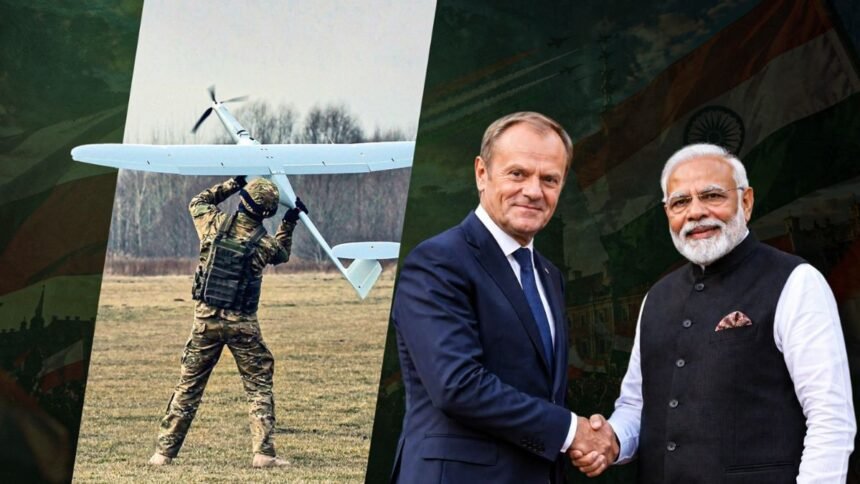
When Polish Prime Minister Donald Tusk arrived in India on October 21, the political talks were expected to draw the headlines. Yet the India-Poland Business Forums-in New Delhi on October 22 and Bengaluru on October 23-may say more about where the relationship is heading. Tusk arrived with Finance and Economy Minister Andrzej Domański and around 100 companies, one of Poland’s most significant business delegations to India in recent years.

Polish Prime Minister Donald Tusk led a significant business delegation to India to boost bilateral trade, reaching US$6.36 billion in 2025, and investment, focusing on sectors like defence and space to address current economic imbalances.
The trade figures are healthy enough. Bilateral trade reached US$6.36 billion in 2025, up about 9.6 per cent, and Poland remains India’s largest trading and investment partner in Central and Eastern Europe. But the flows are lopsided. Polish data put 2025 trade at €5.68 billion: Polish exports to India of €1.37 billion against imports from India of €4.32 billion.
Investment is where the gap is starkest. Polish investment in India stands at around US$750 million, placing Poland roughly 35th among foreign investors. Poland’s Ambassador to India, Piotr Świtalski, has said plainly that he is not satisfied with that figure. He also reports signals that several Polish companies are ready to invest significantly. Investment in the other direction is far heavier. Tata Consultancy Services, Infosys, HCL Technologies, Wipro, Uflex and Glenmark are among the Indian companies operating in Poland, and Indian IT firms alone employ nearly 10,000 Polish professionals.
Some of the reasons are structural. Distance and unfamiliarity play a part, and so does caution over sensitive technology. Świtalski has acknowledged that some Polish companies worry about technology reaching Russia. He argues that firms need agreements on classified information, backed by a clear political signal from the top, before they will feel confident.
The tailwinds, however, are strong. Poland has crossed the US$1 trillion mark to become the world’s 20th-largest economy. The India-EU free trade agreement, concluded in January after almost two decades of negotiation, is due to be signed by the end of the year and could enter into force in 2027. A separate investment protection agreement is still pending. The two countries’ economic committee met in New Delhi in July for the first time in many years, and Warsaw has set its sights on bilateral trade of at least US$10 billion.

The sectors on the table are broad. Świtalski lists defence, space, artificial intelligence, green and hydrogen energy, food processing, agriculture and deep mining. Domański adds machinery, and says Poland is doubling its investment in the space industry and will bring its space companies to India.
Defence may be the quickest route from intention to investment, because India has built the infrastructure to receive it. The Uttar Pradesh Defence Industrial Corridor spans six nodes: Kanpur, Lucknow, Jhansi, Chitrakoot, Aligarh and Agra. It has attracted investment proposals worth nearly ₹40,000 crore, led by Kanpur and Jhansi. Its investors include Adani Defence, BrahMos Aerospace, Bharat Dynamics and HAL, and the state government aims to raise defence investment to nearly ₹1 trillion.

One Polish company already shows how this can work. WB Electronics India Pvt Ltd, popularly known as WB India, is a joint venture with the Poland-based WB Group in which the Indian partner holds the majority stake. The Indian Army first bought the group’s Warmate loitering munition under emergency procurement. A production line is now under development in the Uttar Pradesh corridor. The company says it will redesign its systems around Indian components wherever they meet performance requirements.
The commitment goes beyond a factory. WB India’s chief executive has spoken of investing in infrastructure and working with Indian industry and academia to source components and tap the country’s engineering talent.
Equally significant is how WB sees India. WB Group’s president, Piotr Wojciechowski, describes the country not only as a market but as “a big industrial partner for our production”. He has said the group’s Indian investments are meant to serve other countries as well as India. That matters to New Delhi, which recorded defence exports of ₹38,424 crore in 2025-26. India wants foreign partners that help it sell abroad, not merely sell to it.
The business forums will test whether others in the delegation see India the same way. The template is now visible: sell, prove the product in Indian conditions, then build locally with an Indian partner. If more Polish firms follow it, the investment gap may close faster than the numbers suggest.