



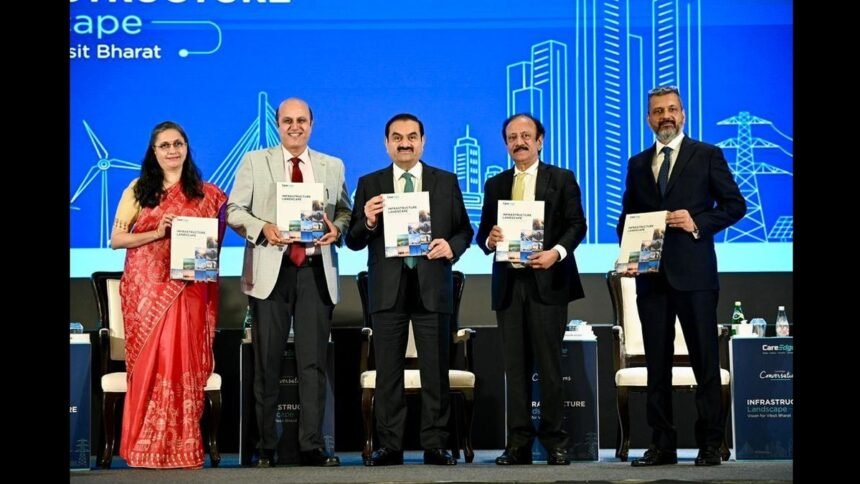
Gautam Adani calls for a comprehensive, platform-focused Credit Framework to assessIndia’s transformational infrastructure. He highlights Mundra, Vizhinjam and Khavda as examples where ecosystem effects and national scale demand new rating approaches, extending beyond traditional asset-based models.
India
-Oneindia Staff

Adani Group Chairman Gautam Adani on Monday called on CareEdge Group to develop what he described as the world’s first comprehensive Credit Framework for Integrated Platform Infrastructure, arguing that India’s transformational infrastructure projects can no longer be adequately assessed through conventional financial models.

Speaking at the CareEdge Group Annual Summit in Mumbai on August 31, 2026, Adani said that while existing rating frameworks were designed for an era when infrastructure evolved incrementally and asset boundaries were clearly defined, India’s infrastructure landscape had fundamentally changed — and the tools used to assess it must change alongside. “India does not need lower standards. India needs wider lenses,” he said, addressing rating analysts, economists and financial professionals gathered at the event.
Gautam Adani calls for a comprehensive, platform-focused Credit Framework to assessIndia’s transformational infrastructure. He highlights Mundra, Vizhinjam and Khavda as examples where ecosystem effects and national scale demand new rating approaches, extending beyond traditional asset-based models.
Adani noted that the Adani Group’s relationship with CareEdge Group spans nearly two decades, with the association now covering more than ₹3 lakh crore of rated assets across 100-plus entities.
Against this backdrop, he framed a central challenge for credit rating institutions: how can the frameworks used to measure India’s risks also be capable of recognising India’s possibilities?
He said the traditional approach — typically built on siloed, single-asset discounted cash flow models — prices risk by isolating an asset from its environment. That approach, he argued, misses the broader economic compounding that defines platform-scale infrastructure.
*Three types of infrastructure — and where frameworks fall short*
Adani drew a distinction between three categories of infrastructure. Replacement infrastructure — expanding or maintaining existing assets — is well served by established rating approaches. Growth infrastructure, where capacity is added in sectors with visible demand, requires frameworks that go further to capture ecosystem effects and multiplier value.
The third category, which he called platform infrastructure, is where he believes the most significant gaps exist. These are assets that do not simply satisfy existing demand — they create new demand, new ecosystems and new capabilities.
He illustrated this with three examples from the Adani Group’s own portfolio.
*Mundra: From marshy coastline to commercial gateway*
Mundra Port in Gujarat, now India’s largest port, was developed on what he described as a marshy coastline with no industrial ecosystem and speculative demand from customers that did not yet exist. A conventional rating assessment at the time, he said, would have seen only execution risk and unverifiable cash flow assumptions.
Three decades later, Mundra is a port connected to rail, logistics centres, power plants and industrial zones serving traders and manufacturers across India. “Mundra proved that platform infrastructure operates as a multi-layer network where each new layer cross-subsidises, feeds and de-risks the other, creating an economic compounding flywheel that linear financial models mostly fail to capture,” he said.
*Vizhinjam: The cost of not building*
At Vizhinjam International Seaport in Kerala, Adani pointed to a different kind of risk — the risk of inaction. For decades, India had to tranship its container cargo through Singapore, Dubai and Colombo, effectively paying what he called “a direct sovereignty tax to foreign ports” because domestic infrastructure was considered too risky for institutional capital.
Vizhinjam was strategically compelling but appeared unprofitable when measured through conventional financial tests. Tender after tender failed over 25 years. The Adani Group built it regardless, and within 18 months of opening it had become the fastest Indian port to handle two million TEUs.
“Conventional credit models correctly measure execution risk. But in strategic infrastructure, we must also learn to recognise the economic value of sovereign resilience,” Adani said. “The greatest risk was never in building Vizhinjam. The greatest risk was India continuing to believe that it could not.”
*Khavda: Where energy meets AI*
The third example was Khavda in the Rann of Kutch in Gujarat, where the Adani Group is building a 30-gigawatt renewable energy platform. Viewed through a traditional framework, he acknowledged, Khavda presents extreme isolation, harsh terrain, execution risk and uncertain demand.
But Adani argued that measuring Khavda purely as a power project misses its larger significance. He described it as a platform where energy, artificial intelligence, manufacturing and digital infrastructure converge — a potential foundation for India’s AI economy and compute infrastructure.
“Measured simply as a power project, Khavda will be underrated for decades. But when measured as a transformational platform, it will be one of India’s most important strategic assets,” he said.
*AI runs on infrastructure*
Adani connected the platform infrastructure argument directly to artificial intelligence, noting that while algorithms, models and software will continue to evolve, AI at scale ultimately requires electrons, data centres, cooling, transmission networks, land and clean reliable energy in enormous volumes.
“The competitive advantage in AI may ultimately lie not only in who writes the best code but also in who can build the infrastructure that allows intelligence to scale,” he said, adding that assets like Khavda must therefore be understood as foundational infrastructure for the AI economy.
*A challenge to CareEdge*
In closing, Adani placed a direct challenge before the CareEdge Group leadership, asking why the world’s first truly comprehensive Credit Framework for Integrated Platform Infrastructure should not originate from India, and why CareEdge should not lead the effort.
The proposed framework would evaluate multi-dimensional infrastructure, recognise ecosystem multipliers and adjacency value, and could — he suggested — become a benchmark for emerging economies worldwide if developed in India.
He was clear that the proposal carries no implication of lower standards or compromised independence. “I am not asking you to compromise your independence or say yes to unviable ambition. I am asking you to use your independence to build dynamic models that recognise the compounding power of national platforms.”
Adani concluded by reflecting on three decades of building infrastructure, saying the true measure of what is built is rarely captured in financial statements alone. “The real measure is found in the lives transformed,” he said. “A rating is not just a letter or a number. It is a judgement of trust.”