


International
oi-Swastika Sruti

Pakistan PM Shehbaz Sharif confirmed his signing of the Mecca Agreement for Joint Defence along with Saudi Arabia and Turkey.

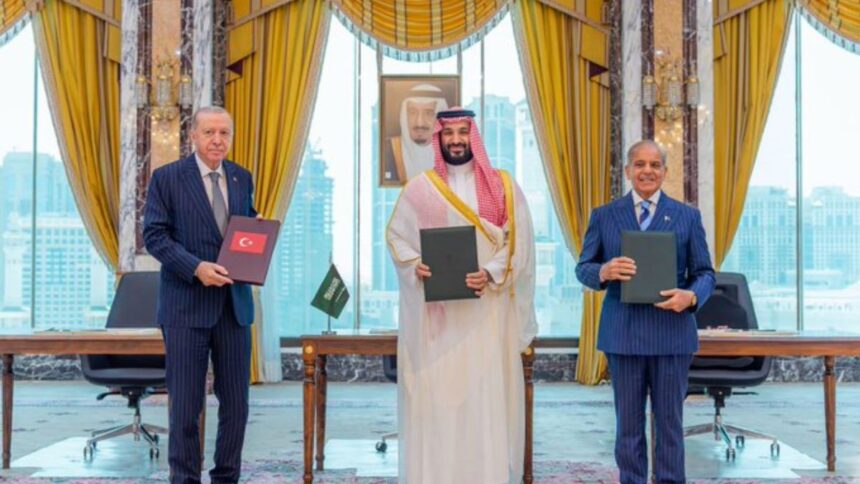
Pakistan, Saudi Arabia, and Turkey have signed the Mecca Agreement for Joint Defence, a trilateral pact aimed at enhancing regional peace and security, reportedly treating an attack on one as an attack on all three.
Posting on X he stated, “Today, I had the honor of signing the Mecca Agreement for Joint Defense alongside my two dear brothers, His Royal Highness Prince Mohammed bin Salman bin Abdulaziz Al Saud, Crown Prince and Prime Minister of the Kingdom of Saudi Arabia, and His Excellency President Recep Tayyip Erdoğan, President of the Republic of Turkey.”
“This historic agreement embodies the unity of three brotherly countries, bound by ties of faith and deep-rooted brotherhood, united by a sincere will and shared vision to strengthen the foundations of peace, security, and stability, and to safeguard the interests of their peoples and serve their nation,” he added.
He further said, “I ask Almighty God to make this blessed agreement, concluded within the precincts of the Two Holy Mosques, an impregnable fortress for peace, a pillar of stability, and a beacon of cooperation and integration among our brotherly countries across generations, and to bless its fruits, so that it may be a cause of greater prosperity and flourishing for the peoples of our three countries, and goodness and benefit for the entire Islamic nation. I also wish to express, in particular, my deepest appreciation and profound gratitude to Field Marshal Syed Asim Munir, whose tireless efforts, steadfast sincerity, and exceptional dedication had a profound impact on the success of this historic endeavor, and on transforming this shared vision into a reality that serves the interests of our homelands and enhances the security and stability of our region.”
تشرفت اليوم بالتوقيع على اتفاقية مكة للدفاع المشترك إلى جانب أخوي العزيزين، صاحب السمو الملكي الأمير محمد بن سلمان بن عبدالعزيز آل سعود، ولي العهد ورئيس مجلس الوزراء في المملكة العربية السعودية، وفخامة الرئيس رجب طيب أردوغان، رئيس جمهورية تركيا.
ويجسد هذا الاتفاق التاريخي وحدة… https://t.co/QR9ZubeVpY
— Shehbaz Sharif (@CMShehbaz) August 7, 2026
What is the agreement about?
A reported Mecca Joint Defence Agreement involving Saudi Arabia, Pakistan and Turkey has drawn attention because of one central claim: that an armed attack on one signatory would be treated as an attack on all three. If implemented in that form, the pact would mark a notable shift in West Asia’s security politics and place Pakistan more firmly inside the Gulf’s evolving defence architecture.
The agreement has been described as a trilateral defence understanding signed by Saudi Crown Prince Mohammed bin Salman, Turkish President Recep Tayyip Erdogan and Pakistan Prime Minister Shehbaz Sharif. Full treaty details have not been made public, which means its military scope, legal triggers and operational commitments remain unclear. That uncertainty is important, especially as comparisons with Nato’s Article 5 have quickly gained ground.
WATCH: THE MOMENT PAKISTAN, SAUDI ARABIA & TURKEY SIGNED THE NEW MECCA TRILATERAL DEFENSE AGREEMENT pic.twitter.com/NL2NJGRzxd
— Sulaiman Ahmed (@ShaykhSulaiman) August 7, 2026
However, there is still no public evidence of an integrated command, permanent joint force, common military budget or formal alliance secretariat. Without those elements, the agreement is better understood as a strategic framework rather than a finished “Islamic Nato”. Its real weight will depend on what the three governments build after the signing.
Why Saudi Arabia, Pakistan and Turkey matter together
The three countries bring different assets to the table. Saudi Arabia is the financial and geopolitical centre of the grouping. It is among the world’s largest defence spenders and sits close to the Red Sea, Persian Gulf, Bab el-Mandeb and Strait of Hormuz, all critical to global energy and trade flows.
Turkey adds defence technology and Nato experience. Its military industry has grown sharply over the past decade, particularly in drones, armoured vehicles, naval platforms and missiles. Turkish systems have been used or exported in several conflict zones, giving Ankara influence beyond its immediate neighbourhood.
Pakistan’s role is different but equally significant. It has one of the world’s largest standing armies, deep experience in conventional and counter-insurgency operations, and a long military relationship with Saudi Arabia. It is also the only Muslim-majority nuclear weapons state, although the reported trilateral pact has not been shown to include any nuclear-sharing arrangement or formal nuclear umbrella.
Together, the three form a potentially powerful combination: Gulf capital, Turkish defence production and Pakistani military manpower. That is why the agreement is being watched beyond West Asia, including in New Delhi, Tehran, Tel Aviv and Washington.
Iran, Israel and the changing Gulf security order
The timing is central to the pact’s significance. West Asia has been under intense pressure from the Gaza war, Iran-Israel tensions, attacks on shipping routes and fears of wider conflict around the Gulf. Gulf monarchies have also questioned whether the United States remains willing to act as the region’s unquestioned security guarantor.
For Saudi Arabia, a wider defence network offers insurance. Riyadh restored diplomatic relations with Iran in 2023 through Chinese mediation, but the rivalry has not disappeared. Missile capabilities, proxy groups, maritime security and regional influence remain serious points of competition between Saudi Arabia and Iran.
Is This A Military Threat To India?
For India, the pact is not an immediate military threat. New Delhi has strong ties with Saudi Arabia and the United Arab Emirates, growing engagement with West Asian states, and a long-standing strategic partnership with Israel. India also maintains careful diplomatic channels with Iran, especially because of energy, connectivity and regional stability concerns.