



India
oi-Madhuri Adnal

The Jharkhand government on Tuesday night cancelled 44 recruitment examinations after months of complaints and protests over alleged irregularities in the state’s recruitment process.
In eight notifications issued late at night, the government said the cancelled exams included those conducted by the Jharkhand Public Service Commission (JPSC) and outsourced agency TSR Data Processing Pvt Ltd (TDPL) since 2014.
Jharkhand cancelled 44 recruitment exams, including JPSC and JSSC tests since 2014, due to alleged irregularities and protests, and is seeking a fast-track court for related cases.

The list covers several important government recruitments, including posts such as drug inspectors, assistant professors, deputy collectors, dental doctors, assistant engineers, civil judges, additional public prosecutors and forest range officers.
Other cancelled exams include recruitment for drug inspectors, lecturers in government polytechnics, senior scientific officers, deputy collectors, dental doctors, assistant engineers, civil judges, additional public prosecutors and forest range officers and several other administrative and technical posts.
The government has also decided to ask the High Court to set up a fast-track court to hear cases linked to alleged irregularities in JPSC and JSSC examinations. An internal vigilance cell will also be set up in the two commissions.
A committee headed by senior IAS officer Amitabh Kaushal, which was formed to suggest reforms in JPSC and JSSC, has been given two months to submit its report.
The decision follows Monday’s Cabinet meeting, where the government cancelled the JSSC Combined Graduate Level (CGL) examination. Scrapping the CGL exam was one of the main demands of the protesting students. The government also cancelled all examinations conducted by TDPL and the results published by the agency.
But the decision has created another problem for candidates who had already cleared the JSSC-CGL exam and secured government jobs. More than 2,000 successful candidates, who are now working in different state government departments, fear that they could lose their jobs. They recently marched from the state secretariat to Birsa Chowk in Ranchi, asking the government to protect their appointments.
The government’s action comes against the backdrop of a growing student movement in Jharkhand. For months, aspirants preparing for JPSC and JSSC examinations had been complaining about delays, irregularities and uncertainty around recruitment.
The issue came to a head over allegations that the JSSC-CGL examination had been compromised through a paper leak. For candidates who had spent years preparing for government jobs, the allegations were deeply frustrating. Many had appeared for exams more than once and spent years waiting for recruitment. The possibility that an examination could be compromised raised fears that all that preparation and effort could go to waste.
The anger in Jharkhand grew at a time when examination irregularities had already become a major issue among young job aspirants across the country. The youth-led Cockroach Janta Party (CJP) agitation in Delhi’s Jantar Mantar had brought the issue into the national spotlight. Jharkhand aspirants said they were inspired by the Delhi protest and its mobilisation around examination-related grievances.
There was a common thread running through both agitations: young job aspirants demanding a recruitment process they could trust. While the CJP protest in Delhi gave voice to these concerns on a wider scale, Jharkhand’s students focused their anger on the alleged JSSC-CGL paper leak and repeated recruitment problems.
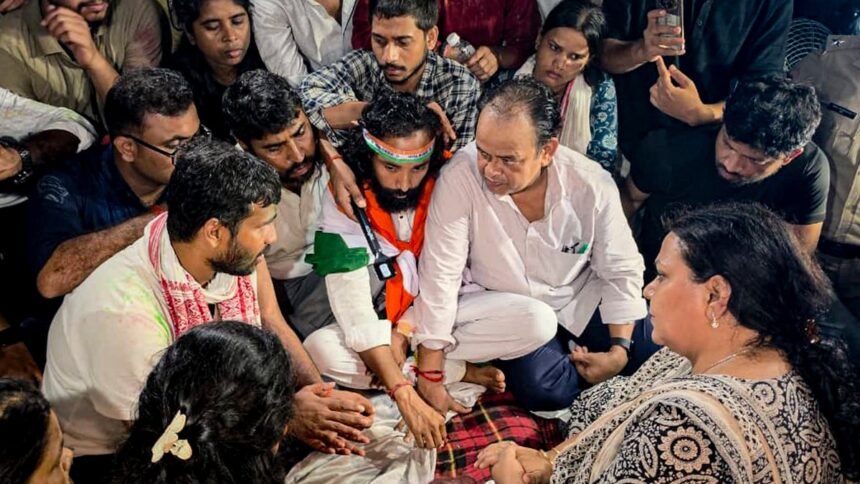
The Jharkhand protest started from July 29, where the aspirants had started a sit-in at Ranchi’s Jaipal Singh Munda Stadium. They were seeking action against alleged irregularities in the examination process and demanding a recruitment system they could trust. For the protesting candidates, the expectation was simple. They wanted government exams to be conducted fairly and without irregularities.
The protest later gained political support, and student leader Devendra Nath Mahto went on an indefinite hunger strike on August 2, adding to the pressure on the government.
The two protests began over different issues, but both were driven by frustration among students and exam aspirants over problems in the examination system. In Jharkhand, the anger was focused on the alleged JSSC-CGL paper leak and wider concerns over irregularities in state recruitment.