



In The News
-Sathish Raman


For more than two decades, a central question has haunted the landscape of digital public governance: can an electronic tendering system be genuinely secure, transparent, and resistant to manipulation? While governments globally rushed to adopt technology as a cure-all for corruption, one man saw the danger early on. He realized that moving from paper to pixels did not banish old evils; it merely gave them a new, invisible place to hide.
Discover Jitendra Kohli’s two-decade battle exposing critical flaws in e-procurement systems. This expert’s relentless pursuit of transparency, from IIT Delhi to international recognition and legal vindication, reveals how he built safeguards against corruption, ensuring public procurement integrity. His story is a must-read for anyone concerned about digital governance.
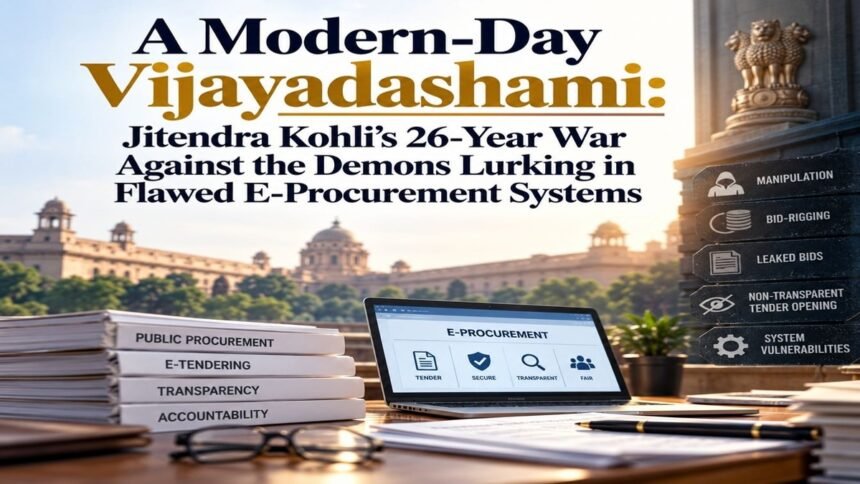
For Jitendra Kohli, a public procurement and e-procurement specialist, exposing these system vulnerabilities has been a 26-year crusade. It is a modern-day Vijayadashami saga—a relentless war to unmask and slay the “demons” lurking deep within the flawed architecture of electronic government procurement systems.
Looking Beneath the Software
An IIT Delhi graduate in Electrical Engineering, Kohli began his career with Larsen & Toubro in 1976 and joined HCL in 1980. Over the next two decades, he held senior positions in IT and telecom, established a strategy management consultancy, and managed India-entry assignments for tech giants like Apple and Compaq. He also served as the General Editor of The Business Guide to India , a handbook on foreign investment published in 1996 by Butterworth-Heinemann (UK/Singapore). This cross-disciplinary exposure to high technology, corporate strategy, and complex government tendering gave him a unique vantage point. He knew exactly how digital systems worked—and exactly how they could be subverted.
In March 2000, Kohli established ElectronicTender to research the security, confidentiality, transparency, and integrity of electronic procurement, and to develop solutions with ‘unquestionable integrity.’ During this process, he discovered vulnerabilities in the design of e-procurement systems that could be exploited by unscrupulous elements. His mission was rooted in the public interest. So, rather than quietly commercializing his findings for higher financial gains, he chose to share his groundbreaking research on generic vulnerabilities with vigilance authorities so that preventative measures could be taken. Building the enterprise brought massive challenges, from funding constraints to protecting specialized know-how, but Kohli persisted with stoic resilience.
His engagement with India’s vigilance authorities began in 2000 and escalated in 2007. Kohli refused to get sidetracked by isolated instances of malpractice. Instead, he targeted systemic flaws, and focused on generic vulnerabilities in bid-sealing, encryption, and electronic tender-opening procedures—loopholes that compromised bid confidentiality and transparency across entire networks.
His guiding principle was uncompromising: electronic procurement must match or exceed the security and transparency of established manual procedures. Yet, the reality he uncovered was alarming. Most e-procurement systems fell dangerously short of the integrity maintained by traditional paper methods. The technology itself wasn’t the enemy; the demon was embedded in the flawed design, allowing bad actors to manipulate outcomes behind a digital screen.
From Vigilance Work to International Recognition
In 2008, Admiral (Retd.) R. H. Tahiliani, then Chairman of Transparency International India (TII), invited Kohli to contribute his unique expertise to strengthen public procurement integrity. Kohli continued this vital work under the tenure of Justice (Retd.) Kamleshwar Nath. One of the landmark outcomes during this period was the e-Procurement Integrity Matrix (EPIM)—a platform-neutral framework created to identify generic vulnerabilities, leaving it to the creativity of individual solution developers to address the lacunae and fortify the digital security and accountability of their respective systems.
In 2010, the EPIM underwent independent technical validation by a panel of internet-security experts led by N. R. Narayana Murthy, then a member of the Central Vigilance Commissioner’s (CVC) vigilance advisory council. Recognizing its value, the CVC forwarded the matrix to the Ministry for further consultation, and the framework ultimately served as an important reference for the Government’s official e-procurement guidelines issued in 2011.
Soon, Kohli ’s battle against these digital vulnerabilities gained international traction. At a 2012 conference (IPPC5) in Seattle, European Union delegates took a keen interest in his research. Subsequently, the European Commission-appointed e-Tendering Expert Group’s 2013 report directly addressed the exact concerns Kohli had spent years highlighting, particularly regarding tender confidentiality and opening.
Between 2011 and 2012, the Asian Development Bank commissioned him to peer-review the Multilateral Development Banks’ e-Procurement Toolkit. He went on to present papers at successive international public procurement conferences, and in 2016, was invited to serve on the Scientific Committee of IPPC7. His academic and advocacy work has remained unbroken, stretching all the way to his research presented at IPPC9 in 2024.
Breaking Language Barriers Safely
As part of his mission to make public procurement truly transparent, Kohli recognized another systemic flaw: language exclusion. He expanded his work to develop comprehensive multilingual e-tendering, enabling buyers to invite and receive bids in native official regional languages alongside English. Under this system, for example, an International Solar Alliance tender could seamlessly support French, Spanish, or Arabic, while an Indian state could operate in its native regional language alongside Hindi and English.
The impact of this innovation goes far beyond mere translation; it democratized the process, allowing smaller, local suppliers with limited English proficiency to participate directly, effectively cutting out intermediaries. However, designing this system introduced a new technical battleground. To protect the absolute confidentiality of the bids, Kohli had to ensure the system bypassed online translation engines or AI-assisted services, which risk leaking sensitive, proprietary bid data to external commercial servers.
Exposing the Demon in the Machine
In 2018, the International Centre for Information Systems and Audit (iCISA)—the international training arm of the Comptroller and Auditor General (CAG) of India—invited Kohli to contribute his insights to its IT-audit journal, PursuIT . His articles, published under the “Audit Aids” section, provided practical blueprints for auditors attempting to police digital spaces.
He crystallized this methodology in his 2024 IPPC9 research paper, boldly titled “Ensuring ‘Unquestionable Integrity’ in E-Procurement / E-Tendering Systems for Public-Procurement – A Challenge for Supreme Audit Institutions.”
The core thesis of his paper perfectly encapsulates his 26-year war: digitizing a manual process does not by itself eliminate malpractice. Cartels, bid-rigging, and non-transparent openings thrive in the digital darkness unless the underlying software incorporates rigid, unalterable checks and balances. Kohli proposed a definitive model framework enabling Supreme Audit Institutions worldwide to evaluate whether an e-procurement system is truly secure or secretly compromised.
This marked a profound progression in his career. The early years were defined by a warning: where is the system vulnerable? The later years evolved into an operational solution: how can an independent auditor check that a system is operating with absolute integrity?
The Personal Cost and Ultimate Vindication
Slaying institutional demons rarely comes without a heavy personal cost. Kohli’s long crusade took a dark, unexpected turn in 2014 following a change in leadership at Transparency International India (TII) and escalating internal governance disputes. Kohli maintains that his aggressive exposure of e-procurement flaws severely threatened vested interests involved in technology-enabled corruption. When his rigorous technical work could not be discredited on its merits, retaliatory, motivated allegations were weaponized against him to tarnish his reputation.
Refusing to back down, Kohli launched civil defamation proceedings against TII in January 2015 in the High Court of Delhi. On July 25, 2026, after an exhausting, more than eleven-year legal battle, the District Court at Saket, New Delhi, delivered a resounding judgment in Jitendra Kohli v. Transparency International India & Others .
The Court vindicated Kohli on all counts. It ruled that the internal enquiry committee set up against him was entirely illegal, unauthorized, and conducted in direct violation of TII’s own rules. Furthermore, the Court held key officials liable for defamation for maliciously circulating the findings of that sham report. Magnifying his professional standing, the Court noted that even the defendants could not dispute Kohli’s stellar credentials, qualifications, or expertise. The court awarded ₹ 10 lakh in damages to be paid to Kohli, while a former TII Board member testified that Kohli’s crusade against e-procurement vulnerabilities perfectly aligned with the core objectives of transparency and accountability.
A Constant Vigil
The grueling litigation was a testament to his resilience, but it does not define his career. Long before the world blindly trusted electronic procurement systems, Jitendra Kohli asked a fundamental question: what happens to public accountability when the physical safeguards of sealed wax envelopes and public, eyewitness tender-openings are transferred to invisible lines of code?
On this Vijayadashami, as his 26-year battle secures both legal vindication and global technical consensus, his core proposition remains an essential truth for modern governance: public procurement can never rely on blind faith in technology alone. Integrity is not automatic; safeguards must be visibly built into the system design, demonstrable in daily operations, and subject to independent, rigorous verification. The demon only wins when we stop looking inside the machine.