Feature
oi-AK Khan

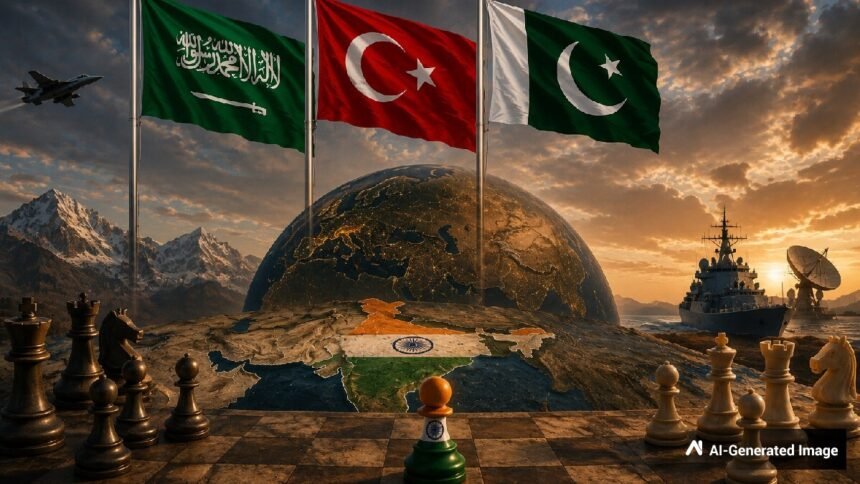
Saudi Arabia, Turkey and Pakistan signed the Makkah Joint Defence Agreement on August 7, committing to a framework of collective defence in which an armed attack against one would be treated as an attack against all. Turkey’s defence minister has described the arrangement as technically comparable to NATO’s Article 5 principle.

Saudi Arabia, Turkey, and Pakistan signed the August 7 Makkah Joint Defence Agreement, establishing a collective defence framework that enhances Pakistan’s strategic position with Saudi and Turkish support, and signals US acceptance of regional security shifts.
Trump has now publicly welcomed the pact, calling it a “big, bold and important first step” and saying it would allow the three countries to defend themselves in a more meaningful way. His endorsement is significant because it signals that Washington is not necessarily viewing the emerging arrangement as a challenge to US interests.
That creates an important strategic complication for India.
Pakistan is no longer the only variable:
For decades, India’s principal security concern has been Pakistan’s military capabilities and its relationship with China. The Saudi-Turkey-Pakistan arrangement potentially adds another dimension: Pakistan could gain deeper access to the military, diplomatic and economic weight of two influential West Asian powers.
Saudi Arabia brings financial and geopolitical influence; Turkey brings a sophisticated defence industry and NATO experience. Pakistan brings a large standing military and nuclear capability.
The three-way arrangement does not automatically constitute an anti-India alliance. There is no evidence that the pact is designed specifically against India. But its collective-defence provision creates a new framework in which Pakistan’s strategic importance to major Muslim powers could increase.
The Council on Foreign Relations, an American think tank focused on US foreign policy, has described the pact as evidence of a wider shift in the Middle Eastern security order, arguing that regional powers are increasingly building arrangements that are less dependent on traditional US-led structures.
For New Delhi, that is the bigger story.
The Turkey factor deserves particular attention:
Turkey’s participation makes the pact more consequential for India.
Ankara already has close defence and political ties with Pakistan. Turkish defence companies have expanded cooperation with Islamabad, while President Recep Tayyip Erdogan has repeatedly taken positions on Kashmir that New Delhi strongly objects to.
A formal collective-defence framework could potentially deepen military interoperability among the three countries.
That does not mean Turkey and Saudi Arabia would automatically support Pakistan in every confrontation with India. Their interests are considerably broader. But the institutionalisation of defence cooperation gives Pakistan another platform through which it can strengthen military and diplomatic relationships beyond its traditional China partnership.
For India, therefore, the question is not whether this pact creates an immediate military threat.
It is whether Pakistan is gradually becoming embedded in a wider network of strategic partnerships.
Saudi Arabia is the most interesting piece of the puzzle:
India has invested heavily in its relationship with Saudi Arabia over the past decade.
Energy remains crucial, but the relationship has expanded into investment, counterterrorism, technology, infrastructure and strategic cooperation. New Delhi has also worked to build stronger relationships with the Gulf as part of its wider West Asia strategy.
That makes Riyadh’s formal defence relationship with Pakistan particularly important for India.
India will have to balance two realities simultaneously- Saudi Arabia remains an important strategic partner for New Delhi, while Saudi Arabia is now entering a defence framework with Pakistan.
The pact therefore need not mean a deterioration in India-Saudi relations. In fact, Riyadh has strong economic reasons to maintain close ties with India.
And then comes Trump:
The most consequential element may ultimately be Washington.
Trump’s endorsement indicates that the United States is comfortable with regional partners taking greater responsibility for their own security.
For India, this raises a larger question: ”is Washington increasingly comfortable with a regional security architecture in which Pakistan has a more prominent role?”
That question matters because India has traditionally benefited from the deepening strategic relationship between New Delhi and Washington.
If Trump’s second-term approach is increasingly transactional and focused on burden-sharing.
The Gaza diplomacy adds another layer:
The timing is also striking.
While Trump is backing the Saudi-Turkey-Pakistan defence arrangement, his administration is simultaneously using Jared Kushner to pursue a new diplomatic push on Gaza.
Kushner held a rare meeting with Hamas political leader Khalil al-Hayya in Egypt and subsequently met Israeli Prime Minister Benjamin Netanyahu as Washington attempted to revive Trump’s 15-point Gaza roadmap. Reuters reported that the talks focused on Hamas disarmament, Israeli withdrawal.
The Kushner-Netanyahu meeting produced optimism but no firm breakthrough. Israel continues to insist that Hamas must be disarmed before an Israeli withdrawal and reconstruction of Gaza, while Hamas has sought Israeli withdrawal and an end to attacks as part of the process.
This matters to India because Saudi Arabia, Turkey and Pakistan are not merely military partners in this emerging equation. They are also important players in the broader political debate over Gaza and the future of the Middle East.
Pakistan has been among the countries involved in regional diplomatic efforts, while Turkey has played a mediating role. Saudi Arabia remains a major Arab power with significant influence over the Palestinian issue.
What should India worry about?:
Three issues deserve close monitoring.
First, defence cooperation- India should track whether the pact moves beyond political symbolism into joint exercises, intelligence sharing, defence production, basing arrangements or coordinated military planning.
Second, Pakistan’s strategic reach- Islamabad could use its relationship with Saudi Arabia and Turkey to expand diplomatic and defence partnerships beyond China. Any transfer of advanced Turkish defence technology or deeper military interoperability would deserve particular attention.
Third, the Gulf balance- India’s strategic relationship with Saudi Arabia and the UAE has become an important pillar of its West Asia policy. New Delhi will need to ensure that Pakistan’s growing role does not erode India’s own strategic space in the Gulf.
The bigger message for New Delhi:
The Makkah pact should not be exaggerated into an “Islamic NATO” aimed at India. The three countries have different strategic interests, and there is currently no indication that the alliance is directed against New Delhi.
But dismissing it as merely symbolic would also be a mistake.
And the simultaneous US effort to negotiate directly with Hamas while engaging Netanyahu demonstrates how Washington is attempting to reshape the political and security architecture of the region rather than simply manage individual conflicts.
For India, the strategic response should therefore be neither alarmism nor complacency.
New Delhi needs to deepen its own relationships with Saudi Arabia, the UAE, Turkey and other regional powers; strengthen maritime security across the Arabian Sea and western Indian Ocean; monitor Pakistan’s military cooperation with Turkey closely; and ensure that India’s growing role in West Asia is not reduced to an economic or energy partnership.