



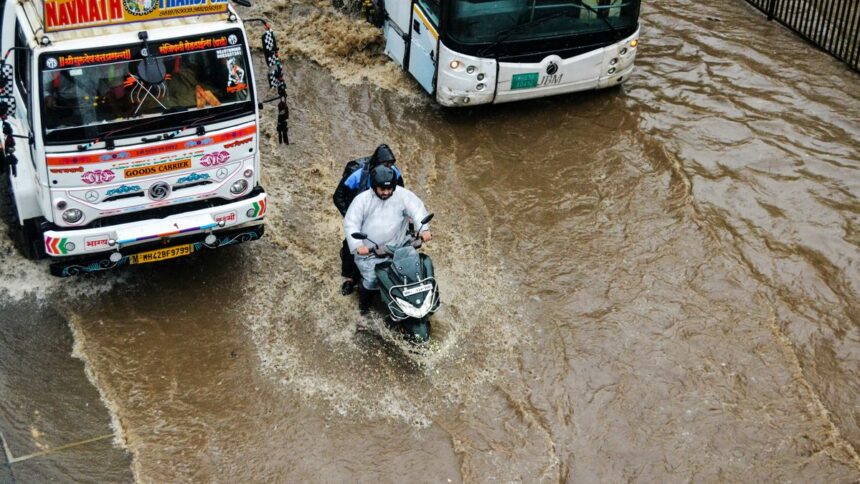
Mumbai
-Prakash KL

Heavy rain in Mumbai has left at least two people dead and pushed civic and emergency teams into high alert, after the city reported building damage, tree falls, short-circuit complaints and localised flooding across several areas. The Brihanmumbai Municipal Corporation said more than 120 rain-related incidents were recorded as intense showers continued over a 24-hour spell.
The latest fatality was reported from Walkeshwar in South Mumbai, where 51-year-old Santosh Ramachandra Bharaskar died after a portion of a third-floor balcony collapsed late on Tuesday. Civic officials said the incident took place around 11.30 pm on Babulnath Road. The building was more than five decades old, according to the BMC.
Heavy rain in Mumbai caused two deaths and over 120 incidents, including building damage and flooding in locations like Mulund and Santacruz, where rainfall exceeded 200 mm, prompting a red alert for the region.

This was the second monsoon-linked death reported in the city within 24 hours. An 11-year-old boy was killed earlier after a tree fell on a school van in Chembur. The two deaths have again highlighted Mumbai’s recurring monsoon risks, especially from ageing structures, unstable trees and sudden waterlogging during intense rain bursts.
Mumbai rain triggers red alert, flooding and emergency calls
The India Meteorological Department issued a red alert for Mumbai and neighbouring Thane, Palghar and Raigad as heavy showers continued over the region. Several low-lying locations, including Andheri, King’s Circle and Gandhi Market, witnessed waterlogging, slowing road movement and raising concerns for commuters during peak travel hours.
According to rainfall data shared by the BMC, Mumbai city recorded 134 mm of rain between 8 am on July 1 and 6 am on July 2. The eastern suburbs received 164 mm during the same period, while the western suburbs recorded 149 mm. Several local weather stations crossed the 200 mm mark.

Mulund was among the worst-hit locations, with Mithagar Municipal School recording 218.6 mm of rain. Santacruz also saw very heavy rainfall, with the SWM Santacruz Workshop recording 216 mm and Nariyal Wadi School reporting 214.4 mm. Powai’s Paspoli Municipal School recorded 208.4 mm, while parts of Mankhurd and Andheri also crossed 200 mm.
| Area | Rainfall recorded |
|---|---|
| Mithagar Municipal School, Mulund | 218.6 mm |
| SWM Santacruz Workshop | 216 mm |
| Nariyal Wadi School, Santacruz | 214.4 mm |
| S Ward Office | 212 mm |
| Paspoli Municipal School, Powai | 208.4 mm |
Why intense rain hits Mumbai so quickly
Mumbai’s monsoon risk is shaped by its geography and dense urban growth. The city receives heavy rain from the southwest monsoon, often in short, intense spells. When high rainfall coincides with high tide, drainage becomes slower in several low-lying pockets. This is why waterlogging can develop rapidly even when rain is concentrated over a few hours.
The latest rainfall pattern also shows how the eastern and western suburbs can receive sharper bursts than the island city. Areas such as Mulund, Powai, Santacruz, Andheri and Mankhurd recorded intense rain during the measured period. These local variations matter because commuting routes, railway access roads and neighbourhood drains can be affected unevenly.

Old buildings are another concern during the season. Mumbai has many ageing residential structures, especially in the island city and older suburban pockets. Prolonged moisture, corrosion, unauthorised alterations and poor maintenance can weaken balconies, parapets and external portions. Civic authorities usually classify dangerous buildings before the monsoon, but local collapses can still occur during heavy rain.