



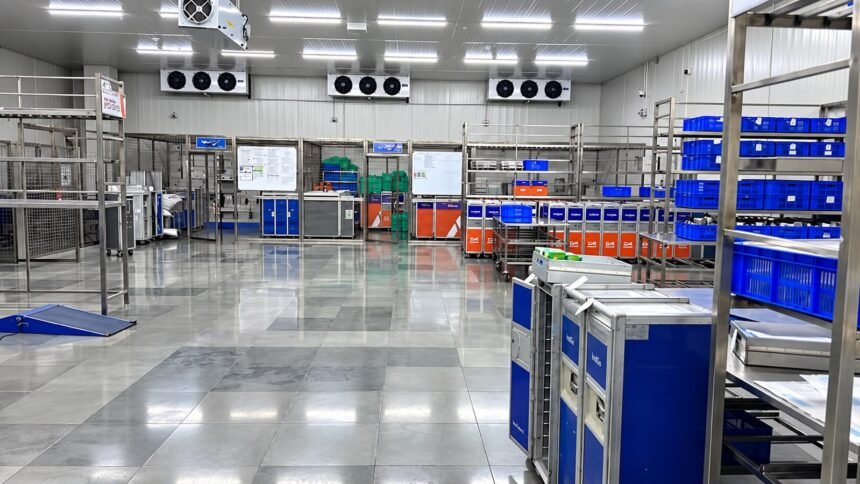
Navi Mumbai International Airport is expanding its catering capacity with a TajSATS flight kitchen, currently serving around 40 departures daily and scalable to 15,000 meals per day. The facility supports both domestic and international airlines ahead of the Winter Schedule 2026-27, emphasising food safety, quality, and efficient meal delivery to flights.
India
-Oneindia Staff

Navi Mumbai International Airport (NMIA) is strengthening its aviation infrastructure ahead of the Winter Schedule 2026-27 with the operationalisation of a dedicated flight kitchen managed by TajSATS.

Navi Mumbai International Airport is expanding its catering capacity with a TajSATS flight kitchen, currently serving around 40 departures daily and scalable to 15,000 meals per day. The facility supports both domestic and international airlines ahead of the Winter Schedule 2026-27, emphasising food safety, quality, and efficient meal delivery to flights.
The facility, located within the airport premises, is currently serving more than 40 departing flights every day and has the capacity to produce up to 7,500 meals daily. The production capacity can be scaled up to 15,000 meals a day as airline operations and passenger traffic increase. The Winter Schedule 2026-27 will be in effect from October 25, 2026, to March 27, 2027.
According to Navi Mumbai International Airport, the TajSATS facility has been designed to cater to the growing requirements of both domestic and international airlines operating from the airport.
The facility combines scalable production infrastructure, modern refrigeration systems and streamlined operational processes to respond to changes in airline schedules and passenger demand. Its location within the airport precinct is also expected to facilitate efficient delivery of meals to departing aircraft.
Subhash Murikenchery, Chief Airport Officer, Navi Mumbai International Airport, said the supporting infrastructure needs to grow alongside the airport’s expanding airline network. “As NMIA expands its airline network, it is important that our supporting infrastructure grows with it. The TajSATS flight kitchen gives airlines the flexibility to meet rising demand and enhances the culinary experience for passengers,” he said.
Catering Support For Domestic And International Airlines
The flight kitchen provides catering services for both domestic and international carriers. For international airlines operating to and from India, the facility offers local meal-uplift capabilities, providing an additional option for managing catering requirements closer to the point of departure.
The airport said around 40 per cent of international carriers operating from India rely on back catering from their own flight kitchens. NMIA’s inflight catering infrastructure has been developed to support this requirement along with the catering needs of domestic airlines. The facility can also cater to diverse dietary requirements, including special meals, allergen-sensitive menus and halal meals.
Focus On Food Safety And Quality
The TajSATS flight kitchen follows food safety and quality requirements, including Hazard Analysis and Critical Control Points (HACCP), ISO 22000 and Food Safety and Standards Authority of India (FSSAI) requirements.
Quality-control processes cover food preparation, handling, storage and dispatch, with the aim of maintaining consistent standards of hygiene, freshness and quality in meals supplied to airlines.
TajSATS has more than four decades of experience in aviation catering and also operates the flight kitchen at Mumbai’s Chhatrapati Shivaji Maharaj International Airport (CSMIA).
With the facility already operational and capable of expanding its production capacity, NMIA is positioning its catering infrastructure to support the next phase of airline connectivity and passenger growth. The airport currently has a production capacity of 7,500 meals per day through the TajSATS facility, with the ability to increase this to 15,000 meals as demand grows.