



India
oi-Swastika Sruti

“As the protest demanding Dharmendra Pradhan’s resignation entered its second consecutive day at Jantar Mantar, Oneindia witnessed moments that could easily have gone unnoticed.”

Students protested at Delhi’s Jantar Mantar for two days, demanding Education Minister Dharmendra Pradhan’s resignation over the NEET exam controversy and alleged paper leaks, using creative slogans and pop culture references to highlight issues of accountability.
A group of young protesters at Delhi’s Jantar Mantar is drawing attention not just for their demands but also for their creativity. As anger over the NEET examination controversy continues, students from different parts of the country have turned to humour, pop culture references, and witty wordplay to express their frustration.
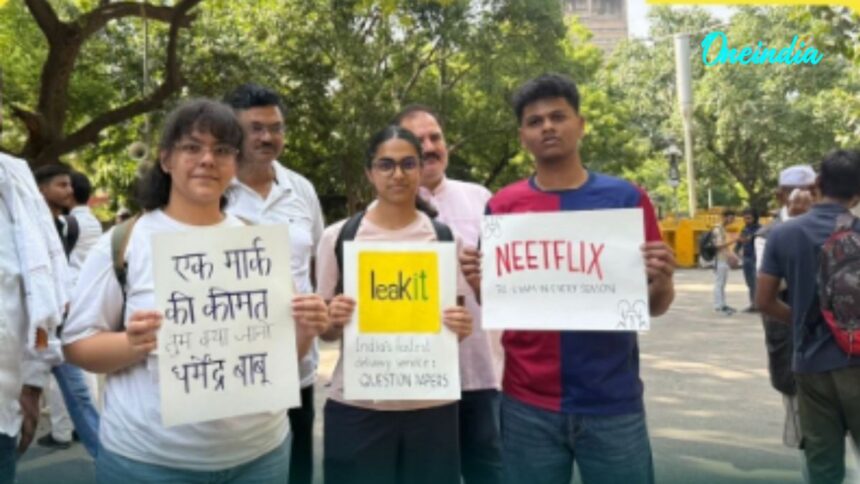
Placards carrying slogans such as “NEETflix: Re-Exam in Every Season,” “Leakit,” inspired by a popular delivery platform, and dialogues inspired by Bollywood films have become the face of the latest protests.
The demonstrations, led largely by students and recent Class 12 graduates, are demanding accountability from authorities over repeated allegations of exam irregularities and paper leaks.
From “NEETFLIX” to “Leakit,” students used satire and creativity to highlight their anger over the NEET paper leak issue and demand accountability.#NEET #NEETUG #NEETLeak #CJPProtest #StudentProtest #NewsUpdate #OI pic.twitter.com/t3w4502hsB
— Oneindia News (@Oneindia) June 21, 2026
Young Voices Lead the Protest
Among the protesters was 17-year-old Riya Mukherjee, who recently completed Class 12. Holding a poster highlighting concerns over marking and evaluation, she said many students had suffered because of what she described as a rushed and unfair process.
According to her, several students lost marks unfairly, while uncertainty surrounding examinations has left many worried about their future.
The protest site saw participation from students across different age groups, many of whom said they were attending such demonstrations for the first time.
‘Students Have Paid the Price’
Another student, Aryaman Dave Sena, said the idea behind the creative posters was to draw attention to an issue that has affected students for years.
He pointed out that concerns about paper leaks have surfaced repeatedly and argued that students have often been left to bear the consequences.
According to him, candidates who had to reappear for examinations or postpone their plans suffered financial and emotional losses, including spending additional money on coaching classes and losing valuable preparation time.
The students also questioned why those responsible for alleged failures in the examination system had not been held accountable.
Social Media Culture Meets Street Protest
One of the most talked-about posters at the protest read “NEETflix: Re-Exam in Every Season,” a play on the popular streaming platform’s name.
Another borrowed a famous Bollywood dialogue and transformed it into a political statement aimed at Education Minister Dharmendra Pradhan.
The colourful posters, featuring black, yellow, and green themes, quickly became popular on social media, where many users praised the creativity of the students.
The protesters said the posters were designed to communicate serious concerns in a way that would capture public attention.
Calls for Greater Accountability
Several students at the protest argued that authorities should take responsibility for repeated controversies surrounding national examinations.
Some protesters questioned why resignations or stronger action had not followed allegations of paper leaks and other irregularities.
The students expressed disappointment with what they saw as a lack of adequate response from the government and mainstream media.
At the same time, many said they remained hopeful that public pressure could lead to meaningful reforms in the examination system.
Could the Movement Spread?
When asked whether the protests could grow into a larger nationwide movement, some participants pointed to demonstrations already taking place in cities such as Bengaluru, Hyderabad, Nagpur, and Pune.
They said students across India were increasingly willing to raise their voices and demand transparency in competitive examinations.
Several protesters noted that many participants had spent nights at protest sites and continued to return despite challenges, which they viewed as a sign of growing public engagement.
A Call for Students to Speak Up
The protesters encouraged students from across the country to participate in peaceful demonstrations and raise concerns about issues affecting education.
While opinions differed on politics and governance, there was broad agreement among participants that students should not remain silent when their future is at stake.
As the protest continued at Jantar Mantar, one message stood out clearly: India’s younger generation is finding new and creative ways to make its voice heard, combining humour, social media culture, and activism to push for accountability in the education system.