


International
oi-Pankaj Mishra

Islamabad says its forces are only supporting Riyadh. But they are now part of a war on Iran’s ally in Yemen, and the balancing act is over.

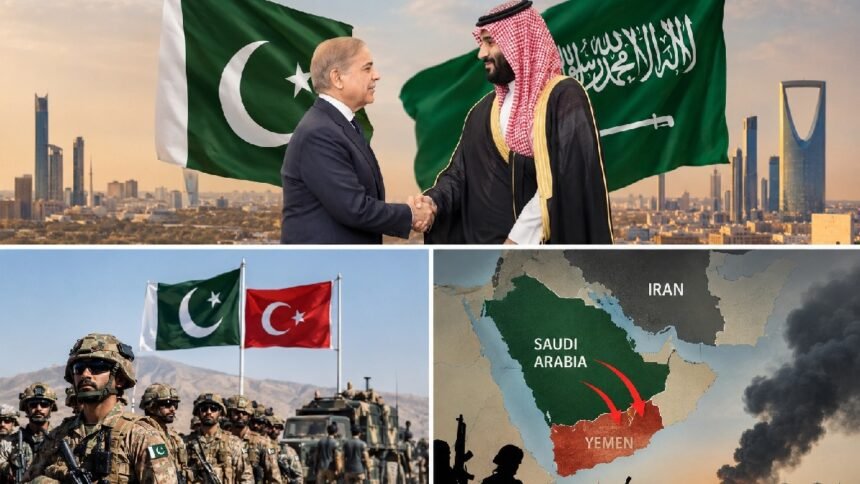
On October 5, Pakistan confirmed its forces are supporting the Saudi-led offensive in Yemen against Iran-backed Houthis through reconnaissance and airpower, ending its mediation role and shifting from neutrality after a defense pact.
Pakistan’s long effort to stand with Saudi Arabia while masquerading as Iran’s friend ended in Riyadh on 5 October. That day, the top committee of the Mecca Joint Defence Agreement agreed to send Pakistani and Turkish forces to the kingdom, which is backing an offensive against Yemen’s Iran-backed Houthis. Hours later, Defence Minister Khawaja Muhammad Asif said Pakistani forces were already at work. “We are definitely involved in reconnaissance and such things,” he said.
Islamabad insists this is not combat. That distinction does not hold. Scouting for an army on the attack and supporting with airpower is part of the attack. The Saudi-led coalition says 100 fighter jets are backing the Yemeni government’s push to retake territory the Houthis seized in September. With Pakistani forces helping to find targets and contributing with airpower for that push, Pakistan is in the fight.
What the Minister Would Not Deny
Asked in Rome on 29 September whether Pakistani forces had joined air strikes in Yemen, Asif declined to answer. He did say that every means Pakistan has would be available to Riyadh. “Any enemy of Saudi Arabia is enemy of Pakistan,” he added.

For Tehran, that enemy is an ally. Javad Heiran-Nia, an analyst with the Persian Gulf Studies Group in Tehran, said Iran can accept Pakistani troops guarding Saudi sites. But a Pakistani role in offensive operations against the Houthis, he said, is a “red line.” On 4 October, Iranian foreign ministry spokesperson Esmaeil Baghaei said he hoped reports of a Pakistani deployment for the war in Yemen were untrue.
Neutral in Name Only
Pakistan was never truly neutral. Its record shows a steady lean towards Riyadh:
- 1967: Pakistan begins training Saudi military personnel. A 1982 agreement formalises the deployment of its troops to the kingdom.
- April 2015: Parliament votes to stay neutral in Yemen, but the same resolution pledges to defend Saudi territory and the holy sites if threatened.
- September 2025: The two countries sign a defence pact treating aggression against one as aggression against both.
- April 2026: Pakistani fighter jets and soldiers arrive at King Abdulaziz air base after Iranian attacks on the kingdom.
- July 2026: A Pakistani official says Islamabad has warned Iran it will treat Houthi attacks on Saudi Arabia as attacks on Pakistan.
- 7 August 2026: Pakistan, Saudi Arabia and Turkey sign the Mecca pact, under which an attack on one is an attack on all three.
Each step was presented as defence. Taken together, they describe an inherent anti-Iran alliance.
The Mediator’s Cover
Pakistan’s other track was its role as go-between. It hosted direct US-Iran talks in Islamabad in April, and Field Marshal Asim Munir, chief of defence forces, travelled to Tehran four times between April and early September.

But the messages now flow one way. On 9 September, Pakistan delivered a Saudi warning to Iran to rein in the Houthis. A country that carries one side’s warnings and supports that side’s army is not a mediator. It is a party to the war.
The Cost of the Double Game
Islamabad’s public line has been unravelling for a month. On 10 September, foreign office spokesperson Sajjad Haider Khan dismissed talk of Pakistani strikes on the Houthis as “hypothetical.” By 5 October, the defence minister was describing Pakistani reconnaissance for a Saudi-backed offensive.
Pakistanis have been told little. Islamabad has not disclosed how many troops are in Saudi Arabia, and the information ministry says the details are confidential. Independent analysts put the figure at around 40,000, with more on the way.
Heiran-Nia said Pakistan’s credibility as a mediator in Tehran is now “highly fragile.”
Pakistan tried to be Riyadh’s ally and Tehran’s friend at once. It is now a supporting player in a Saudi war, and it still calls that defence.