


India
oi-Swastika Sruti

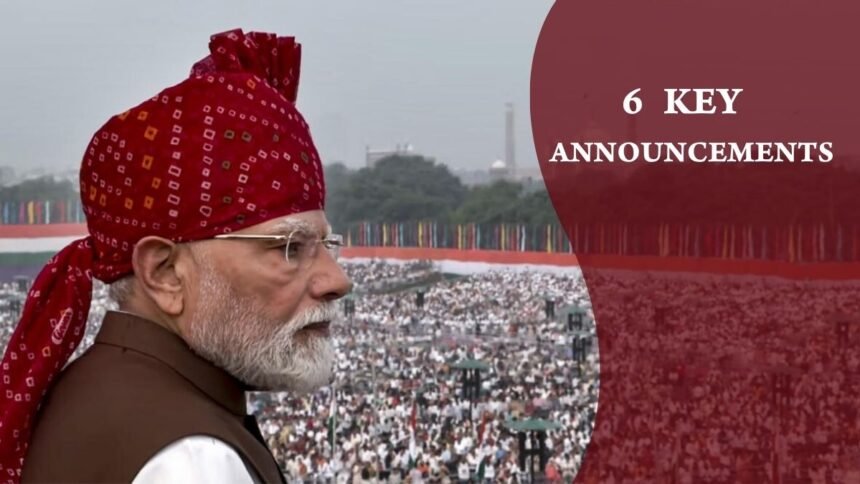
On the 80th Independence day celebration Prime Minister Narendra Modi in his hour long speech announced a series of major initiatives for India’s youth, education, sports, technology, civil defence and energy sectors while addressing the nation from the Red Fort on the occasion of the country’s 80th Independence Day.

Prime Minister Narendra Modi unveiled major initiatives for youth, education, sports, technology, and energy during India’s 80th Independence Day address. Key plans feature AI skills training for 1 crore youth, free online coaching, a nationwide sports talent hunt, expanding semiconductor production, and aiming for 100 GW nuclear capacity by 2047.
The announcements included a plan to provide AI skills to 1 crore young Indians, free online coaching for competitive examinations, a nationwide sports talent hunt and a modern civil defence volunteer network.
The Prime Minister also announced plans to expand semiconductor manufacturing and set an ambitious target of 100 GW of nuclear power capacity by 2047.

1. AI Training For 1 Crore Youth
One of the most important announcements was regarding Artificial Intelligence (AI).
According to PM Modi, the government intends to train one crore youth in AI skills within the year. This is aimed at preparing young Indians to face a technologically-driven world economy and develop skills which they can apply in various sectors.
While addressing the AI Summit in India this year, PM Modi pointed out that Indian youths should have the ability to lead the world in AI.
The program will be targeted at providing youths with access to AI skills.
2. Free Online Coaching For Competitive Exams
Modi PM also announced free coaching through the online mode for various competitive exams.
He mentioned that the cost of coaching classes has become one of the biggest burdens for poor and middle class families where the parents feel compelled to enroll their children into coaching centers.
The government will utilize the available digital infrastructure of India and combine the expertise of teachers along with technology and learning materials to form an online coaching program for the whole country.
It was mentioned that the program will enable the families to save a huge amount of money spent on coaching, and it will enable the students to prepare for the exams at home.
3. Modern Civil Defence Network To Be Created
Reforms to bolster India’s civil defence system have been proposed by the Prime Minister.
The government will build a modern and dynamic civil defence network as well as a huge voluntary group to help in dealing with emergencies in the modern context.
The system proposed by the government will be based on modern training and preparedness, so that the volunteers can help in protecting the citizens from various emergencies.
This initiative has come at a time when governments all over the world are increasingly paying attention to preparedness for emergencies.
4. Nationwide Talent Hunt For Young Sportspersons
Sports was another major focus of the Independence Day address.
PM Modi said India is improving its performance in international sporting events but still has limited participation in several Olympic disciplines.
He noted that the country is a strong contender to host the 2036 Olympics and is scheduled to host the Commonwealth Games in 2030.
To increase India’s participation and performance in international sports, the government plans to launch a nationwide talent identification programme for children aged 5 to 15.
The initiative will aim to identify sporting talent from villages, schools and different parts of the country.
Children identified through the programme will receive specialised training with the aim of developing them into world-class athletes.
The Prime Minister said India wants to participate in at least three-fourths of Olympic events by 2036, compared with its current participation level.
5. India Pushes For More Semiconductor Plants
PM Modi also highlighted semiconductors as a critical part of India’s technology and manufacturing ambitions.
He said chips are essential for a wide range of products, including electronic devices, medical equipment and transportation systems.
According to the Prime Minister, three major semiconductor facilities have already been established in India, with production beginning for exports.
He said India expects five to eight additional semiconductor plants to begin operations in the coming seven to eight years.
The push is aimed at reducing India’s dependence on overseas semiconductor supplies and building a domestic manufacturing ecosystem.
A stronger semiconductor industry could also support electronics manufacturing, electric vehicles, telecommunications, defence technology and other high-tech sectors.
6. India Sets 100 GW Nuclear Power Target By 2047
Energy security was another key area highlighted by PM Modi.
The Prime Minister announced an ambitious target of 100 GW of nuclear power capacity by 2047, saying nuclear energy would play an important role in India’s long-term energy requirements.
He said the government has opened the way for a new nuclear energy framework through the ‘Peace Act’ passed by Parliament.
PM Modi also announced that India aims to commission five new nuclear reactors during the current decade.
He further said India had achieved a major milestone in fast breeder nuclear technology this year, which he described as an important step towards greater self-reliance in nuclear fuel.
From Youth To Technology, A Focus On Future India
PM Modi’s Independence Day announcements covered several areas that are closely linked to India’s long-term development goals.
The AI programme focuses on skills and employment, free online coaching aims to improve access to education, the sports talent hunt seeks to build a stronger Olympic pipeline, while civil defence reforms focus on national preparedness.
At the same time, semiconductor manufacturing and nuclear power are aimed at strengthening India’s technological and energy security.
Together, these announcements reflect the government’s focus on building domestic capabilities while preparing India’s young population for the country’s next phase of growth.
The initiatives also form part of the broader vision of creating a Viksit Bharat by 2047, when India will complete 100 years of independence.