


India
oi-Gaurav Sharma

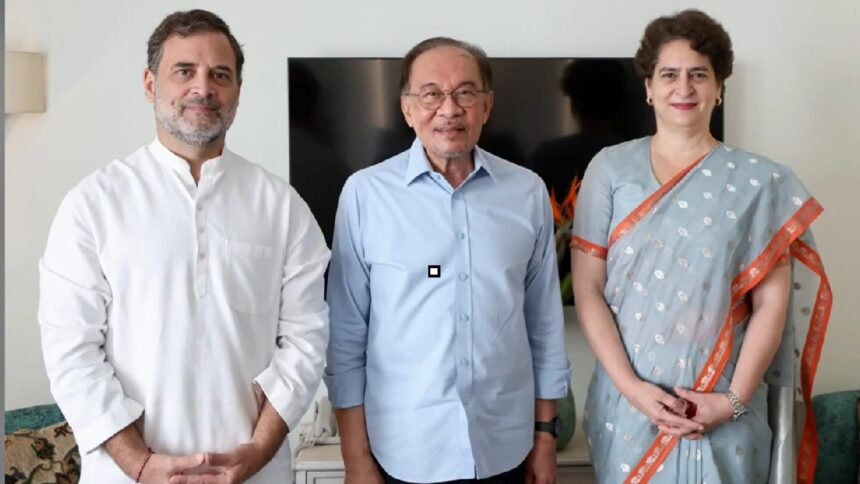
Leader of Opposition in the Lok Sabha Rahul Gandhi met Malaysian Prime Minister Anwar Ibrahim over breakfast in New Delhi on 13 September 2026, in a political interaction that combined current diplomatic context with a personal link to former Prime Minister Manmohan Singh.
Congress general secretary Priyanka Gandhi Vadra was also present at the meeting. The Congress released photographs of the interaction, which took place while Ibrahim is in India for the 2026 BRICS Summit. The party said the discussion touched upon India-Malaysia relations, a relationship that has gained importance through trade, regional cooperation and shared engagement with ASEAN.
Lok Sabha LoP Rahul Gandhi and Priyanka Gandhi Vadra met Malaysian PM Anwar Ibrahim in New Delhi on September 13, 2026, during the BRICS Summit, discussing India-Malaysia relations and Ibrahim’s personal ties and admiration for Manmohan Singh.

Rahul Gandhi-Anwar Ibrahim meeting during BRICS visit
Ibrahim is attending the BRICS Summit in New Delhi as Malaysia’s representative. Malaysia is a BRICS partner country and remains one of India’s important partners in Southeast Asia. The meeting with Rahul Gandhi came a day after Prime Minister Narendra Modi held talks with Ibrahim on the sidelines of the summit.
Modi and Ibrahim discussed cooperation in areas including trade, semiconductors, infrastructure and defence. These sectors have become central to India’s outreach to Southeast Asia, especially as New Delhi seeks deeper supply chain links and stronger economic ties with ASEAN economies.
LoP Shri @RahulGandhi ji and Congress General Secretary Smt. @priyankagandhi ji met H.E. Dato’ Seri @anwaribrahim ji, Prime Minister of Malaysia today. pic.twitter.com/jKuPixys4u
— Vipin Mishra (@vipinmishrainc) September 13, 2026
For Malaysia, the BRICS platform offers wider engagement with major emerging economies. For India, Malaysia’s participation is relevant because of Kuala Lumpur’s location in the Indo-Pacific, its role in ASEAN and its expanding interest in technology-led economic cooperation.
The breakfast meeting was not an official government-level engagement, but it carried political significance. Rahul Gandhi, as Leader of Opposition, has been meeting foreign leaders and delegations in the context of India’s parliamentary democracy and external relations. Priyanka Gandhi Vadra’s presence also underlined the Congress leadership’s participation in the interaction.
Why Manmohan Singh forms the emotional backdrop
The meeting drew additional attention because of Ibrahim’s long-standing admiration for Manmohan Singh. After Singh’s death in December 2024, the Malaysian leader publicly described him as an “honoured and cherished friend” and paid tribute to his role in India’s economic transformation.
In his tribute, Ibrahim recalled Singh as the architect of India’s emergence as a major global economy. Singh, as finance minister in 1991, was central to the economic reforms that dismantled parts of the licence-permit system, opened key sectors and helped reshape India’s growth trajectory.
Ibrahim, who served as Malaysia’s finance minister during the 1990s, had closely followed those reforms. His admiration for Singh was not limited to economics. In his tribute, he also spoke of Singh’s personal decency, political courage and empathy during a difficult period in Ibrahim’s own life.
The Malaysian leader had recalled that Singh offered to help pay for the education of his children when Ibrahim was jailed during political turmoil in Malaysia. Ibrahim said Singh made the offer despite the risk of antagonising the Malaysian government of that period.
“True to his character, he did it anyway,” Ibrahim had said in his tribute. He added that he had politely declined the offer, but remembered the gesture as an example of Singh’s compassion and integrity.
Ibrahim also referred to Singh’s commitment to fighting corruption. He said the two leaders had worked together on addressing a significant corruption case during their respective public roles. While describing Singh as an “awkward politician”, Ibrahim called him a steadfast statesman whose legacy would continue to inspire generations.
India-Malaysia ties and the wider diplomatic setting
India and Malaysia have a broad relationship shaped by trade, investment, diaspora links, education, tourism and regional diplomacy. Malaysia is home to a large Indian-origin community, and people-to-people contact has long formed a social base for bilateral relations.
The two countries also engage through ASEAN-led platforms, the East Asia Summit and wider Indo-Pacific discussions. India’s Act East policy has placed greater emphasis on Southeast Asia, and Malaysia remains an important part of that regional approach.
Economic engagement has become more prominent in recent years. India has been seeking stronger technology and manufacturing partnerships, while Malaysia has an established electronics and semiconductor ecosystem. This explains why semiconductors featured in Modi’s discussions with Ibrahim during the BRICS Summit.
Defence cooperation is another area of interest, particularly in maritime security and regional stability. Both countries are connected by sea lanes that are vital for trade. Infrastructure and connectivity also remain important, especially as India and ASEAN look for more resilient regional supply chains.
Against this backdrop, Ibrahim’s separate engagements in New Delhi reflect Malaysia’s effort to maintain multiple political and diplomatic channels. His interaction with the Congress leadership does not replace formal government talks, but it adds a broader political dimension to the visit.
For the Congress, the meeting also carried symbolic value because of Ibrahim’s public respect for Manmohan Singh. Singh remains closely associated with the party’s economic legacy, and Ibrahim’s tribute after his death had been noted for its personal tone.
The breakfast meeting therefore stood at the intersection of diplomacy, opposition outreach and political memory. While the formal India-Malaysia agenda is being driven through government discussions at the BRICS Summit, Ibrahim’s meeting with Rahul Gandhi and Priyanka Gandhi Vadra highlighted another layer of the relationship: personal bonds shaped over decades of public life.