



India
oi-Prakash KL

Rashtriya Swayamsevak Sangh (RSS) chief Mohan Bhagwat has questioned whether replacing a government can bring about meaningful change, pointing to political unrest in France, Albania, Nepal and Bangladesh to argue that a change of regime does not necessarily improve a country’s situation.
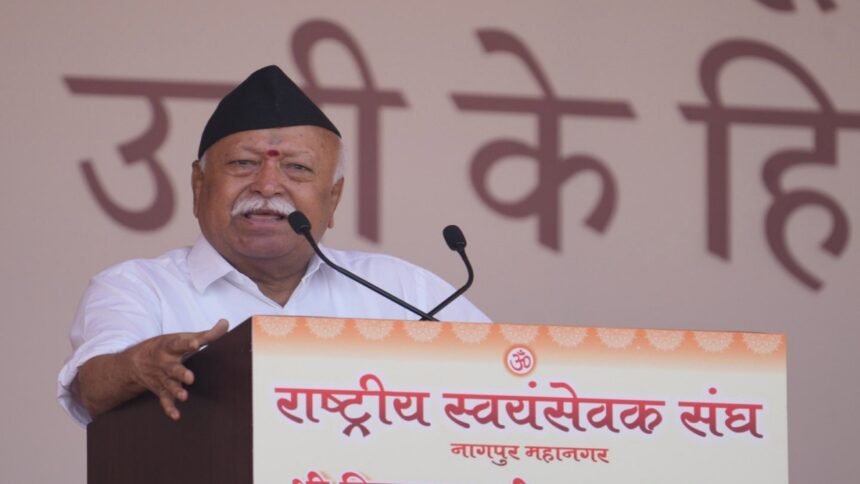
Speaking at the RSS’s annual Vijayadashami programme at Reshimbagh ground in Nagpur on Tuesday, Bhagwat said protests and political upheavals alone could not resolve deep-rooted problems. He also argued that lasting solutions had to emerge from within society rather than through agitation.
Rashtriya Swayamsevak Sangh chief Mohan Bhagwat said on Tuesday that India’s global ascent is causing foreign forces to become displeased, and any attempts to dismantle the country’s democratic order will prove unsuccessful.

“People say that changing the regime will change the situation. But this has never happened. It did not happen earlier, and it will not happen now,” Bhagwat said.
Referring to developments in several countries, the RSS chief spoke of what he described as a wave originating in the West that was challenging established systems, civility and cultural values.
“Look at what is happening in France, what is happening in Albania, and what happened in Nepal and Bangladesh,” he said, citing the examples while questioning the assumption that removing those in power would automatically improve conditions.
Protests have erupted in Delhi and parts of the country following a report in The Indian Express over the irregularities in the SIR process. The Cockroach Janta Party, Congress and Left parties along with various opposition parties are seeking resignation of the Chief Election Commissioner Gyanesh Kumar.
Bhagwat maintained that India was a target of forces seeking to disrupt its progress and weaken institutions, including the RSS.
“India is their main target because India is progressing. These evil forces know that they cannot disrupt India the way it has moved ahead with decisive policies in the last few decades,” Bhagwat said, adding that attempts were being made to dismantle India and the Sangh.
He cautioned that protests driven by political interests or instigation could lead to tension, anarchy and a breakdown of public order. His remarks placed the emphasis on maintaining stability and addressing problems through social efforts rather than relying on demonstrations to bring about change.
The RSS chief’s comments come days after senior Supreme Court lawyer Prashant Bhushan described the protests in Delhi over alleged SIR irregularities as a fight for regime change, setting off a political row.
“The government alleges the opposition wants a regime change… We are currently fighting to ensure that elections are conducted properly. But if this kind of brutality continues, there will certainly be regime change,” Bhushan had said last week.
The BJP criticised Bhushan’s remarks, accusing the opposition of using the protests to pursue a broader political agenda.
Defence Minister Rajnath Singh had accused unnamed groups of attempting to mobilise young people to create political unrest. BJP national spokesperson CR Kesavan, meanwhile, described the anti-CEC protests as a “smokescreen” for what he alleged was an opposition effort to bring down the government.
One Sided Development
The RSS chief said that one-sided development has destroyed the Himalayan region and claimed that the mountainous region has killed over 1,400 people, while more than 6,000 remain unaccounted for, ANI reported.
“Why did what happened in Nepal happen? Across the entire Himalayan region, the countries through which the Himalayas pass – in today’s maps, India, Tibet, Bhutan and China – one-sided development efforts are creating instability in nature throughout the Himalayan region,” the news agency quoted him as saying.
Bhagwat delivered the address during the RSS’s Vijayadashami celebrations in Nagpur as the organisation marks 100 years since its establishment in 1925.
The annual event combines traditional ceremonies with an address by the RSS chief on issues relating to society, governance and national affairs. This year’s speech comes against the backdrop of the continuing political dispute over the SIR exercise and the broader debate over protests, electoral integrity and calls for political change.