


The Tamil Nadu Assembly Election 2026 concluded in a single phase with 85.05% turnout. Counting begins on May 4 at 8 am across 62 centres, managed by the Election Commission of India. The contest features DMK, AIADMK and TVK, with logistics and security focus ensuring transparent results.
Chennai
-Prakash KL

The countdown for the votes for the April 23 elections in Tamil Nadu has started as exit polls largely predicted Stalin-led DMK to return to power.
The Tamil Nadu Assembly Election 2026 was held in a single phase. The Election Commission of India managed polling with tight security and detailed logistics, using large campuses and technology for smoother operations. With a strong participation rate reported across districts, officials are now focused on ensuring transparent counting arrangements at every location. Security agencies have already finalised deployment plans for the crucial counting day.
Vote counting for the Tamil Nadu Assembly Elections 2026, held on April 23rd, is scheduled for May 4th at 62 consolidated college campuses. The election saw a record 85.05% voter turnout, significantly surpassing previous years.

Vote Counting Date and Time
The counting of votes will be done on Monday, May 4 in 62 centres. It will start at sharp 8 am. Over the years, the trends, indicating who will be the winner, will be out by 9 am or 10 pm.
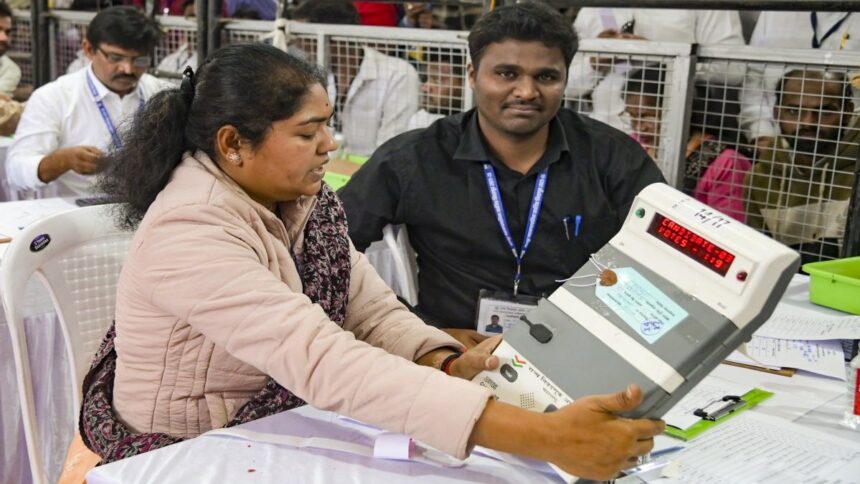
In India, the counting of votes isn’t just “finished” when the numbers are tallied. It follows a strict, multi-step legal procedure mandated by the Election Commission of India (ECI) to ensure every vote is accounted for and no disputes remain.
Even after the EVM (Electronic Voting Machine) counts are completed, the process is not over. The the VVPAT (Voter Verifiable Paper Audit Trail) slips from five randomly selected polling stations in each Assembly segment must be physically counted and matched with the EVM results.
Over the last decade, the number of counting centres in Tamil Nadu has dropped from 81 in 2016 to 62 in 2026. The Election Commission of India has shifted most counting to larger college campuses. These venues allow more constituencies at one site and offer better space, infrastructure and security controls.
The change began in 2021, when centres were first reduced to 70, partly due to COVID-19 requirements. Earlier, more than one-fourth of centres operated in school buildings, which handled fewer constituencies. The consolidated model continues in 2026, with authorities saying it helps manage staff, security and monitoring with greater ease.
| Year | Counting centres | Key reason for structure |
|---|---|---|
| 2016 | 81 | Many centres housed in schools |
| 2021 | 70 | Shift towards colleges, COVID-19 protocols |
| 2026 | 62 | Further consolidation in college campuses |
District-wise changes between 2021 and 2026 show both reductions and small increases. Tiruvallur, Villupuram, Perambalur, Theni and Kanniyakumari each lost one counting centre, while Tiruchy and Vellore lost two each. In contrast, Kallakurichi, Chengalpattu and Madurai gained one centre each, reflecting local logistical needs and available infrastructure.
Madurai, with 10 Assembly constituencies, now has the highest number of counting centres at five. Cuddalore, which has nine constituencies, and Salem, with 11 constituencies, follow with four centres each. Chengalpattu, Thanjavur, Villupuram, Tiruvallur and Chennai have three centres each, while most other districts have one or two, depending on requirements.
Officials say the consolidation of centres has improved security and oversight, using CCTV, controlled entry and coordinated teams on college campuses. With turnout high and political stakes significant, preparations are aimed at smooth counting on 4 May. The final results will show how Tamil Nadu voters have responded to each party’s campaign, adding another chapter to India’s vibrant electoral story.
Tamil Nadu Assembly Election Voters Turnout
Voter enthusiasm reached a new level, with Tamil Nadu recording 85.05 per cent turnout for the 2026 polls. This crossed the earlier high of 78.29 per cent from the 2011 election, when late J Jayalalithaa-led AIADMK defeated DMK. The latest numbers underline strong public interest in state politics, similar to high participation seen in large states like Uttar Pradesh.
In the 2021 Assembly election, the turnout stood at 73.63 per cent. About 4.59 crore electors voted, from a registered list of nearly 6.29 crore voters that year. The sharp rise in turnout in 2026 suggests more citizens are coming out to vote, across urban and rural constituencies.
Tamil Nadu Assembly Election 2026 major parties and contests
The 2026 contest featured a three-way battle between ruling DMK, opposition AIADMK and new entrant TVK, led by actor-politician Joseph C Vijay. Tamil nationalist Seeman’s NTK, active for over 15 years, also stayed in the field. Both DMK and AIADMK expressed confidence about winning, signalling a tight race in many seats.
DMK campaigned aggressively on delimitation-related issues, targeting the AIADMK-BJP NDA alliance, and worked to defend its government. AIADMK highlighted concerns about state debt and alleged law and order problems, asking voters for another chance to govern. TVK and NTK aimed to expand their support base, particularly among younger and first-time voters.
With inputs from agencies.