

By using this site, you agree to the Privacy Policy and Terms of Use.
Accept
Next India Magazine
  • Home
    • Home 2
    • Home 3Hot
    • Home 4
    • Home 5New
  • Home
  • Opinion

    That Provide Critical Analysis on Political Decision-Making

    krutikadalvibiz@gmail.com

    Analyzing Global Dynamics and Unraveling Key Policy Initiatives

    krutikadalvibiz@gmail.com

    Luxurious Stays Redefining Hospitality at Hotel Havens

    krutikadalvibiz@gmail.com

    Electric Cars Subsidies by German Taxpayers End Up on Foreign Roads

    krutikadalvibiz@gmail.com

    Challenge and Inspire Future of Political Thought

    krutikadalvibiz@gmail.com

    Assessing the Diplomatic Challenges and Global Security

    krutikadalvibiz@gmail.com
  • World
  • Politics
  • Market
  • Health
  • Insurance
  • Pages
    • Blog Index
    • Contact US
    • Search Page
    • 404 Page
    • Technology
    • World
  • Pages
    • Blog Index
    • Search Page
    • 404 Page
  • Technology
    TechnologyShow More
    Ramya Sudha Vinukonda: A Biology Teacher Turning Government School Classrooms into Spaces of Possibility
    6 Min Read
    Dr. Nishant Sawant: The Mind Behind Secure Digital Progress
    4 Min Read
    NASA’s Artemis II Mission Rekindles Humanity’s Dream of Deep Space Exploration
    5 Min Read
    Buying a Car Will Soon be Like Buying a Phone, Why Your Next Car Could be an EV
    Hands-On With the iPhone 13, Pro, Max, and Mini
    4 Min Read
  • Posts
    • Post Layouts
      • Standard 1
      • Standard 2
      • Standard 3
      • Standard 4
      • Standard 5
      • Standard 6
      • Standard 7
      • No Featured
    • Gallery Layouts
      • Layout 1
      • Layout 2
      • layout 3
    • Video Layouts
      • Layout 1
      • Layout 2
      • Layout 3
      • Layout 4
    • Audio Layouts
      • Layout 1
      • Layout 2
    • Post Sidebar
      • Right Sidebar
      • Left Sidebar
    • Review
      • Stars
      • Scores
      • User Rating
    • Content Features
      • Highlight Shares
      • Inline Mailchimp
      • Print Post
      • Inline Related
      • Source/Via Tag
      • Reading Indicator
      • Content Size Resizer
    • Table of Contents
      • Full Width
      • Left Side
    • Sponsored Post
  • Contact
  • Pages
    • Search Page
    • 404 Page
Reading: The Nobel for medicine goes to lighting up the brain
SUBSCRIBE
Next India MagazineNext India Magazine
Font ResizerAa
  • My Saves
  • Economics
  • Technology
  • My Interests
  • World
  • My Feed
  • History
  • Business
  • Technology
  • Lifestyle
  • Fashion
  • Health
  • Technology
  • World
Search
  • Pages
    • Blog Index
    • Contact Us
    • Search Page
    • 404 Page
  • Home
    • Home 1
    • Home 2
    • Home 3
    • Home 4
    • Home 5
  • Home
  • Blog
  • Categories
    • Technology
    • Lifestyle
  • Personalized
    • My Feed
    • My Saves
    • My Interests
    • History
  • Demos
  • Categories
    • Technology
    • Business
    • Fashion
    • Economics
  • Bookmarks
  • Categories
    • Technology
    • Health
    • World
  • More Foxiz
    • Blog Index
    • Sitemap
  • Bookmarks
  • Contact
  • More Foxiz
    • Sitemap
Have an existing account? Sign In
Follow US
  • Home
  • World
  • Contact
  • Blog
© Foxiz News Network. Ruby Design Company. All Rights Reserved.
BusinessLifestyleStartup

The Nobel for medicine goes to lighting up the brain

India Times Now
Last updated: October 6, 2026 5:54 am
India Times Now
5 Min Read
Share
SHARE

CHLAMYDOMONAS REINHARDTII is not an obvious subject for high-profile research. It is a pear-shaped, single-celled alga which swims around ponds propelled by two flagella. As a photosynthetic organism, which subsists by converting visible light into chemical energy, it often uses those thin appendages to swim towards sources of light. When doing so it is guided by a reddish patch made of protein known as an eyespot. And, in an example of the potential value of even the most off-the-wall scientific research, studying exactly how this eyespot works has led to both a new scientific field, called optogenetics, and this year’s Nobel prize for physiology or medicine.
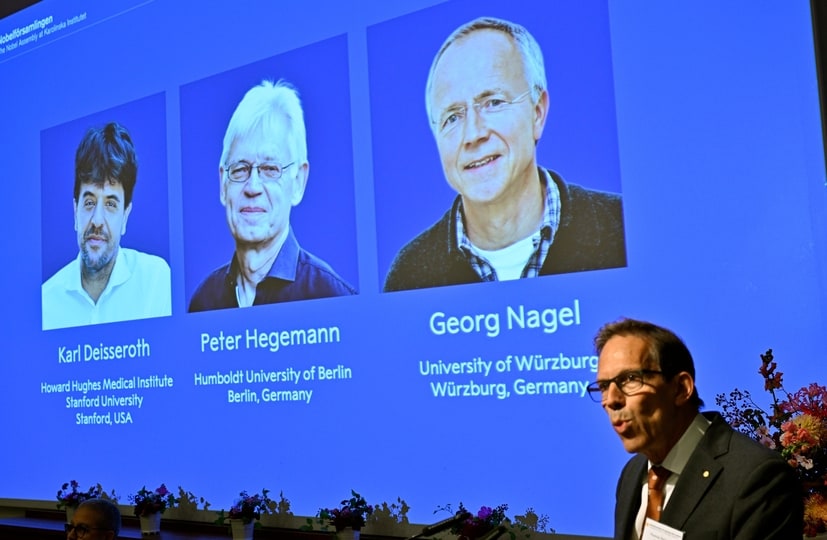
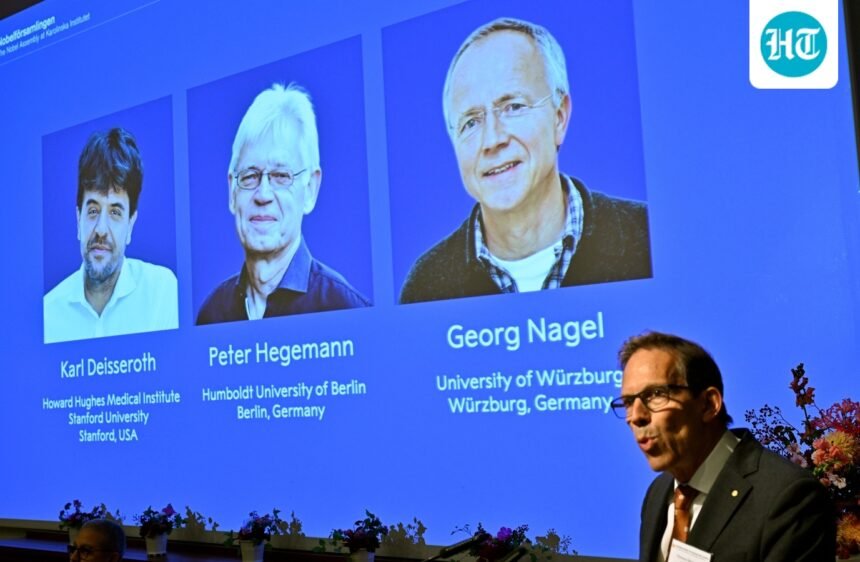
Matthias Prigge, a member of Peter Hegemann's team, speaks to journalists in Hegemann's laboratory after Hegemann, a professor at Humboldt University of Berlin, was awarded the Nobel Prize in medicine, in Berlin, Germany, October 5, 2026. (REUTERS)
Matthias Prigge, a member of Peter Hegemann’s team, speaks to journalists in Hegemann’s laboratory after Hegemann, a professor at Humboldt University of Berlin, was awarded the Nobel Prize in medicine, in Berlin, Germany, October 5, 2026. (REUTERS)

Optogenetics permits neuroscientists to use light to instantaneously activate individual brain cells. It has thus transformed neuroscience by making it possible to work out exactly what particular cells are doing. That enables researchers to investigate both basic neurobiology and the neural basis of illness.

The story begins in the 1990s with Peter Hegemann, then of the Max Planck Institute for Biochemistry in Martinsried, Germany. Dr Hegemann was studying Chlamydomonas’s electrical response to light. He found that it was 20 times faster than the equivalent response of a human eye. In a human retina, one protein molecule detects light and then, via a chain of molecular interactions, triggers another, known as an ion channel, to create an electrical signal. Dr Hegemann hypothesised that in his alga that convoluted process was being compressed.

Testing his guess with the tools then available proved hard, until the blossoming science of genomics came to his rescue. A team of Japanese researchers had produced a map of the DNA of Chlamydomonas, showing that it included two genes resembling those for light-sensitive proteins in some other organisms. This insight was confirmed when Dr Hegemann enlisted the assistance of a colleague, Georg Nagel, then at the Max Planck biophysics campus in Frankfurt. Dr Nagel, who shared the prize, inserted the DNA of the two newly identified genes into some frogs’ eggs, which then turned out the desired proteins in quantities large enough to test. Just as Dr Hegemann had predicted, they turned out to be light-stimulated ion channels.

Realising what they had, Dr Nagel and Dr Hegemann then tried inserting one of the genes, for a protein now known as channelrhodopsin-2, into kidney cells harvested from hamsters and from human embryos. That worked, too. They had, in other words, discovered a way of making mammal cells light-sensitive.

This bit of story was then completed by the third of this year’s laureates, Karl Deisseroth, then at Stanford University. It was he who conceived of putting channelrhodopsin-2 into cells whose raison d’être is the transmission of electrical signals: neurons. When the idea was tested, cultured rat neurons not only responded when exposed to light, but could also pass signals on to their neighbours.

The paper announcing this finding was published in 2005, but other researchers were also exploring similar ideas. Three years earlier, Gero Miesenböck, then at the Memorial Sloan-Kettering Cancer Centre in New York, had done similar work using a light-sensitive protein from a fruit fly. Dr Miesenböck, as an audience member at Monday’s announcement observed, might have serious reason to be miffed.

Regardless of details of priority, though, the subject has since exploded. Dr Deisseroth’s lab led the way, first by repeating what had been done in cultured rat cells in living mouse brains, and then by inventing the trick of using extremely thin optical fibres to illuminate, and thus stimulate, groups of neurons. In combination, these tricks let the researchers control the movements of a mouse’s whiskers.

Optogenetics has since been the subject of thousands of papers. It is being used in laboratory animals to investigate depression, schizophrenia, blindness, deafness, dementia, addiction and anxiety. There is even an attempt to use it to restore vision in people with a form of blindness called retinitis pigmentosa. Great oaks from little acorns grow. Or, in this case, little algae.

Share This Article
Facebook Email Copy Link Print
Previous Article UP Rajya Sabha Polls: SP Decides Against Third Candidate, BJP To Win 8 of the 10 Seats
Next Article Chamkharchhu-I Hydroelectric Project In Bhutan: Adani Power And DGPC Agreement
Leave a Comment Leave a Comment

Leave a Reply Cancel reply

Your email address will not be published. Required fields are marked *

You Might Also Like

BusinessLifestyleStartup

Virat Kohli sets a new bar in Indian cricket with record-extending IPL century to all but confirm RCB’s playoff berth

Virat Kohli turned Raipur into another entry in his chase…

4 Min Read
BusinessLifestyleStartup

Lawsuit seeks to ban Trump Media from charging for early access to president’s posts on US policy

NEW YORK — President Donald Trump was sued in federal…

4 Min Read
BusinessLifestyleStartup

Munawar Faruqui says Abhishek Malhan targeted him since he has lost before on a show: ‘Tu thoda jal chuka hai’

Munawar Faruqui was eliminated on the very first day of…

3 Min Read
BusinessLifestyleStartup

Lionel Messi benched after 20 years, history returns: The 2006 World Cup call that still stings

Lionel Messi starting a World Cup match on the bench…

3 Min Read
Next India MagazineNext India Magazine
Follow US
© 2026 Next India Magazine powered by India Times Now. All Rights Reserved.
Welcome Back!

Sign in to your account

Username or Email Address
Password

Lost your password?