



Feature
oi-AK Khan

Imagine a man named Ravi. He drives a taxi in a busy city, hums old film songs at red lights, and keeps a photo of his two kids taped to the dashboard. One ordinary week, a dull ache in his back and a strange yellow tint in his eyes send him to a doctor.
The word that comes back is one no family wants to hear: pancreatic cancer. It has already spread. The doctor is kind but honest. After chemotherapy, she explains, most patients in Ravi’s situation live only a handful of months.
For forty years, that conversation ended there. The science had simply hit a wall.
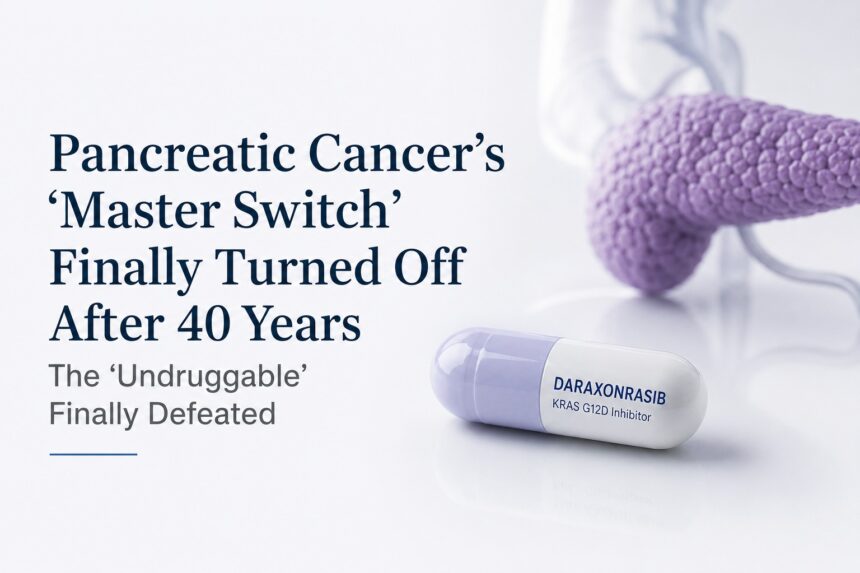
But Ravi is having this conversation now — and now there is a new sentence the doctor can add. A small pill, taken once a day, called daraxonrasib. This is the story of why that one sentence took four decades to earn, and why it matters far beyond Ravi.
✦ ✦ ✦
Why pancreatic cancer is so dangerous
The pancreas is a soft, fish-shaped organ tucked deep behind your stomach. Think of it as a tiny factory. Most of its staff are exocrine cells — the workers that pump out digestive juices to break down your food. That detail matters, because about 95% of pancreatic cancers begin in exactly these worker cells.
When cancer starts in those juice-making gland cells, doctors give it a tongue-twister of a name: pancreatic adenocarcinoma. Break the word apart and it turns friendly — “adeno” simply means gland, and “carcinoma” means cancer. So the whole mouthful just says: cancer of the gland cells of the pancreas.
You never feel this organ. You never think about it. And that is exactly the problem.
Think of a silent house fire. It starts at midnight, inside the walls, where no one can see it. No alarm. No smell of smoke. By the time flames reach the windows, the whole house is already burning. Pancreatic cancer is that fire.
Because the pancreas sits so deep, a tumor can grow for a long time with almost no symptoms. When warning signs finally appear — back pain, weight loss, yellowing skin — the cancer has often already spread. Four things make it especially feared: it is hard to detect early, its symptoms appear late, it spreads quickly, and for decades there were very few treatments that worked.
Infographic 01
The Silent Killer
Healthy
🟢
Smooth · working quietly
Hidden tumor
?
Same outside · danger inside
The broken light switch
To understand the cure, you first have to understand the glitch. And it all comes down to a switch.
Your body is built from trillions of cells. Healthy cells follow rules: they grow when the body needs them, then they stop. That stopping is run by tiny molecular switches inside the cell. One of the most important is called KRAS.
Normally KRAS is one domino in an orderly chain reaction scientists call the RAS growth pathway. Picture a line of dominoes: a signal arrives → KRAS flips ON → the cell grows → the signal stops → KRAS flips OFF. Tidy and controlled.
Picture the light switch on your wall. You flick it ON when you need light, and OFF when you’re done. A healthy KRAS switch works the same way: ON to grow, then OFF to rest.
But in many pancreatic cancers, a tiny typo in the cell’s instruction manual — a KRAS mutation — jams that switch in the ON position. The cell never hears “stop now,” so it keeps growing and dividing, on and on, with no off button. The dominoes never stop falling. A crowd of these runaway cells becomes a tumor.
Infographic 02
The Broken KRAS Switch
Healthy cell
ON → OFF → ON → OFF
Cancer cell
ON → ON → ON → ON …
Why scientists struggled for forty years
Here is the maddening part. Scientists figured out decades ago that KRAS was the villain. They could see the jammed switch clearly. The trouble was reaching it.
KRAS turned out to be a smooth, slippery protein with no obvious handle for a drug to grab. For years, researchers literally called it “undruggable.” It became one of the most famous brick walls in all of cancer research.
Imagine a locked room with no keyhole. You know exactly what’s trapping you inside. You can see the lock. But there’s nowhere to put a key. For forty years, that was KRAS — a problem in plain sight that no one could open.
Infographic 03
Forty Years of Searching
How daraxonrasib finally got in
If you can’t unlock the door from the outside, you find a clever trick. That trick is what makes daraxonrasib special — and it’s worth slowing down for.
Earlier attempts were inhibitors — and an inhibitor is just a fancy word for a blocker, like the brake pedal in a car or the stop button on a machine. The earlier blockers tried to grab slippery KRAS head-on, and it kept wriggling free.
Daraxonrasib doesn’t fight KRAS alone. Instead it teams up with a helper already floating inside the cell: a chaperone protein called Cyclophilin A. A chaperone protein is the cell’s bodyguard — its everyday job is to help other proteins fold and work properly. Daraxonrasib borrows that bodyguard for a different purpose.
Picture a getaway driver — the jammed KRAS switch — flooring the accelerator so the car races out of control. Old drugs tried to grab the driver directly, but he was too slippery to hold. Daraxonrasib does something smarter: it first grabs a bystander already in the car (Cyclophilin A), and the two of them together pin the driver down in a three-way lock. Pinned, he can’t reach the pedal anymore. The car slows.
Scientists call the result a tri-complex inhibitor — “tri” meaning three — because the drug, the chaperone, and KRAS all lock together as a threesome. Some people describe it as a molecular glue, since it glues two things together that then trap the troublemaker.
Even the drug’s mouthful of a name hides a tidy message. Daraxonrasib (da-RAX-on-RAS-ib) is built from code: DARAX is its unique stem, ON means it targets the active “ON” form of the switch, RAS is the protein it acts on, and IB marks it as an inhibitor. Put together, the name literally means “a drug that blocks active RAS.”
Infographic 04
The Three-Way Lock
Step 1 · binary
Drug grabs the helper
Step 2 · tri-complex
Together they trap KRAS
Step 3 · shutdown
The growth signal stops
Cancer’s growth signal is switched OFF
What the molecule actually looks like
All of that cleverness is folded into a single, intricate molecule. Here is the real chemical structure of daraxonrasib. You don’t need to read it like a chemist — just notice how elaborate it is. Every ring and branch is engineered so the molecule can hug Cyclophilin A and snap onto KRAS in just the right way. This is what “precision medicine” looks like up close.

Daraxonrasib · RMC-6236 · oral RAS(ON) multi-selective tri-complex inhibitor
Why this is different from chemotherapy
Most people know chemotherapy. It’s powerful, but it’s blunt. Chemo attacks all fast-growing cells — which is why it also harms healthy ones, causing hair loss, nausea, and exhaustion.
Chemotherapy is like carpet-bombing a whole neighborhood to stop a few criminals hiding inside. Daraxonrasib is more like a precision-guided arrest — it goes after the one switch driving the cancer.
| What we compare | Chemotherapy | Daraxonrasib |
|---|---|---|
| How it attacks | Hits all fast-dividing cells | Targets the cancer switch (RAS) |
| Aim | Broad, blunt | Precise, targeted |
| How it’s taken | Usually through a drip (IV) | A pill, once a day |
| Main downside | Harms healthy cells too | Mostly a skin rash in trials |
The numbers that stunned doctors
The lead investigator for the daraxonrasib clinical trial, Dr. Brian Wolpin, received a standing ovation from normally reserved researchers and doctors when he presented the “game-changing” findings from the international RASolute 302 trial at the American Society of Clinical Oncology Annual Meeting 2026. The study involved 500 patients with advanced pancreatic cancer who had previously undergone chemotherapy and found that daraxonrasib significantly outperformed additional chemotherapy, drawing widespread attention from the oncology community.
Infographic 06
Living Longer — Median Survival
↑ roughly double
Because “undruggable” just became “treatable”
For most of medical history, this cancer’s master switch was untouchable. Doubling survival may sound like only a few months, but for a disease that has barely budged in forty years, it is an earthquake — and it proves the switch can be turned off. Every future drug now builds on that proof.
A note of honesty: daraxonrasib was still under regulatory review at the time of writing and is not yet a routine prescription everywhere. These results come from a clinical trial — but they are real, published, and have changed how doctors talk about this disease.
How AI is joining the fight
A great new drug helps people who are already diagnosed. But remember Ravi’s real problem — the cancer was found late. What if we could catch it earlier? This is where artificial intelligence is quietly changing everything.
1 · Spotting the smoke before the fire
People get CT scans all the time — for stomach pain, after accidents, for unrelated checkups. Often a pancreatic cancer is already whispering in those scans, in patterns too faint for the human eye. AI can learn to read those whispers.
AI is like a detective who smells smoke before anyone sees the fire.
In a 2026 study from the Mayo Clinic, an AI model called REDMOD reviewed routine scans and flagged about 73% of pancreatic cancers a median of roughly 16 months before they were officially diagnosed — far more than expert radiologists spotted on the same scans.
Infographic 07
AI Sees It Earlier
🤖 AI sees it
Usual diagnosis
← ≈16 months earlier →
2 · Mapping the tumor’s city
AI can study millions of cells at once to learn which ones turn cancerous, how tumors survive, and where their weak spots are.
It’s like building a detailed street map of the tumor — so scientists know exactly where to strike.
3 · Discovering drugs faster
Instead of years of slow trial-and-error in the lab, AI can test millions of possible molecules virtually and predict which ones might work — shortlisting the most promising candidates for real-world testing.
4 · A treatment plan made just for you
Future AI systems may predict which drug will work best for your specific cancer, how you’ll respond, and which side effects to watch for — turning a one-size-fits-all approach into something personal.
Teaching the body to fight back
Beyond pills and scans, scientists are working to turn your own immune system into a cancer-hunting army.
The wanted poster: mRNA vaccines
A mRNA vaccine doesn’t prevent cancer the way a flu shot prevents flu. Instead, it teaches the immune system to recognize a tumor. Think of it as handing your immune system a “Wanted” poster: this is the enemy — go find it.
Infographic 08
mRNA Cancer Vaccine
🛡️ 🛡️ 🛡️ 🛡️
Immune cells learn the target
The special forces: T-cells
T-cells are the body’s special-forces soldiers. They patrol constantly, hunting for threats and destroying infected or dangerous cells. Cancer vaccines aim to train more T-cells to recognize cancer as the enemy.
Infographic 09
T-Cells Attack the Cancer
Trained T-cells swarm the tumor like a squad closing in
The future of cancer treatment
For decades, the story of pancreatic cancer was a short, sad one. That is changing in front of us — and the most exciting part is how the pieces fit together.
🤖
AI
Finds cancer earlier and designs smarter treatments.
🎯
Targeted drugs
Precision pills like daraxonrasib that hit the exact switch.
🛡️
Vaccines
Train the body’s own immune army to fight back.
Infographic 10
The Future — Three Forces, One Goal
AI
+
Targeted drugs
+
Vaccines
= more time, more hope
Back to Ravi. His road is still hard; this is not a fairy tale. But for the first time in a generation, his doctor can offer something that didn’t exist before — more months, more birthdays, more songs hummed at red lights. And the science isn’t slowing down.
In one line: Instead of bombing the whole battlefield like chemotherapy, daraxonrasib is a precision strike aimed straight at cancer’s master switch — while AI helps doctors find the enemy earlier and plan the smartest attack.