International
oi-Oneindia Staff

The third rock from the Sun, our planet Earth is an amazing phenomenon. Right from how far it is from the source of energy (the Sun), to how it has just one moon and the size and distance of the Sun and the Moon from the Earth and the presence of live-supporting elements prime among them being the gravity, the atmosphere, the oxygen, the water, etc. everything is magical.

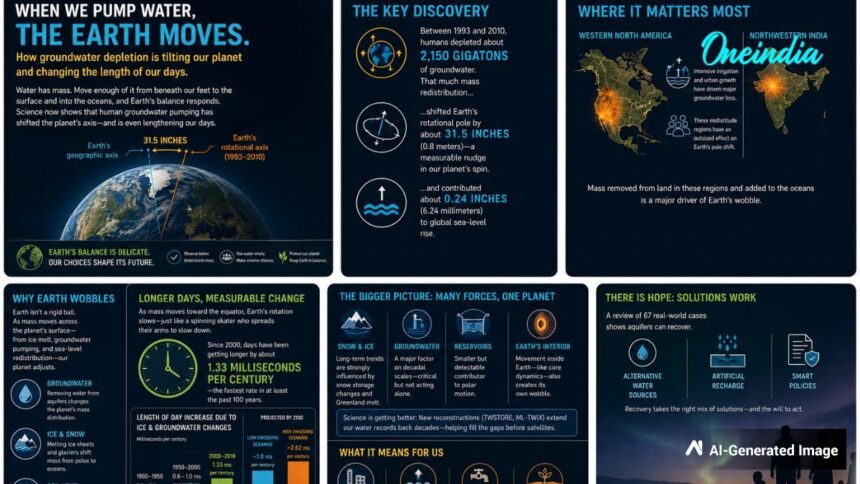
Human groundwater depletion, totaling 2,150 gigatons between 1993-2010, has measurably shifted Earth’s rotational pole approximately 31.5 inches, demonstrating a significant human impact on planetary motion.
Just take into consideration its spinning on its axis, its path around the Sun, and the very important axial tilt that it leans on. Everything on Earth is in a delicate balance.
Earth does not spin in perfect stillness. Its axis wobbles, shifts, and drifts over time, responding to forces both deep within and across its surface. For decades, scientists understood that melting glaciers, shifting oceans, and movements in Earth’s core contributed to this subtle dance.
Now, a growing body of research points to a more immediate and human-driven factor: groundwater depletion. What appears to be a local act of pumping water for farms and cities is, in fact, influencing the very way the planet spins.
The Physics of a Moving Planet
Water has mass, and mass determines motion. When large quantities of groundwater are extracted from aquifers and redistributed across the surface, especially into oceans, the balance of Earth’s mass shifts. This redistribution affects the planet much like adding weight to one side of a spinning top. The rotation adjusts, and the axis responds.

Between 1993 and 2010, scientists estimate that humans depleted around 2,150 gigatons of groundwater. This enormous transfer of mass contributed to a measurable shift in Earth’s rotational pole by approximately 31.5 inches, shows a study (https://agupubs.onlinelibrary.wiley.com/doi/10.1029/2023GL103509) .
While this movement is minuscule compared to the size of the planet, it is significant in geophysical terms. It confirms that human activity is now detectable in Earth’s rotational behaviour.
This is part of a broader phenomenon known as polar motion, where the axis of rotation moves relative to the planet’s surface. Polar motion is not new, but what is new is the extent to which human-driven changes are contributing to it.
Climate, Water, and the Wobble
NASA-funded studies (https://www.nasa.gov/science-research/earth-science/nasa-funded-studies-explain-how-climate-is-changing-earths-rotation/) have expanded this understanding by examining over a century of data.
They reveal that changes in water distribution, including groundwater depletion, melting ice sheets, and sea-level rise, account for a large share of the variations in Earth’s axis. In fact, nearly 90 percent of recurring fluctuations in polar motion between 1900 and 2018 can be traced to these surface-level processes.
The same mechanisms are also slowing the planet’s rotation. As water moves from polar ice sheets or underground reservoirs toward the equator, it changes the distribution of mass. This causes Earth to spin slightly slower, leading to a gradual increase in the length of a day. Since the year 2000, the Earth’s days have been lengthening at a rate of about 1.33 milliseconds per century, a small but accelerating change.
The analogy often used is that of a spinning ice skater. When the skater extends their arms, their rotation slows. Similarly, when Earth’s mass spreads outward, its spin decelerates.
India’s Role in a Global Shift
While this is a global phenomenon, its drivers are not evenly distributed. Regions with intensive groundwater extraction have a disproportionate impact. Studies point to western North America and north-western India as key contributors to the observed drift in Earth’s rotational pole.
This places India at the centre of a planetary-scale issue. The country is one of the largest users of groundwater in the world, with vast aquifers supporting agriculture, industry, and daily life. In states such as Punjab, Haryana, and parts of Rajasthan and Gujarat, decades of intensive irrigation have led to significant depletion.
What makes this particularly concerning is that groundwater loss does not remain local. Once extracted, much of the water eventually makes its way to rivers and oceans, contributing to global sea-level rise and altering Earth’s mass distribution. In this way, India’s water crisis is not just a regional challenge but a contributor to global geophysical change.
Consequences Beneath Our Feet
The impact of groundwater depletion extends far beyond the axis shift itself. As aquifers are drained, land above them can sink, a process known as subsidence. This is already visible in several parts of the world, including coastal regions where sinking land amplifies the effects of rising seas.
In river deltas, which are among the most densely populated and agriculturally productive areas, subsidence has become a dominant factor in relative sea-level rise. Recent studies suggest that in many such regions, the sinking of land due to groundwater extraction now exceeds the rise in sea level itself.
For India, this has direct implications for cities like Kolkata and regions such as the Sundarbans, where rising waters and sinking land create a dangerous combination. Saltwater intrusion into freshwater aquifers further threatens drinking water supplies and agriculture.
An Incomplete but Improving Picture
Despite these advances, scientists caution that Earth’s rotational dynamics are not fully understood. Groundwater is one piece of a complex puzzle that includes glaciers, snowpack, reservoirs, ocean currents, and processes deep within the planet.
New tools are helping refine this picture. Advanced models and reconstructions are extending our understanding of water storage changes further back in time, allowing scientists to better connect observed shifts in Earth’s rotation with specific causes. However, uncertainties remain, especially in the pre-satellite era.
What is clear, however, is that the signal of human activity is becoming increasingly visible in planetary systems once thought to be beyond our influence.
Can the Balance Be Restored
The idea that human actions can influence Earth’s rotation may seem unsettling, but it also carries a measure of hope. If groundwater depletion can shift the planet’s axis, then better management of water resources can help stabilise it.
There is evidence that aquifers can recover under the right conditions. Successful interventions have included artificial recharge, improved water management policies, and the development of alternative water sources. However, these solutions are often region-specific and cannot be easily replicated everywhere.
For India, this underscores the urgency of sustainable water practices. Rainwater harvesting, efficient irrigation methods, crop diversification, and policy reforms are not just tools for local resilience but part of a larger effort to maintain planetary balance.
Just How Important is the Earth’s Tilt
If Earth had no tilt at all, life would be far less dynamic and far more difficult to sustain. The planet’s current tilt is what creates seasons, so without it, there would be no summer or winter, only a constant distribution of sunlight where the equator remains perpetually hot and the poles permanently cold.
No tilt would mean disrupted global climate patterns, weakened systems like the Indian monsoon, and large parts of the world either too dry or too extreme for reliable agriculture.
Ecosystems that depend on seasonal cycles for flowering, migration, and breeding would struggle to survive, leading to reduced biodiversity.
Ocean currents and atmospheric circulation would also become more static, limiting the natural redistribution of heat across the planet.
For human civilisation, especially in countries like India that rely heavily on seasonal rainfall, the consequences would be severe.
Ironically, the very tilt that seems fragile is essential, as it helps distribute energy across the Earth and makes much of the planet habitable.
A Planet in Our Hands
Earth’s axis will continue to drift and wobble as it always has. But the growing influence of human activity on this process marks a turning point. In just over a century, changes in water distribution driven by climate and human use have left a measurable imprint on the planet’s rotation.
This is not a distant or abstract phenomenon. It is a reflection of how deeply interconnected human systems are with the natural world. The water drawn from a well in Punjab, the melting of ice in Greenland, and the rise of seas along India’s coasts are all part of the same story.
The lesson is both sobering and empowering. The balance of the planet is delicate, but it is not beyond our influence. The choices made today about how water is used, conserved, and managed will shape not just local ecosystems but the very motion of the Earth itself.
In that sense, the story of a 31.5-inch shift is not about instability. It is about responsibility.