


India
oi-Swastika Sruti

As India preps up to celebrate its 80th Independence Day, a group of deaf and speech impaired school students in Chandigarh has drawn attention to a very different reality – one where children are still forced to protest for basic educational facilities.

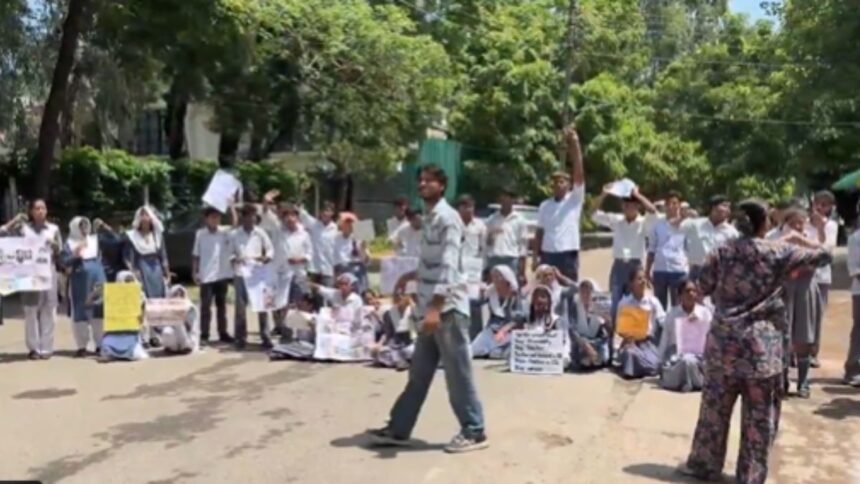
Deaf and speech-impaired students in Chandigarh protested outside the District Education Officer’s office, demanding basic educational facilities, improved teaching, Maths and Science classes, sign language training for teachers, and transport services.
The students reportedly came out in protest and gathered outside the office of Chandigarh’s District Education Officer, carrying posters that explained the problems they face at school.
The students were unable to communicate through spoken slogans, they tried to make themselves heard in the only ways available to them- through signs, written messages, placards and their presence outside the education office.
जो बच्चे बोल नहीं सकते, वो चंडीगढ़ के जिला शिक्षा अधिकारी के ऑफिस के सामने प्रोटेस्ट कर रहे हैं….
वो अपने पोस्टर पर लिख कर बताने की कोशिश कर रहे हैं कि उनके स्कूल में क्या कमियां हैं…
>No – VBS on College
>No medical helpline
>No emergency helpline
>No Police Station
>No Govt… pic.twitter.com/sMpfML7HJP— Alka Maurya (@MauryaAlka76391) August 13, 2026
Their protest raises an uncomfortable question: After nearly eight decades of independence, why are children with disabilities still having to demand basic access to education and essential facilities?
What Are The Students Demanding?
The students have raised several demands linked directly to their education, safety and daily needs.
Their key demands include:
- Professional faculty and better teaching facilities
- Mathematics and Science classes for Classes IX to XII
- Mandatory Indian Sign Language training for teachers
- Better-quality mid-day meals
- Pick-and-drop bus facilities
A charging facility on the school campus so the existing electric bus can be used regularly
These are not demands for luxury facilities. They are basic requirements that can directly affect the quality of education and the everyday lives of students with hearing and speech disabilities.
जो बच्चे बोल नहीं सकते, वो चंडीगढ़ के जिला शिक्षा अधिकारी के ऑफिस के सामने प्रोटेस्ट कर रहे हैं….
वो अपने पोस्टर पर लिख कर बताने की कोशिश कर रहे हैं कि उनके स्कूल में क्या कमियां हैं…
>No – VBS on College
>No medical helpline
>No emergency helpline
>No Police Station
>No Govt… pic.twitter.com/sMpfML7HJP— Alka Maurya (@MauryaAlka76391) August 13, 2026
‘They Cannot Shout, But They Still Have A Voice’
What makes the protest particularly emotional is the way the students have tried to communicate their concerns.
For children who cannot hear or speak in the conventional way, a protest itself presents an additional challenge. They cannot rely on slogans or speeches to draw attention to their demands.
Instead, they have used placards, written messages and sign language to explain what is wrong.
Their protest is a reminder that communication should never be confused with the ability to speak.
A student may not be able to shout a slogan, but that does not mean the student has nothing to say.
Maths And Science Education Is Also A Concern
The students have specifically demanded Mathematics and Science classes from Classes IX to XII.
These subjects are important for students who want to continue their education and pursue higher studies or professional courses.
If students with disabilities are denied access to the same range of subjects as other students, their choices after school can become limited.
Providing proper subject teachers and accessible teaching methods is therefore not only about passing examinations. It is about giving these students a fair chance to decide what they want to do with their future.
Transport And Basic Facilities
The demand for a pick-and-drop facility also highlights the practical difficulties faced by students and their families.
For children with disabilities, reliable transportation can be essential for attending school regularly and safely.
The students have also demanded a charging facility for the electric bus already available to the school. The issue is simple: a bus cannot provide regular transport if the infrastructure needed to operate it is missing.
This is the kind of gap that can turn a facility created to help students into a facility that remains underused.