


International
-Oneindia Staff

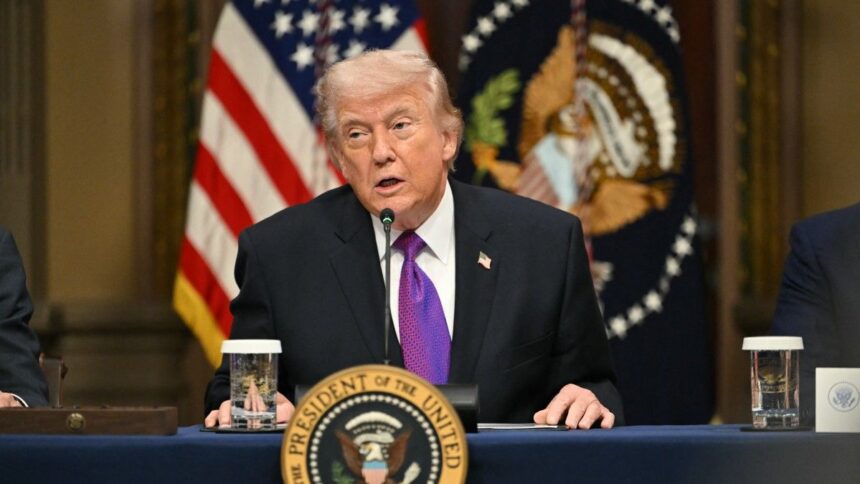
US President Donald Trump has said Iran poses a constant threat to him, claiming he is “number one” on Tehran’s list, during an unusual exchange with reporters aboard Air Force One after blinds near their seats were ordered shut.
The remarks came as Trump was flying after attending a NATO summit in Ankara, amid renewed tensions with Iran and fresh questions over presidential aircraft security. Reporters travelling with him were told to close the window blinds before one of them asked why the instruction had been issued.
US President Donald Trump stated on Air Force One that Iran poses a constant threat and he is their ‘number one’ target, amidst heightened US-Iran tensions and questions regarding presidential aircraft security.

“Because you are probably on a dangerous flight because of the sleazebags we have to deal with. These Iranians are sick people,” Trump said, according to the account of the exchange. When asked whether he personally faced a threat from Iran, he replied: “I have a threat all the time. I’m number one on their list, before you. But if I go, you go.”
Trump links Air Force One security to Iran threat
The comments were made in the close confines of the presidential aircraft, where security instructions often draw attention because of the symbolic and operational importance of Air Force One. The aircraft is not only a mode of transport for the US president but also a secure command platform during foreign travel and crises.
Trump’s language pointed directly at Iran at a time when Washington and Tehran are again locked in a dangerous standoff. His warning to the travelling press corps was also characteristic of his combative style, mixing a personal security claim with a pointed remark that journalists may want to consider another profession.
The exchange followed Trump’s statement at the NATO summit that a ceasefire involving the United States and Iran was “over”, as far as he was concerned. He also warned of “much worse” consequences if Tehran continued attacks on vessels in the Strait of Hormuz, one of the world’s most important oil shipping routes.
After those remarks, explosions were reported in parts of Iran, including Bandar Abbas, Konarak and Chabahar. Part of Chabahar reportedly lost electricity. Kuwait, Bahrain and Qatar also sounded missile alert sirens early on Thursday, warning of a possible Iranian attack in the region.
Plane switch raises fresh questions
The security-focused comments came during a flight sequence that had already drawn scrutiny. Trump had travelled to Ankara on a newer Air Force One jet, a Boeing 747-8 gifted by Qatar and retrofitted for presidential use, according to reports. But on the return journey, he flew part of the way on an older baby blue Air Force One aircraft.
The newer red, white and navy blue aircraft was reportedly sent ahead to Royal Air Force Mildenhall in the United Kingdom before the president’s departure. Trump then flew from Ankara to the UK on the older presidential plane, later suggesting that the switch had been made “for old time’s sake”.
Trump said both aircraft would stop at RAF Mildenhall, a base used by US troops. In a social media post after landing, he said the newer Air Force One had been sent earlier so service members at the base could see it. “They were very excited,” he wrote.
The aircraft switch is politically sensitive because the Qatari-gifted jet has already attracted debate in Washington. Reports said the United States spent about $400 million to retrofit it for presidential use. Any change in presidential transport arrangements can raise questions about security, communications systems and contingency planning.
Why Iran’s threat perception matters for Washington
Trump’s claim that he is Iran’s top target cannot be independently confirmed from his remarks alone. However, tensions between the United States and Iran have long included concerns over threats to American officials, military personnel and diplomatic facilities, especially during periods of open confrontation in the Gulf.
The Strait of Hormuz remains central to the current escalation. A large share of global oil and liquefied natural gas shipments passes through the narrow waterway between Iran and Oman. Any sustained disruption there can affect energy prices, shipping insurance, naval deployments and the wider security posture of Gulf states.
For India and other major energy importers, instability in the Gulf carries direct economic significance. India relies heavily on crude imports and has a large diaspora across West Asia. Missile alerts, port disruptions or military escalation in the region can therefore affect fuel markets, aviation routes and evacuation planning if tensions worsen.
The White House has not, in the reported exchange, provided public details of any specific threat assessment behind the instruction to shut aircraft blinds. Presidential travel security is usually handled discreetly by the US Secret Service, military communications teams and aviation security officials, particularly during flights through sensitive regions.
Trump’s comments also came against the backdrop of a NATO summit where allies were already dealing with multiple security concerns. Any US-Iran escalation risks complicating allied coordination, especially if Washington seeks diplomatic support, military access or public backing for further action in the Gulf.
For now, the president’s remarks have added a personal dimension to a wider geopolitical crisis. His claim of being under constant Iranian threat, the unusual aircraft switch and the renewed warnings to Tehran together underline how quickly security concerns around presidential travel can merge with active foreign policy confrontation.