



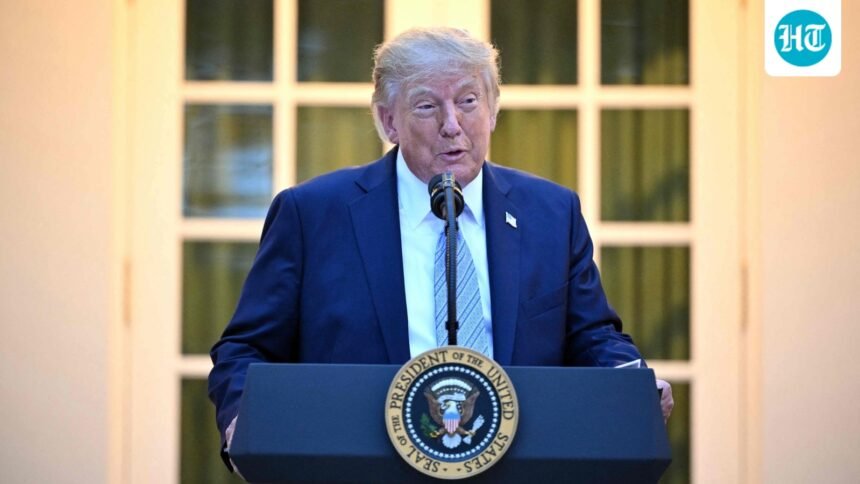
US President Donald Trump on Friday signed the Lindsey O Graham Sanctioning Russia and Iran Act of 2026 into law, acquiring congressionally backed authority to impose tariffs of up to 100% on goods from the five largest buyers of Russian oil — a list that by current import volumes includes China and India.

New law expands Trump’s tariff powers
The law gives Trump a tariff instrument his broader trade campaign has lacked. His sweeping duties on global trade have relied on executive powers — first under the International Emergency Economic Powers Act, which the Supreme Court struck down in February, and then under Section 122 of the Trade Act, which carries a 150-day expiry. The new law faces neither constraint. Once in effect, it gives the president durable, congressionally authorised power to penalise buyers of Russian energy.
India had warned on Thursday, hours after the House passed the bill, that it was determined “to take all necessary measures to protect its trade and economic interests.” The external affairs ministry said the legislation’s implications — “for not just the bilateral relationship but also the international energy market” — had been “very clearly articulated” to US interlocutors at high levels in recent months.
To be sure, Trump has yet to announce a new tariff rate under these powers.
On Saturday, Union minister of state for external affairs Kirti Vardhan Singh reiterated India’s position. “We have our own independent foreign policy. We will not follow any country,” he told news agency ANI, adding that the government would “take every strong step for the strength and stability of our country, our population of 140 crores.”
Also read: India says Russia sanctions bill threatening 100% tariffs can impact US ties, global energy market
China echoes India’s response
China too responded on Saturday, in similar language to India’s statement on Thursday, with the ministry of commerce saying it reserved the right “to take all necessary measures” to firmly safeguard China’s interests, “as well as the legitimate and just rights and interests of Chinese companies.”
The law does not name any country. It tasks the US Trade Representative, in consultation with the Secretary of State and Secretary of Energy, to identify the five largest importers of Russian crude oil and natural gas by total volume over the preceding 12 months, with the list reassessed every 180 days. The tariff rate, up to the 100% ceiling, is at the president’s discretion; the law does not compel him to act. It also includes an exemption for countries whose Russian natural gas imports account for less than 15% of Russia’s total gas exports and that are “taking significant steps” to reduce those imports — a provision that shields several European nations but offers no protection to India or China.
But the bill’s backers have left little doubt about where the pressure is aimed. “To China and India: You better clean up your act. Buy your oil and gas somewhere else,” Senator Richard Blumenthal said after the House passed the bill on Wednesday.
Also read: US sanctions on Russian oil, 100% tariff to make reaching Ukraine deal ‘harder’, warns Kremlin
Bill’s 18-month journey through Congress
Trump’s signature brings to a close an 18-month legislative saga that began in April 2025, when Senators Lindsey Graham and Richard Blumenthal introduced an earlier version proposing tariffs as high as 500% on buyers of Russian energy. Graham, a close Trump ally who spearheaded the legislation, died suddenly in July; the law now bears his name. The bill was softened — the top-line tariff brought down to 100%, its scope narrowed to the five largest purchasers — but its passage through Congress was far from assured. Members of the majority Republican party unexpectedly brought it to a House vote this week after the Rules Committee removed a procedural hurdle on Monday. On Tuesday, the House narrowly voted 214-211 to schedule the final vote after two Democratic lawmakers crossed the aisle. It passed on Wednesday 262-159. The Senate had cleared it 86-11 on August 7.
The White House’s role in securing passage remains unclear. Last month, US Ambassador Sergio Gor said Trump’s support had been muted even as legislators sought to give him expanded tariff authority. But recent reports in US media indicate the administration may have helped push the bill through by persuading opposition Democratic lawmakers to vote for it.
Also read: ‘Russian oil buyers will have to pay’: US senator backs bill threatening higher tariffs on India
Trump retains power to waive tariffs
The president can waive tariffs on any country by certifying to Congress that the waiver serves the national interests of the United States. To permanently lift them, he must certify that the country has stopped purchasing Russian energy and has provided “reliable assurances” it will not resume.
India’s purchases of Russian crude have been a persistent friction point in the bilateral relationship. India scaled back Russian oil imports under US pressure through much of 2025, but the widening conflict in West Asia and the effective closure of the Strait of Hormuz forced New Delhi to seek alternative supplies. Washington itself granted a series of general licences temporarily allowing countries including India to resume Russian purchases to cover the shortfall.
The law’s 12-month lookback period for identifying the top five purchasers would capture that surge — meaning Washington is now empowered to penalise purchases it had itself facilitated.
Also read: US-India ties, trade talks: What to watch as the Russia sanctions bill heads to Trump’s desk
Exporters warn of tariff impact
Indian exporters expressed alarm. “If the US imposes high tariffs, it will completely halt our exports to the US. No importer can afford this high level of tariffs,” said SC Ralhan, president of the Federation of Indian Export Organisations, according to PTI. He noted the actual impact could be assessed only after Washington announces the tariff rate, product coverage and implementation schedule.
The textile sector, where the US is India’s largest market by a significant margin, flagged particular vulnerability. “Any additional tariffs under this Act will be very difficult to absorb for the MSME-dominated Indian textile and apparel sector already under stress due to several factors, including the continuing turmoil in West Asia,” said CITI chairman Ashwin Chandran, according to ANI.
Ajay Srivastava of the Global Trade Research Initiative said Washington could use the tariff threat to pressure India into reducing Russian oil purchases and accepting an unequal trade agreement. “India should protect its energy security and continue buying Russian crude while it remains commercially competitive,” he said.