



International
oi-Oneindia Staff

Pakistan Navy’s public identity has shifted noticeably over the past decade. Chinese-built Type 054A/P frigates have entered service. Hangor-class submarines are being progressively delivered under a Chinese-assisted program.

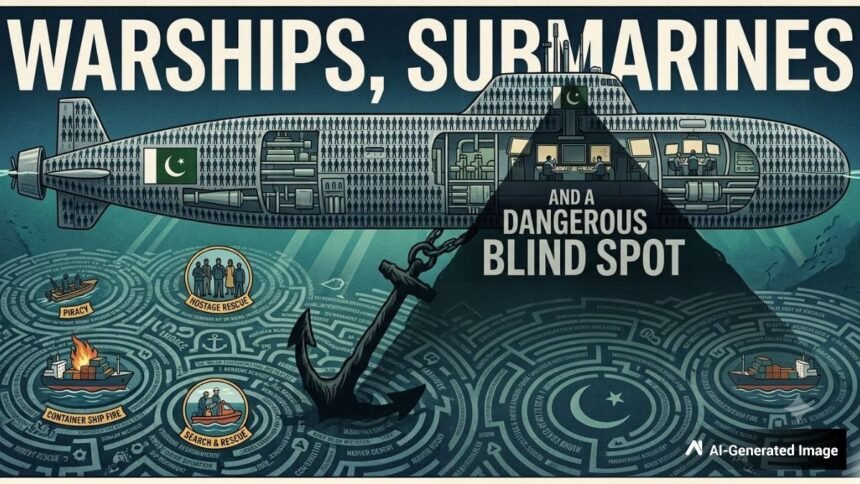
Pakistan Navy’s modernization with Chinese frigates and submarines contrasts with incidents like the August 11, 2026 Tihamah strike impacting its seafarers abroad, raising questions about resource priorities between power projection and citizen protection.
Maritime surveillance and patrol assets have expanded. Naval leadership speaks with increasing confidence about blue-water reach and regional maritime influence, and that narrative is amplified consistently through official statements, exercise participation, and defence-focused media coverage.
On paper, this is a service in the middle of a real transformation.
Running alongside that narrative is a separate, less publicized ledger: a pattern of incidents involving Pakistani seafarers across the Gulf of Aden, Red Sea, and wider Arabian Sea over the past several years – casualties, hijackings, and hostage situations that rarely receive the same attention as a frigate commissioning ceremony.
Placing these two records side by side raises a question Pakistani defence commentary rarely poses directly: what share of naval procurement and doctrine is actually oriented toward protecting citizens at sea, as opposed to deterrence and power projection?

Submarines and frigates serve real strategic functions – regional balance, undersea deterrence, a credible conventional posture. None of those functions has meaningfully reduced the exposure of Pakistani nationals crewing foreign-flagged vessels through the world’s most dangerous shipping corridors.
The August 11, 2026 missile strike on the cargo vessel Tihamah, which killed several crew members including Pakistani nationals near the Bab al-Mandeb Strait, is simply the most recent and starkest entry in that longer pattern, not an isolated anomaly.
Retired officers and naval analysts have periodically raised a version of this question in general terms – whether a “blue-water navy” framing is even the right yardstick for a force whose citizens are more routinely endangered by piracy, hijacking, and now missile strikes on foreign-flagged commercial vessels than by any scenario a submarine or frigate is built to deter. A smaller-scale but more seafarer-oriented posture – faster liaison with flag states, quicker consular and repatriation response, dedicated crew-welfare mechanisms – would plausibly do more for the citizens actually exposed to this corridor’s risk than another vessel added to the order of battle. That case deserves more scrutiny than it currently receives inside Pakistan’s own defence discourse.
None of this is an argument that naval modernization is misguided. Deterrence, alliance signaling with China, and a credible undersea capability serve functions unrelated to seafarer safety, and those functions are not interchangeable with citizen protection – this is a question of resourcing and priority, not a claim that the submarines and frigates are worthless. But priority is precisely the point. A navy’s budget is a statement of what it considers worth protecting, and measured against that statement, the connection between years of modernization and the outcome for Pakistani nationals aboard vessels like the Tihamah is not visible in any procurement line publicly available.
If naval success were judged by citizen-protection outcomes rather than fleet announcements, the metrics would look different from the ones currently celebrated: faster crew repatriation timelines, a standing liaison channel with CMF or the coalition structures operating in the Red Sea, a seafarer welfare fund with teeth, or bilateral arrangements with the flag states that employ the bulk of Pakistan’s maritime workforce.
None of these currently exist in a form that shows up in public records. Until they do, the fleet will keep growing, the press releases will keep arriving on schedule, and the gap between what the navy says it is becoming and what it has actually delivered for its own citizens at sea will keep resurfacing.
(Ashu Maan is an Associate Fellow at the Centre for Land Warfare Studies. He is currently pursuing his PhD from Amity University, Noida, in Defence and Strategic Studies.)