International
oi-Ashish Rana

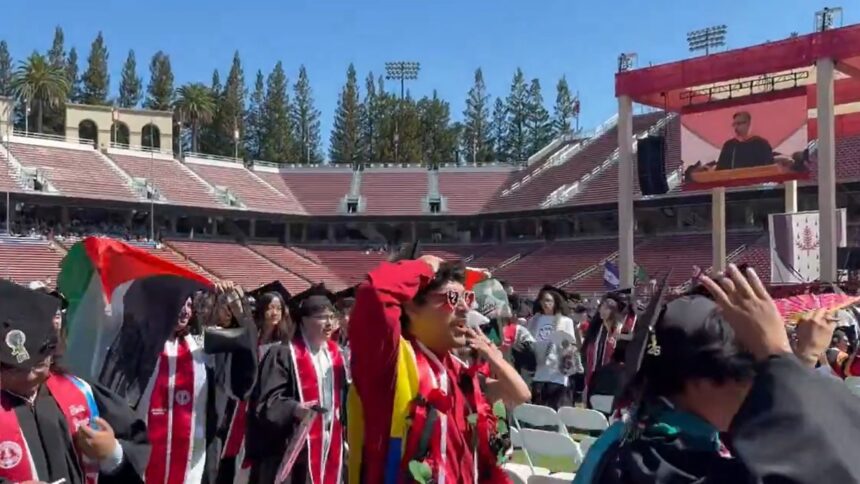
Google CEO Sundar Pichai faced a wave of protests and student walkouts during Stanford University’s 2026 graduation ceremony, as demonstrators voiced opposition to Google’s ties with Israeli government contracts and security agencies.

Google CEO Sundar Pichai faced protests and student walkouts at Stanford’s 2026 graduation ceremony, with demonstrators opposing Google’s involvement in Israeli government contracts like Project Nimbus. Around 200 students protested, waving Palestinian flags, while Pichai delivered his speech.
Around 200 students participated in the protest when Pichai, a Stanford alumnus, was introduced as the commencement speaker. Students stood from their seats, waved Palestinian flags, blew whistles and chanted slogans inside the stadium. Many protesters also wore keffiyehs, a symbol often associated with solidarity with Palestinians.
Students Stage Walkout During Pichai’s Speech
Videos circulating on social media showed graduating students leaving the ceremony in their caps and gowns as Pichai began addressing the audience. Some attendees could also be heard booing while exiting the venue.
Despite the disruption, Pichai continued with his remarks and opened with a light-hearted comment about his public speaking experience.
“I must warn you all, this is only the second commencement speech that I have ever given. The first was literally in my backyard,” Pichai can be heard saying.
The demonstration was organised by student groups Students for Justice in Palestine and No Tech for Apartheid. Protest organisers said the action was intended to draw attention to Google’s business relationships with the Israel Defense Forces (IDF), the US Department of Homeland Security and Immigration and Customs Enforcement (ICE).
Stanford grads walk out as Google CEO Sundar Pichai takes the stage as commencement speaker. No mention of AI, unlike other uni speakers getting booed down this year. Story for @sfgate shortly pic.twitter.com/qvS2rJ91Ip
— Matt Brown (@maattttbrown) June 14, 2026
Project Nimbus Remains A Flashpoint
A major focus of the protest was Project Nimbus, a $1.2 billion cloud-computing agreement involving Google and the Israeli government.
Pro-Palestinian activists have repeatedly criticised the project, arguing that Google’s technology services support Israeli government operations. The issue has sparked internal dissent among some employees and has remained a point of contention on university campuses and within the broader tech industry.
As part of the protest, many students left the official commencement ceremony and attended an alternative gathering known as the “People’s Commencement.”
The event featured Mahmoud Khalil as the keynote speaker, according to SFGate. Khalil drew national attention after being detained by US immigration authorities for more than 100 days because of his involvement in pro-Palestinian activism at Columbia University in 2024.
Pichai Avoids Discussion On Artificial Intelligence
Notably, Pichai chose not to focus on artificial intelligence during his commencement address, despite AI being one of the most pressing topics for graduating students entering the workforce.
Concerns over automation, job displacement and layoffs in the technology sector have fuelled anxiety among many graduates in recent years. Several tech executives have encountered hostile reactions while speaking positively about AI at university events.
Earlier this year, former Google CEO Eric Schmidt and other technology leaders were booed during campus appearances after promoting AI at a time when many young professionals were facing a challenging job market.
Google Chief Says He Remains Optimistic About Young People
The possibility of facing criticism from students had already been raised before the ceremony. During an appearance on the Hard Fork podcast last month, Pichai was asked how he would respond if students booed him during a Stanford commencement speech.
At the time, the Google chief expressed confidence in the next generation and argued that young people would play a central role in shaping the future of artificial intelligence.
“I’ve always been extraordinarily optimistic about the next generation. AI doesn’t change that. These graduates are actually both going to be a big part of driving that progress and also dealing with the impact,” he said.
Although the protests overshadowed portions of the ceremony, Pichai’s remarks continued as demonstrators exited the venue, highlighting the growing intersection of technology, politics and activism on university campuses.