


Bengaluru
oi-Oneindia Staff

Bengaluru’s merchants may not pass the new UPI transaction cost directly on to customers, but some businesses say they could encourage customers to use cash or cards instead once the new Merchant Discount Rate (MDR) kicks in next month.
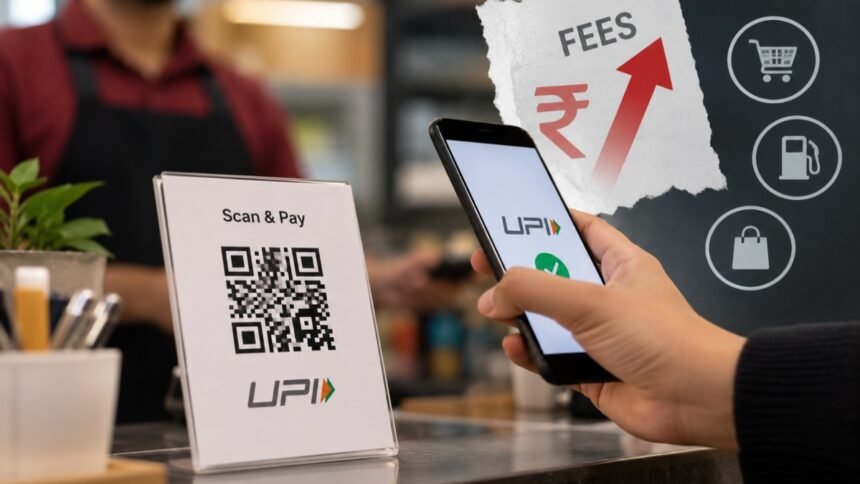
From October 15, specified person-to-merchant UPI transactions above ₹2,000 will attract an MDR of 0.4%, with the charge capped at ₹300 per transaction. The government and NPCI have said the cost will be borne by merchants and customers will not be charged separately for using UPI.
Starting October 15, Bengaluru merchants will incur a 0.4% MDR on UPI transactions exceeding ₹2,000, capped at ₹300. While customers won’t be charged directly, businesses may encourage alternative payments or adjust pricing due to cumulative costs.

But conversations with businesses in Bengaluru suggest that the impact may not end with the merchant simply absorbing the cost.
For some businesses, the concern is the cumulative cost across hundreds of transactions. For others, particularly those selling expensive products, the additional payment cost could eventually find its way into pricing.
‘We Will Try To Bring Down UPI’
Ajay, who runs a pet shop in Bengaluru, said customer retention would make it difficult for his business to impose an additional charge on customers.
Instead, he expects the business to encourage customers to use other payment modes.
“We will never impose it on the customers because ours is a sector where we have to maintain customer retention,” he said.
Ajay said his business could increasingly look at cash and card payments for higher value purchases.
“So mostly, we will be converting customers into either cash payments or card payments. We will try to bring down UPI for sure,” he said.
The concern, he added, is less about one individual transaction and more about how the cost adds up over an entire month.
“If there is a bill of ₹5,000, even a single paise counts. We have around 20 to 60 customers walking in a day. When you calculate it for a month, it is actually a good amount of money,” he said.
For a business handling several high value UPI payments every day, even a relatively small percentage can therefore become a recurring operating cost.

Carpet Sellers See A Different Problem
For high value businesses, the calculation is different.
Pooja, owner of Bunkar Carpets in Koramangala, said most of her business transactions are already through NEFT, particularly because carpets are high value products. However, UPI remains relevant for smaller payments and certain customer transactions.
She said a 0.4% charge becomes more noticeable when the value of the product itself runs into thousands of rupees.
“My product starts from that range. So I have to either include that in my MRP and then sell it, or there is an option of putting it through EFT. Cash would be the very last option,” she said.
According to her, absorbing the additional cost is difficult because the price of a product already factors in transportation and several other business expenses.
“If we cannot shrink margins, because our MRP includes a lot of other aspects like transport and other things, everything has to be calculated and then we work on a healthy margin. How can I compromise on my margin?” she said.
That could leave businesses with two choices: absorb the cost or rework their prices.
Pooja said the impact would be particularly visible on expensive products.
“For something which is ₹10,000 or ₹15,000, those value products definitely make a lot of difference,” she said.
She expects businesses to review their margins and pricing rather than simply absorb the MDR.
“Technically, it will hit when you see the overall transactions. If you talk about one product, it may not affect me that much. But when I’m looking at volume, overall it will affect,” she said.
Could UPI Costs Eventually Become A Pricing Problem?
The new framework does not permit merchants to simply add a separate UPI charge to the customer’s bill. The fee is a merchant side cost.
That, however, does not prevent businesses from responding in other ways.
A pet shop could encourage cash or card payments. A high value retailer could use bank transfers such as NEFT for larger purchases. Another business could review its overall pricing to account for rising payment and operating costs.
This distinction is important because the immediate impact on customers may not appear as a line item saying “UPI charge”. Instead, it could show up as a change in how merchants accept payments or, in some businesses, as a broader pricing adjustment.
Petrol Pumps Want An Exemption
Petrol pump dealers are raising a separate concern.
The All India Petroleum Dealers Association has sought an exemption from MDR for petrol pumps, arguing that dealers operate on fixed margins and have limited room to absorb additional payment costs. The association has also sought clarity on whether oil marketing companies will absorb or reimburse the charge.
Fuel payments above ₹2,000 fall under the special category carrying a flat ₹5 MDR rather than the 0.4% rate.
For petrol pumps, the issue is particularly sensitive because dealers’ margins are linked to the quantity of fuel sold rather than the value of an individual customer’s digital transaction, according to the dealers’ association.

Bengaluru’s UPI Habit Could Face A Small Change
UPI has become one of the most convenient payment options for Bengaluru’s consumers, particularly for high value purchases where carrying cash is inconvenient.
The new MDR does not make UPI a paid service for consumers. But the conversations with Bengaluru businesses indicate that the merchant side cost could change how some businesses handle larger transactions.
For a ₹5,000 UPI payment, 0.4% works out to ₹20. At ₹10,000, it is ₹40, while a ₹50,000 transaction would mean ₹200. The charge reaches the ₹300 cap at ₹75,000.
So, while customers may continue to see UPI as “free”, the businesses accepting those payments are now doing a different calculation.
And for some Bengaluru merchants, the question is no longer whether they will charge customers for UPI.
It is whether they will quietly start asking: “Cash or card?”