


India
oi-Gaurav Sharma

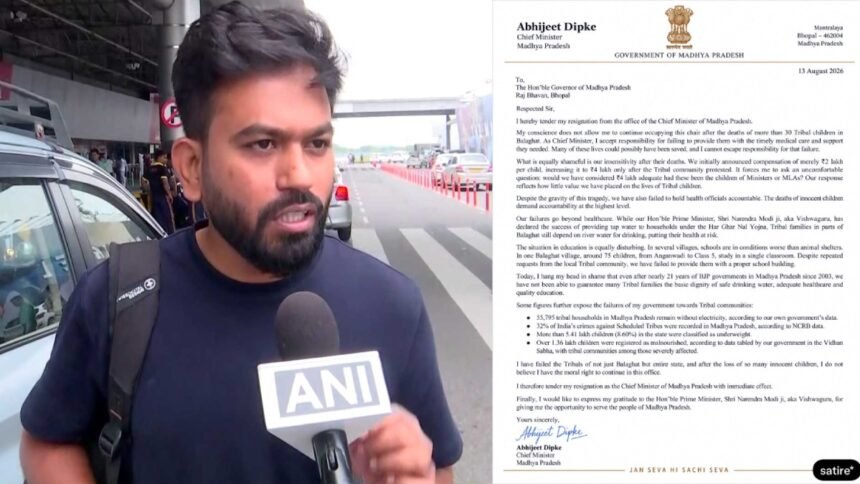
Cockroach Janta Party founder Abhijeet Dipke has sparked a political and legal uproar in Madhya Pradesh by posting a satirical “resignation” letter on X which portrayed him as resigning as the state’s chief minister. The post followed on from a hostile questioning of Dipke when visiting Balaghat, where tribal children are reported to have died from infectious diseases and the lack of treatment.
Dipke shared the letter on X on Sunday, and used it to criticise the Madhya Pradesh government for a series of issues, including the deaths of the Balaghat tribal children in particular. The manner in which the post was presented has attracted sharp criticism from some social media users, who accused Dipke of falsely using an official letter head and implying that he occupied the post of chief minister of the state.
Cockroach Janta Party’s Abhijeet Dipke posted a satirical resignation as Madhya Pradesh CM on X, criticizing state governance amid Balaghat tribal child deaths, sparking controversy over alleged misuse of official letterhead and drawing attention to the High Court’s scrutiny of the deaths.

Why Abhijeet Dipke’s satirical resignation caused a row
The post contained the line, “I hereby resign as the Chief Minister of MP with immediate effect. I thank Hon’ble PM @narendramodi ji for giving me the opportunity to serve the people of MP, an opportunity in which I have clearly failed.” This statement was not a genuine resignation as Dipke does not hold the post of chief minister of Madhya Pradesh.
I hereby resign as the Chief Minister of MP with immediate effect.
I thank Hon’ble PM @narendramodi ji for giving me the opportunity to serve the people of MP, an opportunity in which I have clearly failed.@GovernorMP pic.twitter.com/BVhfJDIf5n
— Abhijeet Dipke (@abhijeet_dipke) September 13, 2026
The satire was directed at chief minister Mohan Yadav and his government and at allegations that some tribal children had died from infectious diseases and the Sagar hooch tragedy. The CJP spokesperson Ashutosh Ranka added to the mock tone by suggesting that Dipke was “running away” from duty.
The controversy stemmed from the fact that some social media users appeared to be taking the post seriously. A social media account (identifying its user as a member of BJP) requested police action, claiming that Dipke was improperly utilising the letter head of the Madhya Pradesh chief minister and misrepresenting himself as the post-holder.
A user requested an impartial investigation and the filing of a case under the relevant provisions of the law. He stated that the case appeared significant on the surface and requested strict action if any offence was found. There has been no confirmed report that an FIR has been filed against Dipke for this post.
What happened during the Balaghat visit
The online spat followed Dipke’s Saturday visit to Adori, Korka and Bondari villages in Balaghat district, which he made to meet families of tribal children who allegedly had died from infectious diseases. He also sought to evaluate local healthcare facilities and visit with residents to discuss access to treatment.
A video of the visit has gone viral. In the video, a woman who is identified as a social media influencer approaches Dipke, who is being driven away in a vehicle and asks him whether he had come to “do politics on corpses” and why he had taken so long to visit the region. Dipke was heard apologising for the delay. The woman said, “A good road has been constructed here. Can’t you see it?” As the exchange became tensed, CJP workers moved Dipke to a different vehicle. As he was leaving, the woman was heard saying, “he ran away, he ran away.”
I ask the govt sponsored reporters who’s responsible for the death of kids in Balaghat?
Their answer was – “सभ्यता” pic.twitter.com/1AnakkS5oq
— Abhijeet Dipke (@abhijeet_dipke) September 13, 2026
Local journalists questioned the presence of influencers from outside the area in a remote village. They raised doubts over whether the group had come independently or had been sent to confront Dipke during his visit. These are allegations and have not yet been proven.
Balaghat child deaths under court scrutiny
This political exchange has occurred against the backdrop of a reported death of tribal children in Balaghat region. The Madhya Pradesh High Court has recently sought a response from the state government in view of allegations that more than 30 children died in the area following contagious illnesses and a lack of proper treatment.
The court sent notices to the state Health Department, the Women and Child Development Department, the Balaghat collector and others while listening to a public interest litigation. The petition alleged that children were being denied adequate medical treatment and had claimed that almost 400 children are being treated in a hospital with only 50 beds.
The allegations have intensified the focus being placed on healthcare delivery to tribal and remote areas of Madhya Pradesh. It is in these areas that delayed diagnosis, a lack of beds, inadequate transport, poor nutrition and deficient primary health systems can transform a seasonal infection into a large-scale public health emergency. The intervention of the court means the state’s response is now a focal point.
For the government, this matter has administrative and political implications. It must respond to the court on the specific allegations being made, while also addressing public concern regarding whether the affected families were offered timely care. For the opposition voices and smaller political groups, Balaghat has become a focal point to question governance, beyond regular party attacks.
Dipke’s satirical post has shifted the debate from a public health issue to that of a political one. Supporters may view it as an attempt to draw attention to alleged state failure, while critics argue that symbols or formats of any official should not be used in a manner that causes confusion. The legal question (if pursued) would hinge on whether authorities find impersonation, forgery or misuse.
The immediate controversy will likely continue online, but the larger issue is that of the condition of families in Balaghat and the state’s account before the High Court. The deaths of children, availability of beds and the quality of medical response are now the key questions that must be answered by the administration.