


India
oi-Pankaj Mishra

There is a particular kind of political death that is slower and more humiliating than electoral defeat- the death of popular trust. In West Bengal and Tamil Nadu, two of India’s most politically consequential states, that process is now well underway, playing out not in dramatic collapses but in the quiet, accumulated grievances of ordinary citizens who once believed in their leaders.
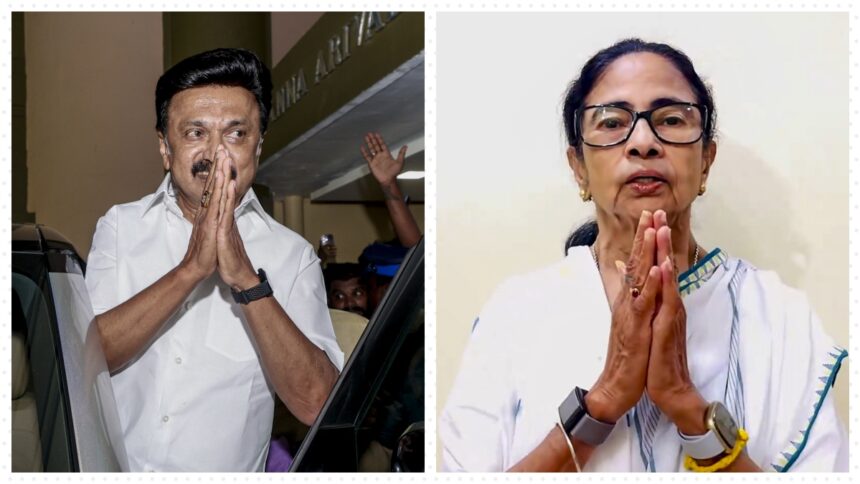
Mamata Banerjee built her political career on being the voice of Bengal’s streets. She was the agitator, the rebel, the woman who stood against the Left’s four-decade machine. That image sustained her through two commanding victories. But power, as it so often does, changed the ecosystem around her. And this time, the erosion is structural.
In West Bengal, the TMC faces declining public trust due to local cadre control over welfare and a ‘syndicate’ economy, whereas Tamil Nadu’s DMK experiences voter fatigue despite welfare delivery, signaling a need for political reinvention over mere longevity.

The most damaging indictment of Trinamool Congress rule is not coming from the opposition. It is coming from the lanes of rural Bengal, where a farmer seeking a government sanction for a pucca house must first negotiate with a local TMC functionary who treats public welfare as a private franchise.
The syndicate economy – where construction materials, labour and even basic civic approvals are controlled by party-affiliated operators – has turned Mamata’s cadre into a parallel taxation system. For a government that rose on the promise of delivering dignity to the dispossessed, this is not merely corruption; it is ideological collapse.

Then there is the question of space – literally. TMC offices have spread across Bengal with the aggressive logic of territorial occupation, encroaching on community grounds, public land, and civic infrastructure. What was once a political organisation has become a presence that people are required to navigate around, not engage with. The symbolism is damning.
In Tamil Nadu, the DMK returned to power in 2021 on the strength of welfare economics – cash transfers, subsidies, and flagship social schemes. M.K. Stalin’s government read the electorate correctly in that election, understanding that Tamil voters respond to tangible delivery. But delivery alone, without a visible commitment to governance quality, institutional reform, or economic transformation, has a short shelf life.

The DMK got caught in the trap of its own success – assuming that popular policies are a substitute for political evolution. Tamil Nadu’s voters have demonstrated before, and appear ready to demonstrate again, that they will not remain static audiences for a party that is.

The broader pattern is one that election strategists and political analysts have begun to name with unusual directness. It has been captured sharply in the aftermath of recent results: “Survival is less about who a party is, and more about how often it can reinvent itself.” What the message describes is not ordinary anti-incumbency – it is voter fatigue with political repetition, with leaders who mistake longevity for legitimacy.
My takeaway from the election results yesterday is that parties and leaders who don’t do things differently are doomed.
Parties whether in power or in opposition need to change their campaign/governance style and mechanisms according to the changing public mood.
Change is the…
— Naresh Arora (@nishuarora) May 5, 2026“>
In contemporary India, that distinction is proving fatal. The message from Bengal and Tamil Nadu is identical, even if the languages differ: the electorate is no longer rewarding memory. It is demanding motion.