



India
oi-Prakash KL

Supreme Court judge Justice Ujjal Bhuyan has once again placed the Constitution at the centre of a contentious public debate, this time over the right to vote and the ongoing controversy surrounding the Election Commission’s Special Intensive Revision (SIR) of electoral rolls.
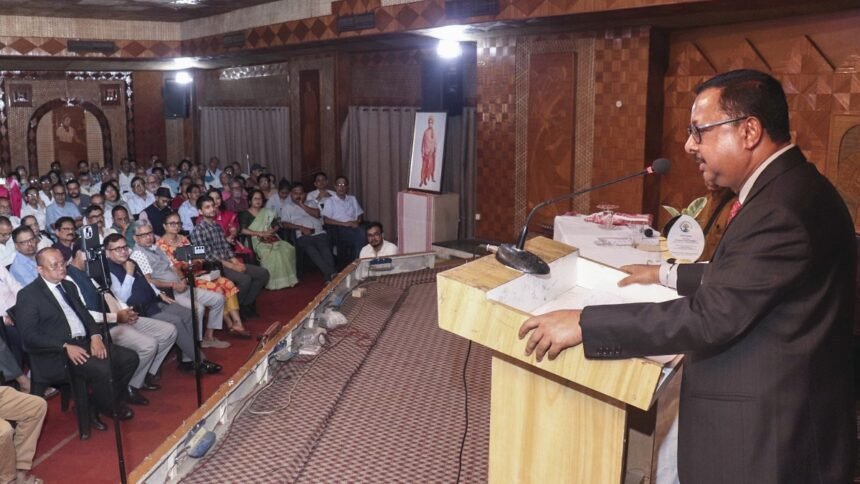
Speaking at the valedictory ceremony of the 19th Justice Bodh Raj Sawhney Memorial Moot Court Competition at NALSAR University of Law in Hyderabad, Justice Bhuyan said any process that could disenfranchise millions of citizens and leave them without voting rights would strike at the heart of the Constitution.
Supreme Court judge Justice Ujjal Bhuyan emphasized that disenfranchising citizens strikes at the Constitution, calling the right to vote integral to constitutional democracy and citizenship. This stance aligns with his judicial career, which consistently upholds constitutional guarantees for ordinary citizens.

His remarks were significant not merely because of their timing, but also because they fit into a broader pattern visible in his judicial career. Over the years, Justice Bhuyan has dealt with questions involving equality, dignity, personal liberty, procedural fairness and the limits of state power.
On the issue of voting rights, he rejected the idea that Indian citizens could effectively be divided into two categories – those who have voting rights and those who do not. He said wholesale disenfranchisement would be contrary to Articles 326 and 14 of the Constitution and described the right to vote as an integral part of constitutional democracy.
Justice Bhuyan also made a strong distinction between the right to vote and an ordinary statutory entitlement. According to him, the right to be a voter cannot simply be viewed as a right flowing from parliamentary legislation such as the Representation of the People Act, 1951. He linked it directly to the constitutional framework governing elections.
His comments also touched upon the procedure for removing names from electoral rolls. Referring to Section 22 of the Representation of the People Act, he stressed the importance of giving a voter a reasonable opportunity to be heard before their name is deleted, except in cases such as the death of the voter.
For Justice Bhuyan, therefore, the question is not merely about an electoral list. It is about the relationship between a citizen and the constitutional system. He described the right to vote as so closely connected with citizenship that separating the two would be akin to taking the soul out of the body.
That emphasis on constitutional rights has been a recurring feature of his judicial journey.
Born in Guwahati on August 2, 1964, Justice Bhuyan comes from a legal family. His father, Suchendra Nath Bhuyan, was a Senior Advocate and former Advocate General of Assam. After schooling at Don Bosco High School and studies at Cotton College in Guwahati, he graduated in Arts from Kirori Mal College in Delhi. He subsequently obtained his law degree from Government Law College, Guwahati, followed by an LL.M. from Gauhati University.
He enrolled with the Bar Council in 1991 and spent two decades practising law, appearing before the Gauhati High Court as well as several of its benches. His practice also took him to tribunals, civil courts, labour courts and consumer forums.
A substantial part of his early legal career was spent representing the Income Tax Department. He served as Junior Standing Counsel and later Senior Standing Counsel for the department, besides holding several government and institutional legal positions.
Justice Bhuyan was designated a Senior Advocate in 2010 and became Additional Advocate General of Assam the following year. In October 2011, he was appointed an Additional Judge of the Gauhati High Court and was confirmed as a permanent judge in 2013.
His judicial career subsequently took him beyond Assam. He moved to the Bombay High Court in 2019 and then to the Telangana High Court in 2021. In June 2022, he became Chief Justice of the Telangana High Court. He was also associated with legal education and served as Chancellor of NALSAR during his tenure as Chief Justice.
In July 2023, the Supreme Court Collegium recommended his elevation to the Supreme Court, and he took oath as a judge of the country’s highest court on July 14 that year.
Some of his significant judgments provide an indication of the issues that have shaped his judicial outlook.
As Chief Justice of the Telangana High Court, Justice Bhuyan authored the judgment striking down the colonial-era Telangana Eunuchs Act, 1919. The law allowed warrantless arrests and registration of transgender persons. The court found the provisions manifestly arbitrary and inconsistent with constitutional guarantees of equality, privacy and dignity.
At the Supreme Court, he has been part of benches dealing with a wide range of issues. In a 2025 case involving maternity leave, he was part of a bench that held that a government employee could not be denied maternity leave for a third child merely because she had remarried.
In another matter concerning armed forces personnel, the court strengthened the presumption in favour of service-related disability where a disease had not been detected at the time of enrolment.
His work has also extended into criminal law. In one case, Justice Bhuyan authored a judgment acquitting a murder accused after finding that an extra-judicial confession, particularly one allegedly made when the accused was in a confused mental state, could not by itself provide a safe basis for conviction.
He was also part of the bench that granted bail to former Delhi Chief Minister Arvind Kejriwal in the Delhi Excise Policy money laundering case. In another ruling, a bench including him held that bail conditions allowing investigating agencies to constantly track an accused’s whereabouts could be arbitrary and unlawful.
His judicial record also includes cases involving victim rights, environmental clearances, banking responsibilities and the distribution of powers between the Centre and states.
Taken together, these cases point to a judicial career that has repeatedly engaged with the question of how constitutional guarantees operate in the lives of ordinary citizens.
That is what gives his latest comments on voting rights a wider context. His warning against disenfranchisement was not simply about the mechanics of electoral-roll revision. It was a reminder that, in a constitutional democracy, citizenship cannot be separated from the rights that give that citizenship meaning.
And his message was unequivocal: no authority, institution or individual is above the Constitution.