


India
oi-Oneindia Staff

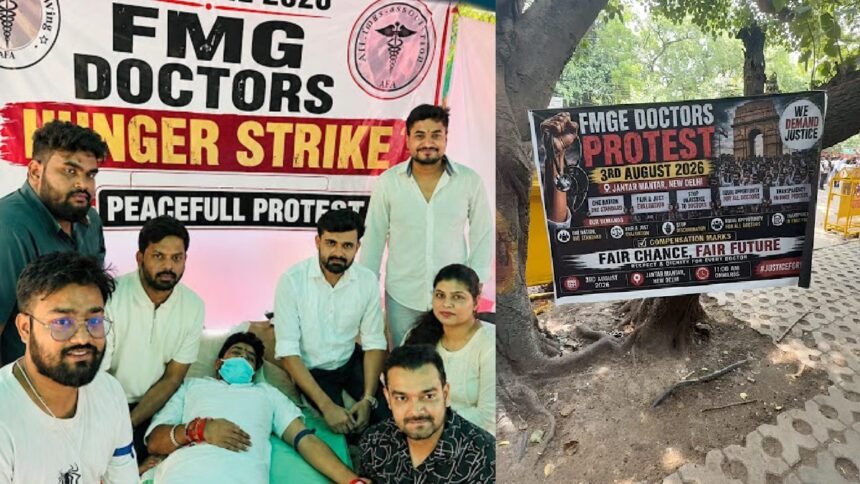
The Foreign Medical Graduate Examination (FMGE) has become a fresh point of concern for medical graduates who say they want greater clarity and fairness from the system that will determine their eligibility to practise in India. The June 2026 examination has triggered protests, with candidates questioning the difficulty of the paper, video-based questions and the transparency of the evaluation process.
For foreign medical graduates, the issue is particularly significant. Predominantly Indian students who have completed or are completing medical education abroad, FMGs must clear the FMGE before becoming eligible to practise medicine in the country. Many of those protesting have therefore sought greater transparency, including clarity on how their answers are assessed and the release of an official answer key.
Medical graduates are protesting the June 2026 Foreign Medical Graduate Examination (FMGE), demanding greater transparency and fairness in its evaluation process, while the National Board of Examinations in Medical Sciences upholds competency standards; an expert panel has suggested potential reforms like holding the exam thrice yearly.

“Foreign medical graduate examination should be conducted as a screening test only. What I demand is full transparency, fair evaluation and answer key release. That will establish trust in the system. Don’t forget that the FMGs are our very own Indian students,” said Dr Vivek Jain, a national-level faculty member.
Dr Vivek Jain’s statement places the issue beyond the question of whether the examination should be made easier. His focus is on trust – whether candidates can be confident that the FMGE is functioning as a screening test and that every student is being assessed through a transparent and fair process.
The protests over the June examination come after a period in which examination integrity has become a major concern among students across the country. The NEET paper-leak controversy sparked widespread student protests and renewed demands for stronger safeguards, accountability and reforms in the examination system.
For many medical aspirants, such controversies can be deeply demotivating. Students spend years preparing for medical careers, often facing intense academic pressure, and uncertainty over examination procedures can leave them questioning whether their efforts will be judged fairly. The FMGE protests reflect similar concerns among foreign-trained medical graduates.
Candidates have also sought relief through grace or compensatory marks, particularly over concerns surrounding the June paper. The National Board of Examinations in Medical Sciences (NBEMS), however, has rejected demands to lower the qualifying standard, maintaining that the FMGE is intended to ensure that doctors trained abroad meet the minimum competency required to practise medicine in India.
At the same time, an expert panel constituted by NBEMS has proposed several changes aimed at making the examination more transparent and candidate-friendly. These include examining the feasibility of conducting FMGE three times a year, allowing candidates access to their recorded responses and reviewing the examination fee. The panel did not recommend grace or compensatory marks for the June examination.
The developments have put the spotlight back on a basic question: how can a high-stakes examination maintain its standards while also giving candidates confidence in the process? For Dr Vivek Jain, transparency is central to that answer. Releasing an answer key and ensuring fair evaluation, he argues, could help rebuild confidence among students who are already under immense pressure.
Dr Vivek Jain’s appeal also carries a wider message for the FMG community. These are not simply candidates appearing for another competitive examination; they are medical graduates seeking an opportunity to continue their profession in their home country. As Jain stressed, “the FMGs are our very own Indian students.”