



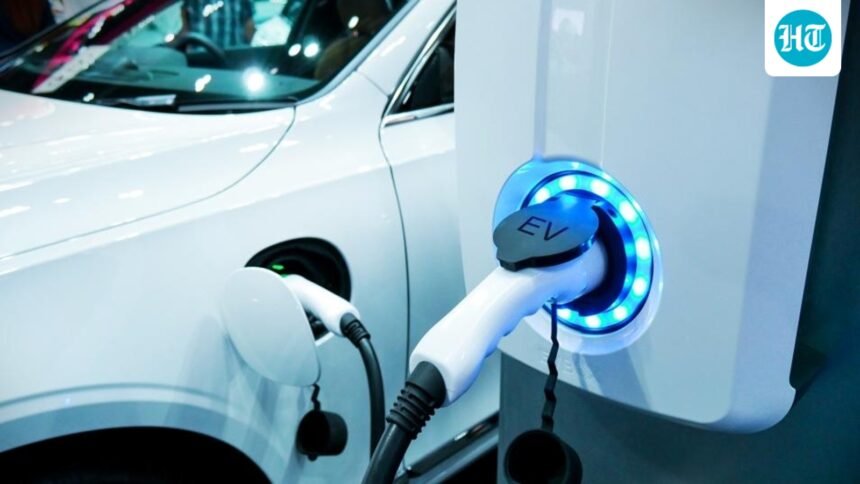
India is in the midst of evolving its energy transition. The discussion is no longer about simply boosting renewable energy capacity or putting more EVs on the road. The focus has shifted to creating a complex interlinked ecosystem consisting of renewable energy produced from different sources, electric vehicles, batteries, charging infrastructure, and modern storage capabilities that would work in sync.
This shift presents an important question: As India builds more energy infrastructure, how do we make that infrastructure smarter?
The next generation of energy infrastructure will need to be more than physical. It will need to be observable, measurable and increasingly intelligent.
Today, the magnitude of transformation is already substantial. Vahan Portal data reports that there were 2.3 million EVs sold in India in the year 2025 and this corresponds with approximately 8% of new vehicles sold. At the same time, India’s total capacity of renewable sources reached 295.55 GW by August 31, 2026 and this includes 168.04 GW of solar and 58.52 GW of wind energy according to the ministry of new and renewable energy. The development of such infrastructure continues and the challenge is shifting from creating the capacity to the management of existing assets.
India is investing significantly in electric mobility, renewable energy, batteries and energy storage. But deploying these assets is only the first step. As millions of distributed assets come online, understanding how they perform in the real world will become equally important.
An EV battery, for instance, is not simply a physical component. Its performance can vary depending on utilisation, charging behaviour, temperature, road conditions and operating patterns. The same principle applies to other distributed energy assets.
As electricity demand becomes more dynamic—with the International Energy Agency forecasting India’s electricity demand to grow at an average annual rate of 6.3% between 2025 and 2027—the ability to monitor and optimise energy assets will become increasingly important.
This is the point where information on batteries and data about products can stay at the centre of the technology. We shouldn’t work only to answer whether any system is working; we have to find out how effective this process is, why it is changing, what will it be like in future, and how it can be improved.
One of the less discussed opportunities is the role that intelligence can play in unlocking capital.
Financing an EV, battery or distributed energy asset involves assessing risks that are still difficult to quantify: Utilisation, battery degradation, maintenance requirements, residual value and operational performance.
NITI Aayog has previously identified technology risk, utilisation risk, operations and maintenance risk and resale risk among the barriers to scaling EV finance. It also noted that limited historical performance data makes it difficult for financial institutions to assess EV asset risk.
Better asset-level data can begin to change this equation.
If lenders and insurers can access credible information on battery health, utilisation patterns, operating conditions and maintenance history, underwriting can gradually move from broad assumptions towards evidence-based assessment.
This could have implications well beyond EVs. As batteries become increasingly important in stationary storage and distributed energy systems, data could become an important bridge between physical assets and financial capital.
The boundaries between mobility and stationary energy are also beginning to blur.
An EV is simultaneously a transportation asset, a battery and an energy consumer. A stationary battery is an energy storage asset, but increasingly forms part of a wider system involving renewable generation, grid requirements and commercial energy consumption.
India’s own electricity planning reflects the scale of this convergence. The Central Electricity Authority’s National Electricity Plan estimates substantial growth in battery energy storage requirements as renewable penetration increases, with the 2031-32 planning scenarios involving tens of GW of BESS capacity and hundreds of GWh of storage.
This creates an opportunity for a common intelligence layer across mobility and stationary energy.
Instead of considering each battery as a separate component, India can start building an ecosystem based on data coming from vehicles, batteries, charging infrastructure, renewable resources and storage systems, thus providing a deeper understanding of energy usage.
Such knowledge can lead to more efficient usage, predictive maintenance, optimising energy consumption and emergence of new commercial models.
There is another reason why India needs to develop its own intelligence capabilities.
Energy and mobility assets do not operate in laboratories. They operate in India’s heat, traffic, varied road conditions, diverse geographies and highly differentiated usage patterns. Charging behaviour, utilisation intensity and environmental conditions can all influence asset performance.
Consequently, intelligence built from real-world Indian operating data could become increasingly valuable.
Over time, such data can help identify patterns that may not be visible through conventional testing or assumptions based on other markets. It can contribute to a deeper understanding of battery behaviour, asset degradation, utilisation and performance under Indian conditions.
For companies building this intelligence layer, the long-term opportunity therefore extends beyond monitoring. It lies in developing an understanding of how energy assets actually behave in India.
India’s energy transition will undoubtedly require massive investment in physical infrastructure. But the infrastructure of the future cannot be defined only by the number of EVs, batteries, charging points or renewable assets deployed.
It will increasingly be defined by how effectively these assets can be observed, understood and optimised.
The next competitive advantage may, therefore, lie not simply in owning energy infrastructure, but in building the intelligence that sits above it.
As India moves toward a more distributed and interconnected energy ecosystem, an intelligence layer can potentially bring together physical assets, real-world data and decision-making, helping make the country’s next generation of energy infrastructure not just larger, but smarter, more measurable and more resilient.
(The views expressed are personal)
This article is authored by Kapil Sharma, co-founder, Ursaa Energyworx.