


Featured
oi-AK Khan

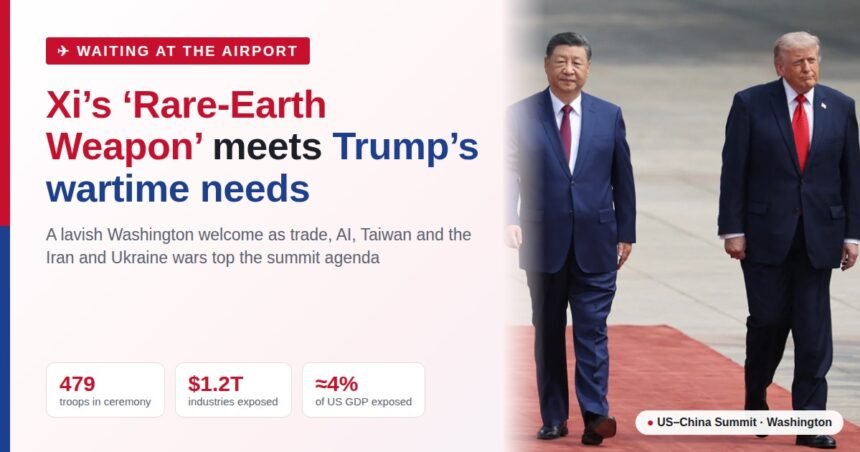
Chinese President Xi Jinping has arrived in Washington for a three-day state visit — his first state visit to Washington in more than a decade — with President Donald Trump personally greeting him at Joint Base Andrews.
Xi Jinping
- ⛏ Dominance of rare-earth processing & magnets
- ⚙ Leverage over US defence, tech and auto supply chains
- ⚑ Taiwan as a non-negotiable red line
VS
Donald Trump
- ⚔ The US war with Iran
- ⚔ The Russia–Ukraine war
- ⚠ Exposure to Chinese critical-mineral supply
01 · The Welcome
Trump on the tarmac — a red carpet and a show of military might
When Xi’s plane landed at Joint Base Andrews in Maryland, Trump was there in person to greet him, rolling out the red carpet for China’s president. First lady Melania Trump joined him for the arrival ceremony, alongside Xi’s wife, Peng Liyuan.
The airport welcome is unusual: US presidents generally receive visiting leaders at the White House rather than meeting them at the airport. Trump’s decision follows the large welcome he received during his own visit to China in May. He has spoken positively about his relationship with Xi and has said he wants the Chinese leader to receive a high-level welcome in Washington.
The official programme for the State Arrival Ceremony went well beyond protocol, with a massive military display involving 479 personnel from all branches of the US Armed Forces, along with a flyover by a B-2 Spirit stealth bomber and four F-22 Raptors.

479
personnel from all branches of the US Armed Forces
1
B-2 Spirit stealth bomber flyover
4
F-22 Raptors in the flyover
10+
years since Xi’s last US state visit
The state visit programme
Day 1 · Joint Base Andrews
✈ State Arrival Ceremony ✓ Done
Trump and Melania Trump greeted Xi and Peng Liyuan personally on the red carpet at the Maryland military base. The ceremony programme included 479 service members and a flyover by a B-2 Spirit and four F-22 Raptors.
Day 2 · The White House
★ Main ceremony
The main ceremony on the second day will see Trump and first lady Melania Trump welcome Xi and Peng at the White House. The two presidents will review troops in the Rose Garden before holding closed-door talks.
The South Drive will be lined with an Armed Forces Full Honour Cordon and displays of US and Chinese flags. The ceremony will also feature a Presidential Salute by the US Marine Silent Drill Platoon and a military review.
Day 2 · Smithsonian
✦ First ladies’ engagement
Melania Trump and Peng Liyuan are scheduled to visit the Smithsonian National Museum of Asian Art.
Day 2, evening · The White House
♔ State dinner
Xi and his wife will later be guests of honour at a state dinner hosted by Trump. The guest list is also expected to bring together some of America’s biggest technology and corporate names, including:
Jeff Bezos Elon Musk Sundar Pichai Michael Dell Jensen Huang Sam Altman

02 · A Striking Contrast
Beijing then, Washington now
The extraordinary pageantry stands in sharp contrast to Trump’s visit to China in May.
Trump received a large welcome when he travelled to Beijing, but Xi did not go to the airport to receive him. There was no comparable fighter-jet flyover and no parallel first-ladies’ engagement. This time, Trump personally met Xi on the tarmac and rolled out the red carpet, while Washington is putting on an unusually elaborate display of military and diplomatic honours.
| Gesture | Trump in Beijing (May) | Xi in Washington (now) |
|---|---|---|
| ✈ Host leader at the airport | ✗ Xi did not go | ✓ Trump met him on the tarmac, red carpet rolled out |
| ✈ Fighter-jet flyover | ✗ None comparable | ✓ B-2 Spirit + four F-22 Raptors |
| ✦ First-ladies’ engagement | ✗ No parallel event | ✓ Smithsonian Museum of Asian Art |
| ★ Military honours | — | ✓ 479 personnel, Honour Cordon, Silent Drill Platoon |
Why it matters: The contrast has drawn attention to the changing dynamics of the US–China relationship. The symbolism comes at a moment when Beijing has significant leverage over Washington through its dominance of critical minerals, particularly rare earths. China controls a dominant share of global rare-earth processing and magnet production, while US industries remain exposed to potential disruptions. Reuters has reported that this dependence has contributed to a less confrontational US approach ahead of the summit.
03 · Trump Arrives Under Pressure
Several crises competing for Washington’s attention
The optics also matter because Trump enters the meeting with several major foreign-policy challenges competing for Washington’s attention.
The US war with Iran
Remains a major issue. Reuters has noted that the Iran conflict is among the issues hanging over the Trump–Xi summit.
The Russia–Ukraine war
Continues to demand American diplomatic and strategic attention.
Critical-mineral dependence
US industries remain exposed to potential disruptions in Chinese rare-earth supply.
How war feeds China’s leverage
The Iran war also has a direct connection to the rare-earth problem. Analysts have warned that prolonged military operations can increase demand for weapons and equipment that depend on critical minerals, highlighting the risks created by America’s dependence on Chinese supply chains. That gives Xi an important negotiating card.
⚔Prolonged warMilitary operations drag on
➜
⚙More weapons neededDemand for arms and equipment rises
➜
⛏More rare earthsThese systems depend on critical minerals
➜
♚Xi’s cardUS reliance on Chinese supply chains deepens
04 · Rare Earths
China’s economic weapon
Rare earths are essential to smartphones, electric vehicles, advanced electronics and military systems.
China dominates the processing and production stages of the supply chain, leaving the US vulnerable to disruptions while alternative supply chains are still being developed.

☎Smartphones
⚡Electric vehicles
⌨Advanced electronics
⚔Military systems
What’s at stake for the US economy
If Beijing were to significantly restrict supplies again, the consequences could extend beyond defence manufacturing to US technology, automobiles and other industrial sectors.
Bloomberg Economics has estimated that industries accounting for roughly $1.2 trillion, or about 4% of US GDP, are exposed to rare-earth inputs, although the actual impact of any disruption would vary by industry and the availability of substitutes.
⚔ Defence manufacturing ⌨ Technology ⛟ Automobiles ⚙ Other industrial sectors
Trump’s balancing act
That vulnerability creates a difficult political and domestic economic calculation for Trump.
▲ Push China too hard
Could risk another supply-chain shock.
⚖
▼ Appear too accommodating
Could become a domestic political liability.
05 · Taiwan
Beijing’s red line
Against this backdrop, China has again made clear that Taiwan remains a core issue.
Xi is expected to reiterate Beijing’s opposition to US arms support for Taiwan and press Washington to reduce its support for Taipei.
★ Beijing’s claimChina claims Taiwan as part of its territory.
◆ The reality on the groundTaiwan has been self-governed for decades.
06 · On the Table
One summit, seven high-stakes issues
The summit therefore brings together trade, tariffs, AI, rare earths, Taiwan and the wars involving Iran and Ukraine — with both leaders having strong incentives to demonstrate that they can protect their respective national interests. Trade, artificial intelligence, Taiwan and Iran are expected to feature in their meetings.
⇄Trade
%Tariffs
◉AI
⛏Rare earths
⚑Taiwan
⚔Iran war
⚔Ukraine war