



In The News
-Sathish Raman


For many women, the decision to consider breast reduction does not begin in front of a mirror. It may begin with a painful bra strap digging into the shoulder, difficulty finding clothes that fit comfortably, avoiding certain physical activities, or simply feeling physically restricted by the size and weight of the breasts.
Breast reduction is evolving beyond just size. Many women seek it for profound comfort, improved body proportion, and enhanced quality of life, often after years of discomfort. This personalized procedure addresses physical and emotional well-being, moving past the misconception of merely changing cup sizes.
For a long time, breast reduction has been viewed primarily as a cosmetic procedure. But that perception is changing.
Today, more women are looking at breast reduction as a decision that can involve comfort, proportion, physical activity, clothing, confidence and overall quality of life.
As a plastic surgeon, I believe it is important to move beyond the simple question of how much breast tissue should be removed. Every woman has different anatomy, expectations and reasons for considering surgery. The right approach should be based on the individual rather than a predetermined cup size.
When Breast Size Becomes More Than an Aesthetic Concern
Breast size is highly individual, and what feels comfortable for one woman may feel physically challenging for another.
Women with larger breasts may experience discomfort around the neck, shoulders and upper back. Some develop deep indentations from bra straps or irritation beneath the breasts. Others find running, exercising or participating in sports uncomfortable.
Even everyday activities can become frustrating.
Finding a well-fitting bra or clothing can be difficult when the upper and lower portions of the body have different proportions. Some women may also change the way they dress because they feel uncomfortable with the appearance or weight of their breasts.
These concerns do not mean that every woman with larger breasts needs surgery. But they are valid reasons to seek a professional consultation.
The important first step is understanding whether breast size is contributing to the concerns a woman is experiencing and whether breast reduction may be an appropriate option.
Breast Reduction Is Not Simply About Choosing a Cup Size
One of the most common misconceptions I encounter is that breast reduction is simply about going from one cup size to another.
In reality, surgical planning is much more individualised.
During a consultation, a plastic surgeon may consider breast volume, shape, skin quality, body proportions, nipple position, asymmetry and the distribution of breast tissue. A woman’s lifestyle and expectations are equally important.
The objective is not simply to make the breasts smaller.
It is to create a result that is appropriate for the individual’s body while addressing the concerns that brought her to consultation in the first place.
This is why two women with apparently similar breast sizes may require very different surgical plans.
Why Some Women Wait for Years Before Seeking Help
Many women live with breast-related discomfort for years before discussing it with a plastic surgeon.
Sometimes they assume that the problem is purely cosmetic. Others believe they should lose weight first, wait until after pregnancy, or simply learn to live with the discomfort.
There can also be concerns about surgery itself — scars, recovery, changes in sensation, breastfeeding and whether the final result will look natural.
These are all questions that deserve an open discussion.
A consultation should not be about persuading someone to undergo surgery. It should be an opportunity to understand the available options, potential benefits, limitations and risks, and then make an informed decision.
Pregnancy Can Change the Conversation
Pregnancy and breastfeeding can significantly change the breasts. Breast volume, skin elasticity and breast shape may change during and after pregnancy.
This is why women who are considering breast reduction and are also planning a future pregnancy should discuss timing with their plastic surgeon.
There is no universal answer to whether breast reduction should be performed before or after pregnancy. The decision depends on individual circumstances, expectations and future plans.
Another important consideration is breastfeeding. Breast reduction can potentially affect the ability to breastfeed depending on the surgical technique and individual anatomy. This should be discussed honestly during the consultation.
What About Scars?
Scarring is one of the most frequently discussed concerns during breast reduction consultations.
Breast reduction involves incisions, and scars are therefore an expected part of the procedure. The pattern and extent of scarring can vary depending on the surgical technique, breast size, amount of tissue being removed and individual healing.
However, scars do not remain unchanged forever. They generally evolve and mature over time, although the final appearance varies from person to person.
I believe patients should have realistic expectations before surgery rather than being promised a scar-free result.
Understanding both the benefits and limitations of surgery is an important part of responsible plastic surgery.
The Importance of Proportion
One of the most important aspects of breast reduction is proportion.
The goal should not be to achieve the smallest possible breast size. A breast size that looks appropriate in relation to one woman’s frame may not have the same effect on another woman’s body.
Body structure, shoulder width, chest dimensions, skin characteristics and overall proportions all matter.
This is why a personalised surgical plan is essential.
For me, a successful breast reduction is not defined only by how much tissue is removed. It is also about whether the final result is harmonious with the patient’s body and whether her concerns and expectations have been appropriately addressed.
Breast Reduction Is a Personal Decision
Despite increasing awareness, breast reduction remains a deeply personal decision.
Some women seek surgery because of physical discomfort. Others are primarily concerned about proportion or clothing. For some, the motivation may be a combination of physical and emotional factors.
There is no single “right” reason.
What matters is that the patient understands what the procedure can and cannot achieve.
A detailed consultation allows us to discuss medical history, breast anatomy, expectations, surgical options, recovery, possible complications and future considerations.
Patients should also have the opportunity to ask questions — including questions they may feel embarrassed to ask.
A Personalised Approach at Pink Apple Aesthetics
At Pink Apple Aesthetics, breast procedures are approached with an emphasis on individual anatomy, patient expectations and appropriate surgical planning.
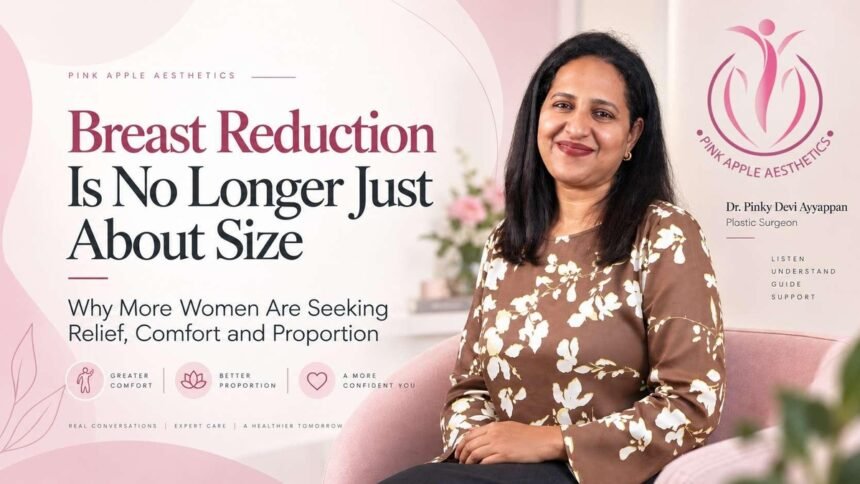
Dr. Pinky Devi Ayyappan, Plastic Surgeon and lead surgeon at Pink Apple Aesthetics, believes that conversations around breast surgery should extend beyond appearance.
Every woman’s body is different, and breast reduction should therefore be approached as an individual surgical decision rather than a standardised procedure.
At Pink Apple Aesthetics in Bangalore, consultations focus on understanding why a woman is considering breast reduction, assessing her anatomy and discussing the potential benefits, limitations, recovery and risks associated with surgery.
The objective is to help patients make informed decisions rather than simply pursue a particular size.
Looking Beyond Size
Breast reduction is often described in terms of reducing volume. But for the woman considering surgery, the real question may be much broader.
Can I exercise more comfortably?
Can I find clothes that fit better?
Can I reduce the physical discomfort I experience every day?
Can I achieve proportions that feel more natural to me?
Can I feel more comfortable in my own body?
These questions are part of a much larger conversation around breast reduction.
Ultimately, the decision to undergo surgery should be personal, informed and based on realistic expectations.
Breast reduction may change breast size, but the reasons women consider it are often about much more than size itself — they can be about comfort, proportion, movement and feeling more at ease in everyday life.
Dr. Pinky Devi Ayyappan
Plastic Surgeon
Pink Apple Aesthetics, Bangalore