


International
dwnews-DW News


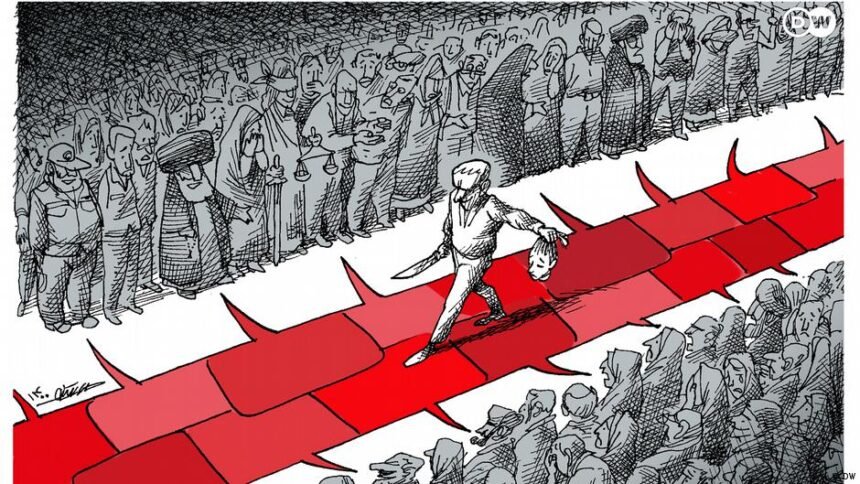
In the early hours of Monday, October 5, 2026, the life of Maryam Yarmohammadi came to a violent end. The 28-year-old mother of two was attacked with knives by her brother and husband on Qeshm Island in southern Iran. Her genitalia were mutilated. She died shortly afterward in hospital. Both her husband and brother were arrested.
On October 5, 2026, Maryam Yarmohammadi, 28, was fatally attacked with knives and mutilated by her husband and brother on Qeshm Island, Iran, in an apparent honor killing.
According to media reports, around 50 relatives gathered outside the hospital to protest the arrests. They reportedly believed that death had been the “least severe punishment” Maryam Yarmohammadi deserved.
What exactly the young woman had done, and why her relatives considered her guilty, remains unknown. Yet both the circumstances of the case and the extreme violence involved follow a familiar pattern seen in so-called honor killings.
In such cases, the underlying belief is often that a man must erase a perceived “dishonor” brought upon the family by a sister, daughter, or wife. Failure to do so may expose him to rejection, humiliation or social exclusion within his community.
No opportunity to defend themselves
What constitutes “honor” or “proper conduct” is often defined by family expectations or local social and cultural norms. In some traditionally conservative regions, even laughing loudly or engaging in a friendly conversation with an unrelated man may be viewed as a violation of these norms.
Women accused of such transgressions are frequently denied any meaningful opportunity to defend themselves against the allegations.
For years, women’s rights activists in Iran have sought to establish nationwide support networks offering counseling and protection to women at risk. One such initiative is the Campaign to End Honor Killings.
Rezvan Moghaddam, a spokesperson for the campaign, told DW that there appeared to be no activist or local group in the region capable of supporting Maryam Yarmohammadi.
Through civil society networks, the campaign has in some cases succeeded in relocating threatened women to safe locations and securing shelter for them.
Moghaddam stressed that Maryam Yarmohammadi’s death should not be interpreted as criticism of women’s rights activists in those regions: “I myself come from Khuzestan in southern Iran and am fully aware of the restrictions that exist there.”
Failure of the justice system
Iran’s laws, based on the interpretations of Shariah, or Islamic law, do not treat women as equal citizens in many areas of life. Their ability to make decisions about education, employment or travel may depend on the consent of their fathers or, later, their husbands.
Even after a woman’s death, male relatives can, under certain legal provisions, influence the course of criminal proceedings.
Iranian criminal law applies the principle of retribution in certain offenses, including murder. In homicide cases, the victim’s relatives may choose either to demand retribution, which can result in the death penalty, or to pardon the perpetrator.
These provisions raise particular concerns in cases of honor killings. When an alleged perpetrator is also among the relatives empowered to influence decisions on punishment or forgiveness, a serious conflict of interest emerges.
Such situations expose the protection gaps critics say exist within Iran’s justice system regarding violence against women.
According to a 2020 study by Iran’s Police Academy, honor killings — defined as the murder of a woman by male relatives such as her father, brother or uncle for allegedly violating social norms of modesty and family honor — accounted for up to 45% of all murders in some traditionally conservative provinces in western and southern Iran.
In March 2025, the UN Special Rapporteur on human rights in Iran reported that at least 179 women were murdered by men within their family circles in 2024. These cases were recorded as femicides.
When violence is socially legitimized
In Maryam Yarmohammadi’s case, it was above all the extraordinary brutality of the crime that shocked the public. The murder triggered a wave of grief and outrage on social media. Many women reacted strongly to what they saw as a femicide driven by hatred in the name of “honor” and “shame.”
At the same time, numerous comments focused on victim-blaming, holding the victim responsible for her own death. Others described the killing as the “punishment of an unfaithful woman” or attempted to justify it by “understanding the men’s anger.”
Psychoanalyst Saba Alaleh argues that, for years, men have been socialized to believe they are responsible for controlling women and monitoring their behavior and decisions. Male identity, she said, is simultaneously tied to a woman’s “obedience.”
Violence becomes normalized when beliefs, social approval and silence reinforce one another within this structure, Alaleh explained.
“When cultural, social, political, economic, legal and educational factors are closely intertwined, they acquire enormous power. Under such conditions, women are also highly economically dependent and lack sufficient social support. Preventive mechanisms are absent as well. All of this increases the risk of violence.”
Women’s struggle for self-determination
Atefeh Rangriz, a sociologist and women’s rights activist, told DW: “Femicides have always existed, and their political manifestations can be traced throughout history, from forced unveiling [under Reza Shah Pahlavi in the 1930s] to the slogan ‘Either the headscarf or blows to the head’ in the Islamic Republic.”
Rangriz believes that women understand the path toward liberation and, despite tremendous obstacles, have achieved significant progress over the past decades.
Women in Iran have been driving since 1940. They have been allowed to vote and run for political office since 1963. Women account for half of all university graduates in the country. The number of women filing for divorce or mutually ending unhappy marriages has also continued to rise.
The “Woman, Life, Freedom” movement, which emerged from the nationwide protests following the death of Jina Mahsa Amini in police custody in 2022, has further transformed public perceptions of women in Iran.
“Women have learned to focus on the present rather than postponing justice to the future. They demand it now,” said Rangriz. “They want to exercise autonomy over their own bodies, live as they choose, and free themselves from the structures of domination, oppression and exploitation. It is a kind of radical revolution.”
Many Iranian women no longer wear the mandatory hijab in public, openly defying the Islamic Republic’s dress regulations.
Yet hardly anyone asks what the young mother Maryam Yarmohammadi wanted, or how she wished to live. She was brutally killed.
This article was originally written in German.
Source: DW