


Entertainment
oi-Swastika Sruti

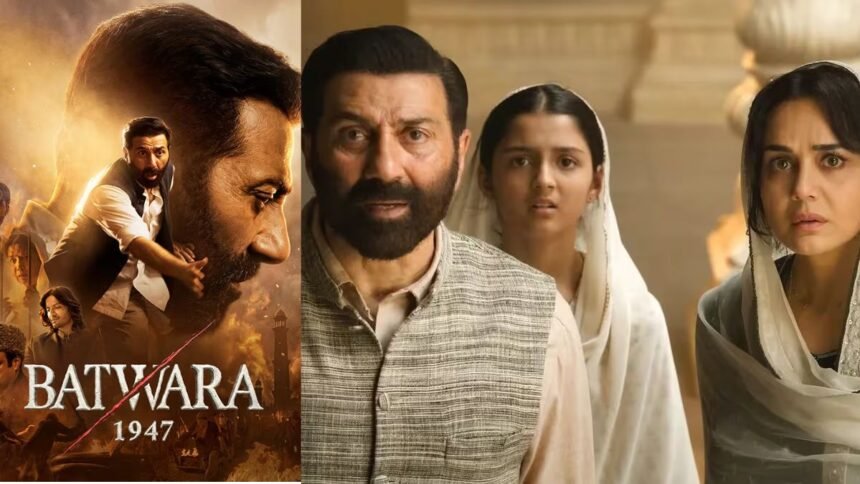
Batwara 1947 arrives with a promising idea: tell the story of Partition without reducing it to a simple Hindu-versus-Muslim conflict. Directed by Rajkumar Santoshi and starring Sunny Deol, Preity Zinta, Shabana Azmi and Karan Deol, the film tries to look at 1947 through the eyes of people who were caught between violence, displacement and humanity.

Batwara 1947, directed by Rajkumar Santoshi and starring Sunny Deol, Preity Zinta, Shabana Azmi, and Karan Deol, released August 14, 2026, portrays the Partition via shared human suffering and humanity. The film’s strong message and Shabana Azmi’s performance are noted, but execution is uneven with pacing issues.
It released in theatres on August 14, 2026.
The film has an important message, but the execution is drastic. The first half moves slowly and takes too long to create an emotional connection. Things become more engaging after the interval, particularly when the conflict between Sikander and his son Javed becomes central to the story.
Sunny Deol As A Muslim Character: Does It Work?
This is probably the biggest challenge for the audience.
Sunny Deol is an actor most Indians instinctively associate with characters from films such as Gadar and Border – loud, aggressive and deeply connected with patriotic action cinema. Here, he plays Sikander Mirza, a Muslim man who moves to Lahore with his family after Partition. His wife Hameeda is played by Preity Zinta, while their son Javed is played by Sunny’s real-life son Karan Deol.
And that is where the film struggles.
It is not that Sunny Deol cannot play a Muslim character. The problem is that the character does not always feel naturally rooted in the world the film creates. There are moments when the audience is reminded more of Sunny Deol the star than Sikander Mirza the character.
Even small details can feel distracting. For instance, when Sikander refers to his wife as “begum”, it can sound forced rather than something that naturally belongs to the character and period.
For an actor whose screen image is so strongly established, the transformation needed to be deeper. Sunny does settle into the quieter portions of the role, but the film never completely makes you forget the larger-than-life Sunny Deol persona.
Karan Deol Is The Weakest Link
Karan Deol plays Javed Mirza, Sikander and Hameeda’s son. The casting could have been an interesting choice because the father-son conflict is an important part of the story.
But unfortunately, the performance does not always match the emotional weight of the character.
Javed is supposed to carry the scars and anger of Partition-era violence. He has witnessed brutality and is pulled towards the wrong side of the conflict.
All of his angry scenes feel more performed than lived.
Instead of feeling the character’s rage, there are moments when the expressions and delivery become distracting. The emotional scenes needed greater control, especially because Javed’s journey is supposed to represent how hatred can pass from one generation to another.
The basic idea is strong. The execution is not.
Preity Zinta Looks Like She Has Forgotten To Act
Preity Zinta returns to the big screen after an eight-year gap, and that itself creates curiosity. She plays Hameeda Mirza, Sikander’s wife and Javed’s mother.
But her performance is surprisingly flat.
Hameeda is surrounded by fear, uncertainty and family conflict, yet Preity’s expressions often remain on the same emotional level. There are scenes where the character should be frightened, heartbroken or angry, but the performance does not always communicate those emotions strongly enough.
This is particularly noticeable because Shabana Azmi is performing at an entirely different level.
Preity does have moments where she works well opposite Sunny Deol, especially in the family’s emotional scenes. But overall, the role needed more intensity.
Shabana Azmi Is The Heart Of The Film
If there is one performance that consistently holds the film together, it is Shabana Azmi as Mai.
Mai is an elderly Hindu woman who refuses to leave the haveli that has been her home. The Mirza family initially sees her as an obstacle, but their relationship gradually changes.
What makes Mai important is that she does not become just another Partition victim. She becomes a symbol of the humanity that survives even when society around her is collapsing.
Shabana plays the character with tremendous restraint. She does not need loud dialogues to communicate pain. A look, a pause or a small gesture often says more.
The Film’s Best Idea: Partition Did Not Kill Only One Community
This is where Batwara 1947 deserves credit.
The film tries to move away from the familiar idea that Partition can be understood only through one community’s suffering. Hindus suffered. Muslims suffered. Families were separated, homes were abandoned and millions were forced to leave everything behind.
The film’s central message is that violence does not belong to one religion, and humanity does not belong to one religion either.
That is a powerful idea, especially at a time when young Indians are increasingly questioning attempts to bring religious divisions into every public conversation.
The film repeatedly comes back to the idea that people can choose humanity even when hatred is being sold to them as identity.
Where The Screenplay Falls Short
The biggest problem with Batwara 1947 is that several character transformations happen too quickly.
The Mirza family initially wants Mai out of the haveli. Later, they are willing to risk their lives for her. The emotional change is understandable, but the film does not spend enough time showing how that relationship develops.
Similarly, some potentially powerful supporting characters are not used to their full potential.
Ali Fazal’s refugee poet Nasir Kazmi is one such character. He represents another side of Partition the loss of home, love and identity. His story could have added considerable emotional depth, but the film sidelines him when the larger conflict takes over.
Final Verdict: A Good Message, Uneven Execution
Batwara 1947 has a story worth telling.
Its strongest point is its attempt to look at Partition through the lens of shared human suffering rather than communal blame. That idea is relevant even today.
Sunny Deol gives the film much of its required weight, while Shabana Azmi delivers the standout performance. Preity Zinta is serviceable but underwhelming, and Karan Deol struggles to carry some of the film’s most demanding emotional scenes.
The film is also held back by a slow first half and abrupt character developments.
If you go expecting another Gadar, you may be disappointed. If you watch it as a Partition drama about hatred, displacement and the possibility of humanity surviving all three, there is enough here to make the film worth considering.
Rating: 1.5 /5