



India
oi-Madhuri Adnal

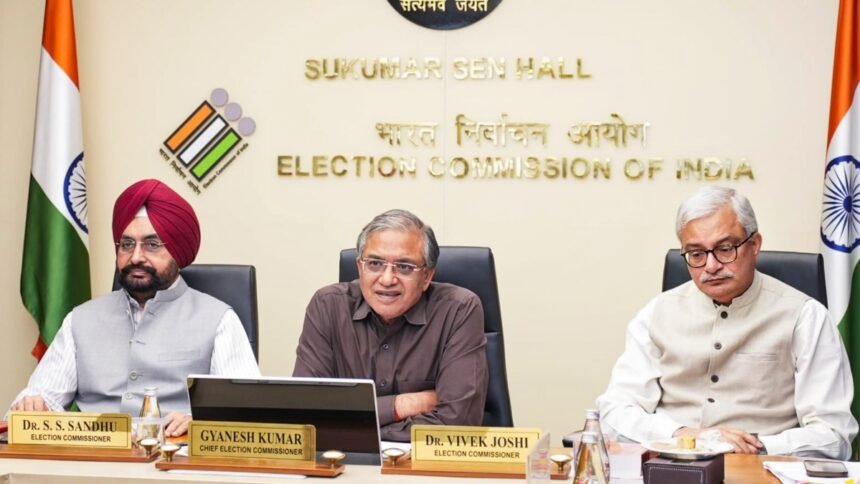
The reported differences between Chief Election Commissioner Gyanesh Kumar and fellow Election Commissioners Sukhbir Singh Sandhu and Vivek Joshi have brought an old constitutional question back into focus: when the three members of the Election Commission disagree, who has the final say?

Disagreements between CEC Gyanesh Kumar and Election Commissioners Sandhu and Joshi over electoral roll revisions raise constitutional questions about the Election Commission’s decision-making process, clarifying that the 2023 Act mandates majority rule, not a CEC veto, when consensus fails.
The question has gained urgency after The Indian Express reported that Sandhu and Joshi recorded at least 14 objections over 10 months to decisions connected with the Special Intensive Revision of electoral rolls. Their concerns reportedly covered issues including changes to Form 6, access to electoral roll databases and the handling of voter deletions and additions.
The Election Commission has acknowledged the existence of the objections but described them as part of its decision-making process. It has maintained that decisions taken by the Commission, including those related to the SIR, were unanimous.
The controversy has therefore moved beyond the SIR itself. It has raised questions about how a three-member constitutional body is expected to function when its members disagree, and what powers the CEC has in relation to the other two Election Commissioners.
The Constitution does not make the CEC a sole decision-maker
The starting point is Article 324 of the Constitution.
It gives the Election Commission responsibility for the “superintendence, direction and control” of electoral rolls and the conduct of elections to Parliament, state legislatures and the offices of President and Vice-President.
The provision also says the Commission consists of the Chief Election Commissioner and such number of other Election Commissioners as the President may decide.
That wording is important because the Constitution does not require the Election Commission to always have three members. For several periods in its history, it functioned with only a single CEC. The present three-member structure has been in place since October 1993.
The Supreme Court has, however, made it clear that once other Election Commissioners are appointed, the Commission functions as a multi-member body.
Does the CEC have more power than the other two?
This question reached the Supreme Court in the 1990s.
In T N Seshan v Union of India, the then CEC challenged the government’s decision to appoint Election Commissioners and argued, among other things, that the CEC had a superior position.
The Supreme Court did not accept that interpretation. It held that the Commission becomes a multi-member body once Election Commissioners are appointed and that the CEC does not have a veto over them.
The principle is particularly relevant to the current controversy because the Election Commission’s business is not supposed to depend solely on the CEC’s individual decision.
The law currently provides a mechanism for resolving differences.
Under Section 18 of the Chief Election Commissioner and Other Election Commissioners Act, 2023, the Commission is expected to conduct its business unanimously as far as possible. If the members disagree, the matter is decided by majority.
That means the CEC does not automatically get the final word simply because he is the head of the Commission.
The same provision allows the Commission to determine the distribution of its work, but that is also to be done through a unanimous decision.
Why the latest objections matter
The significance of the latest disclosures lies not simply in the fact that two Commissioners disagreed with the CEC.
Differences between members of a constitutional body are not, by themselves, unusual or unlawful.
What has attracted attention is the nature and frequency of the objections.
According to The Indian Express, Sandhu and Joshi formally recorded objections at least 14 times over the past 10 months. They reportedly questioned changes to Form 6, the centralisation of electoral roll databases and decisions concerning voter additions and deletions.
In the case of Form 6, the two Commissioners reportedly argued that changes to the statutory form could not be made simply through an SIR order or internal instructions and would require changes to the relevant rules. Sandhu subsequently described the changes as “unauthorised” and “illegal” in a note.
The two Commissioners also raised concerns about the increasing centralisation of the electoral roll database and whether statutory officials at the state and constituency level continued to have the access required to perform their responsibilities.
These issues go to the heart of how electoral rolls are prepared and maintained.
What happens when the Commission disagrees?
The law provides a relatively straightforward answer: decisions are to be taken by majority when consensus is not possible.
But the current dispute raises a different practical question: how does that majority rule work when two members say decisions were taken without their knowledge?
The reported objections suggest that this is where the controversy lies.
The Election Commission’s response has been that the objections were part of the deliberative process and that its final decisions were unanimous. The Commission has not disputed the existence, dates or contents of the 14 notes reported by The Indian Express.
The disagreement therefore appears to concern not merely whether dissent existed, but how those objections were dealt with before decisions were finalised.
How are Election Commissioners appointed?
The other constitutional issue concerns how the members of the Election Commission are selected.
For years, the President appointed the CEC and Election Commissioners on the advice of the Union government.
That system was challenged before the Supreme Court. In Anoop Baranwal v Union of India in 2023, a Constitution Bench directed that appointments should be made by a committee consisting of the Prime Minister, the Leader of Opposition and the Chief Justice of India until Parliament enacted a law on the subject.
Parliament subsequently passed the Chief Election Commissioner and Other Election Commissioners Act, 2023.
The new law replaced the Chief Justice with a Union Cabinet minister nominated by the Prime Minister. The selection panel now consists of the Prime Minister, the Leader of Opposition in the Lok Sabha and the nominated Union Cabinet minister.
The law has itself been challenged before the Supreme Court. The challenge argues that the new selection mechanism does not provide the institutional independence contemplated by the 2023 judgment. The Supreme Court has not stayed the law or appointments made under it.
On Wednesday, the Supreme Court’s consideration of the challenge added another layer to the debate, with a two-judge bench giving a split view on whether the matter should go before a larger bench.
Removal rules are different for the CEC and other Commissioners
The Constitution also treats the CEC differently when it comes to removal.
Article 324 provides the CEC with protection similar to that available to a Supreme Court judge. Removal requires the grounds and procedure applicable to a Supreme Court judge, including a parliamentary process based on proved misbehaviour or incapacity.
The other Election Commissioners do not enjoy exactly the same protection.
An Election Commissioner can be removed from office only on the recommendation of the CEC.
This creates an unusual constitutional arrangement: the CEC and the other Commissioners participate together in the Commission’s decision-making, but their protections against removal are not identical.
The larger issue
The latest SIR controversy has therefore brought several separate questions together.
One concerns the treatment of voter rolls and the safeguards surrounding changes to them. Another concerns the extent to which the CEC can act independently of the other Commissioners. A third concerns the institutional design of the Election Commission itself, including how its members are appointed and removed.
The law does provide for disagreements: where consensus fails, the majority view prevails.
The more difficult question raised by the latest episode is whether that mechanism is sufficient when members of the Commission allege that decisions were taken without their knowledge or that statutory safeguards were bypassed.
That is ultimately a question not just about one SIR exercise, but about how India’s election machinery is expected to function when the people entrusted with running it do not agree.