


By using this site, you agree to the Privacy Policy and Terms of Use.
Accept
Next India Magazine
  • Home
    • Home 2
    • Home 3Hot
    • Home 4
    • Home 5New
  • Home
  • Opinion

    That Provide Critical Analysis on Political Decision-Making

    krutikadalvibiz@gmail.com

    Analyzing Global Dynamics and Unraveling Key Policy Initiatives

    krutikadalvibiz@gmail.com

    Luxurious Stays Redefining Hospitality at Hotel Havens

    krutikadalvibiz@gmail.com

    Electric Cars Subsidies by German Taxpayers End Up on Foreign Roads

    krutikadalvibiz@gmail.com

    Challenge and Inspire Future of Political Thought

    krutikadalvibiz@gmail.com

    Assessing the Diplomatic Challenges and Global Security

    krutikadalvibiz@gmail.com
  • World
  • Politics
  • Market
  • Health
  • Insurance
  • Pages
    • Blog Index
    • Contact US
    • Search Page
    • 404 Page
    • Technology
    • World
  • Pages
    • Blog Index
    • Search Page
    • 404 Page
  • Technology
    TechnologyShow More
    Ramya Sudha Vinukonda: A Biology Teacher Turning Government School Classrooms into Spaces of Possibility
    6 Min Read
    Dr. Nishant Sawant: The Mind Behind Secure Digital Progress
    4 Min Read
    NASA’s Artemis II Mission Rekindles Humanity’s Dream of Deep Space Exploration
    5 Min Read
    Buying a Car Will Soon be Like Buying a Phone, Why Your Next Car Could be an EV
    Hands-On With the iPhone 13, Pro, Max, and Mini
    4 Min Read
  • Posts
    • Post Layouts
      • Standard 1
      • Standard 2
      • Standard 3
      • Standard 4
      • Standard 5
      • Standard 6
      • Standard 7
      • No Featured
    • Gallery Layouts
      • Layout 1
      • Layout 2
      • layout 3
    • Video Layouts
      • Layout 1
      • Layout 2
      • Layout 3
      • Layout 4
    • Audio Layouts
      • Layout 1
      • Layout 2
    • Post Sidebar
      • Right Sidebar
      • Left Sidebar
    • Review
      • Stars
      • Scores
      • User Rating
    • Content Features
      • Highlight Shares
      • Inline Mailchimp
      • Print Post
      • Inline Related
      • Source/Via Tag
      • Reading Indicator
      • Content Size Resizer
    • Table of Contents
      • Full Width
      • Left Side
    • Sponsored Post
  • Contact
  • Pages
    • Search Page
    • 404 Page
Reading: Delhi Monsoon Shock: Only 1 ‘Good’ Air Day In 92 Days Despite Heavy Rain
SUBSCRIBE
Next India MagazineNext India Magazine
Font ResizerAa
  • My Saves
  • Economics
  • Technology
  • My Interests
  • World
  • My Feed
  • History
  • Business
  • Technology
  • Lifestyle
  • Fashion
  • Health
  • Technology
  • World
Search
  • Pages
    • Blog Index
    • Contact Us
    • Search Page
    • 404 Page
  • Home
    • Home 1
    • Home 2
    • Home 3
    • Home 4
    • Home 5
  • Home
  • Blog
  • Categories
    • Technology
    • Lifestyle
  • Personalized
    • My Feed
    • My Saves
    • My Interests
    • History
  • Demos
  • Categories
    • Technology
    • Business
    • Fashion
    • Economics
  • Bookmarks
  • Categories
    • Technology
    • Health
    • World
  • More Foxiz
    • Blog Index
    • Sitemap
  • Bookmarks
  • Contact
  • More Foxiz
    • Sitemap
Have an existing account? Sign In
Follow US
  • Home
  • World
  • Contact
  • Blog
© Foxiz News Network. Ruby Design Company. All Rights Reserved.
World

Delhi Monsoon Shock: Only 1 ‘Good’ Air Day In 92 Days Despite Heavy Rain

India Times Now
Last updated: October 1, 2026 1:23 pm
India Times Now
6 Min Read
Share
SHARE

Contents
PM2.5 Fell During Rain But Returned QuicklyMonsoon Air Was Better Than April-May, But Not CleanWhat Does ‘Moderate’ Air Quality Mean?Rain Cannot Remove All Types Of PollutionVehicles And Industry Can Keep Pollution In The AirPollution Could Rise Again Before Winter

New Delhi

oi-Swastika Sruti

Time
Published: Thursday, October 1, 2026, 18:38 [IST]

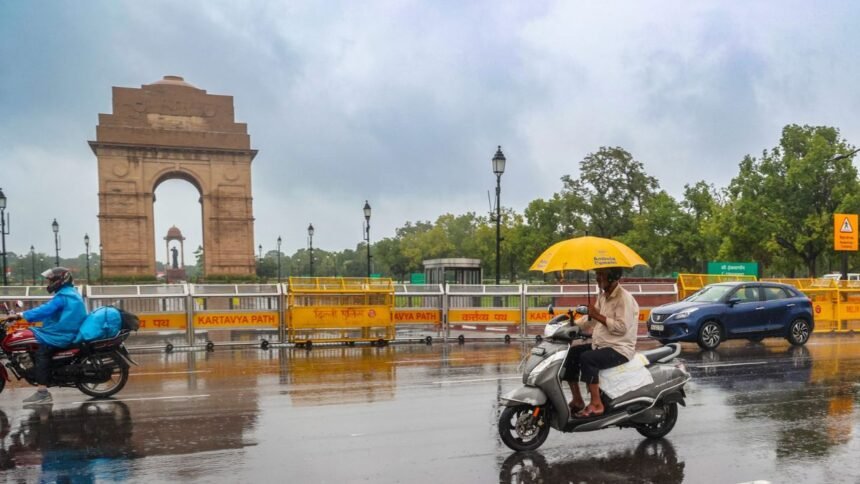
Although the monsoon season of 2026 witnessed a lot of rainfall in Delhi, it was unable to keep the air of the city clean. In a recent study conducted by the Centre for Science and Environment (CSE), it was found that there was only one day when the air quality was ‘Good’ in Delhi from June 1 to August 31, 2026.

Delhi Monsoon Shock
Delhi Monsoon Shock

A CSE study revealed Delhi had only one ‘Good’ air quality day during the 2026 monsoon season (June-August), despite significant rainfall. While rain temporarily lowered PM2.5 levels, they quickly rebounded, and gaseous pollutants like ground-level ozone remained a concern.

The study was conducted keeping in view the weather and air quality of the monsoon season, which comprised 92 days. During this period, Delhi witnessed 576.9 mm of rainfall according to the data available for Safdarjung and Palam.

PM2.5 Fell During Rain But Returned Quickly

According to the findings from the study conducted by CSE, rainfall had a temporary effect on PM2.5, which is among the most important pollutants of the city’s air.
The average concentration of PM2.5 during rainfall is 32.7 micrograms per cubic meter. However, the effects are only temporary.

After 24 hours, PM2.5 concentration becomes 36.2 micrograms per cubic meter. In 48 hours, the concentration increases to 45.1 micrograms per cubic meter.

Consequently, there is an increase in PM2.5 by about 37.9% in 48 hours after rainfall.
Another comparison was made between pollution levels before, during and after six rainfall cases in the monsoon season. Pre-rain PM2.5 concentration was 40.6 micrograms per cubic meter, while during rainfall it was 32.7 micrograms, a decrease of about 19.5%.

However, after rainfall, the process of accumulation of pollutants starts again. At 48 hours, PM2.5 concentration becomes 45.1 micrograms per cubic meter, 11.1% higher than before rainfall.

Monsoon Air Was Better Than April-May, But Not Clean

Delhi’s overall air quality did improve during the monsoon compared with the hotter months immediately before it.

According to the CSE analysis, Delhi’s average PM2.5 concentration during April and May was 60.2 micrograms per cubic metre. During the June-August monsoon period, it dropped to 40.2 micrograms.

That represents a reduction of approximately 33.2%.

However, lower pollution levels did not mean consistently clean air.

Out of the 92 monsoon days:

  • 1 day had ‘Good’ air quality
  • 35 days had ‘Satisfactory’ air quality
  • 53 days had ‘Moderate’ air quality
  • 3 days had ‘Poor’ air quality

The only ‘Good’ air day was July 9, when the average rainfall recorded at Safdarjung and Palam was 67.75 mm.

Interestingly, Delhi’s highest single-day rainfall during the monsoon was recorded on August 8, at 101.05 mm. Even then, the city’s air quality was classified as only ‘Satisfactory’.

What Does ‘Moderate’ Air Quality Mean?

The CSE study points out that ‘Moderate’ does not mean that the air is completely clean.
Under the classification discussed in the study, 24-hour average PM2.5 levels in this category can range between 61 and 90 micrograms per cubic metre.

This is above India’s national PM2.5 standard of 60 micrograms per cubic metre.
For comparison, during April-May, Delhi had 38 Moderate days, 17 Poor days and six Satisfactory days. There was not a single ‘Good’ air day during those 61 days.

Rain Cannot Remove All Types Of Pollution

Rain is effective at bringing down particulate pollutants such as PM2.5 and PM10 by removing some particles from the air.

However, gaseous pollutants are a different problem.

The CSE study found that ground-level ozone, nitrogen dioxide and carbon monoxide remained important pollutants during several monsoon days.

Ground-level ozone was the leading pollutant on 20 monsoon days. It had also been a major pollutant on 49% of the days during the summer period analysed by CSE.
Nitrogen dioxide emerged as the leading pollutant on 10 monsoon days, while carbon monoxide was the major pollutant on 7% of monsoon days.

Vehicles And Industry Can Keep Pollution In The Air

According to the CSE analysis, emissions from vehicles, diesel generators and industries can continue contributing gaseous pollutants even when it rains.

When sunlight returns after cloudy or rainy conditions, chemical reactions involving these pollutants can contribute to the formation of ground-level ozone. This explains why heavy rain does not automatically translate into consistently clean air in Delhi.

The study therefore highlights that controlling only particulate pollution is not enough. Different sources and types of pollution need to be addressed throughout the year.

Pollution Could Rise Again Before Winter

The temporary improvement brought by the monsoon is expected to weaken as weather conditions change. As winter approaches, lower wind speeds and changes in the height of the atmospheric mixing layer can make it harder for pollutants to disperse.

CSE has therefore argued that Delhi-NCR cannot depend only on emergency measures during the winter pollution season.

The study calls for pollution-control measures throughout the year, particularly targeting emissions from vehicles, industries, construction activity, waste burning and diesel generators.

TAGGED:AirDayDaysDelhiGoodHeavymonsoonRainShock
Share This Article
Facebook Email Copy Link Print
Previous Article How to realise you are starting to resent someone? Therapist shares 5 signs to watch out for before things turn worse
Next Article Anup Bagchi appointed MD & CEO of HDFC Bank for 3 years, set to take charge from October 27
Leave a Comment Leave a Comment

Leave a Reply Cancel reply

Your email address will not be published. Required fields are marked *

You Might Also Like

World

Cannes 2026: Tara Sutaria Reveals Her Third Look At The Women In Cinema Gala

Entertainment oi-Oneindia Staff Published: Friday, May 15, 2026, 17:36 Tara…

4 Min Read
World

Delhi Weather: No Rain In Sight As Temperature Hits 36°C; Check IMD Forecast For Next 5 Days

New Delhi oi-Swastika Sruti Published: Saturday, August 29, 2026, 8:13…

3 Min Read
WorldLifestyle

Inside the World of Dr. Suruchi Sharma: A Remarkable Journey of Impact, Innovation and Integrity.

Success is often defined by choosing one path and mastering…

2 Min Read
World

DK Shivakumar Swearing-In Ceremony: Bengaluru Police Issue Traffic Diversions, No-Parking Advisory

Bengaluru -Madhuri Adnal Updated: Tuesday, June 2, 2026, 22:04 Bengaluru’s…

4 Min Read
Next India MagazineNext India Magazine
Follow US
© 2026 Next India Magazine powered by India Times Now. All Rights Reserved.
Welcome Back!

Sign in to your account

Username or Email Address
Password

Lost your password?